Tuesday, July 03, 2012

Kinyarwanda


Kinyarwanda ranks among the best films I’ve seen this year.

This is a film about the Rwandan genocide.  Unlike the fine Hotel Rwanda, which uses the story of one courageous man as a device to explore the horror, Kinyarwanda tells overlapping and intersecting stories about people on all sides of the genocide.  And unlike Crash, Kinyarwanda handles its transitions and reveals with delicacy and grace.  Like Munyurangabo, this is a film that rewards repeat viewing, though it’s so heartbreaking that I understand should anyone wish to forego the experience.

It’s easy to write a page about the failings of a film like John Carter, but it’s hard to write more than a few paragraphs about a film like this.  I can only tell you that it’s perfect and that it moved me.  I can only press it into your hands, implore you to overcome your hesitation if it isn’t “your kind of movie,” and ask you to trust me.  Kinyarwanda is powerful and brilliant and entirely successful in every way.  Trust me.

Saturday, June 30, 2012

John Carter


I was all set to give John Carter a fair shot.  I like and respect the previous work of its director, Andrew Stanton, I’m always up for a science fiction adventure, and the love interest is pretty.  For its part, John Carter did its best to wow me.  It had all the elements of an exciting story, it introduced cool creatures and civilizations, and it ended in a rousing battle of good vs. evil.  Unfortunately, the film felt flat.  It put me off right at the beginning, and I never could bring myself to invest in what was happening onscreen.

John Carter begins with two false starts.  They make sense by the time the closing credits roll, but they made me hesitate to commit once the main story got underway.  Once the story does get moving, we’re introduced to the eponymous Carter, realize it’s a year or two after the close of the Civil War, and learn that Carter was a Confederate cavalry officer in that war.  Judging by his conduct toward the U.S. Army officer who wants his help for something, we gather that he has a deep hatred for the Union and the soldiers who fought for it.

Ok, you lost me right there.  The Confederate cause, which they labeled “states’ rights,” was actually the right of states not only to choose to enslave human beings, but to extend the Peculiar Institution to newly chartered states and territories.  Screw anyone and everyone who was on board with that program.  [Personal aside #1: I have children in Florida public schools.  The Ellermann family position on the Civil War does not go over well.]  [Personal aside #2: I can’t wait to leave.]  John Carter didn’t bother to give its protagonist exculpatory dialogue, so I began the story in opposition to him.  When he finds himself on Mars and clapped into chains, I thought, “Serves him right.”

Dominic West, whom everyone who has seen ‘The Wire’ thinks is a great guy, plays the antagonist.  He’s a Martian warlord who’s supposed to be really evil, but is no more evil than any number of other conquerors in history.  Had John Carter allowed him to Rickman it up and have some fun, we might have enjoyed him.  He plays the material straight, however, which made our only grounds for opposition the fact that he meant to unify his planet. 

Unfortunately, I never had a reason to oppose his conquest beyond a general sense of “conquest is bad.”  The “good guy” city-state, led by the great Ciaran Hinds and represented by the remarkably attractive Lynn Collins, didn’t show me why it was better than Westville.  In fact, it was led by a moron and had a princess who was willing to sacrifice untold numbers of her subjects’ lives to avoid marrying someone she didn’t like because “that’s no way to live.”  Sure thing, lady.  Tell it to the widows and orphans of the men you sacrificed on the altar of your quality of life.  The other sentient race we met, which also feared Western domination, was brutish and nasty and could have used a little Baltimore justice.

And away we go, I guess.  John Carter does a fish-out-of water thing when Carter first arrives on the planet, then kicks over to a reluctant hero narrative with space monsters and a princess whose costume design could have used a little more Frazetta and little less drapery.  It has sword fights and laser beams and betrayals and heroics and all the hallmarks of a grand adventure, but I never had a dog in the fight.

I’ve seen Stanton run rings around stories like this in Toy Story, Finding Nemo, and WALL-E. Next time around, here’s hoping he returns to form and gives us heroes we can root for, villains we can love to hate, an adventure we can get into, and some depth of meaning.  Unfortunately, John Carter simply does not deliver.

Friday, June 29, 2012

Tigerland


Tigerland is your mark one, mod zero movie about a rebellious military draftee sticking it to The Man.  Unlike Catch-22, which has something to say about the arbitrary nature of life and death or M*A*S*H, which is laugh-out-loud funny, Tigerland only succeeds in showcasing a petulant jerk and trying to make a hero of him.

Colin Farrell plays the jerk, a Vietnam-era draftee trying his best to fail out of infantry school.  He’s amused to find himself in the middle of a “platoon movie,” complete with earnest writer, redneck sociopath, doo-wop group, reluctant hero, and even good- and bad-guy sergeants (As with most platoon movies, Tigerland is actually about a squad.  Platoons consist of 36 people, squads 12.  36 characters are just too many for most films to handle.). He intentionally misses targets on the range.  He sabotages equipment.  He undermines his unit’s training at every opportunity.  Of course, he’s a natural soldier and a brilliant leader and could save lives in country if only he’d apply himself.  I was supposed to root for him.  Instead, I spent the film thinking, “I’m sure glad we don’t have a draft any more.”

See, the problem with a draft is that it forces a military organization to deal with people who don’t want to be there.  It’s hard enough to train, motivate, and discipline volunteers.  Once you have to waste time corralling troublemakers you can’t simply release for fear of opening a floodgate of calculated insubordination, you can’t get that time back for teaching your people they skills they need to survive and execute your mission.

So I never bought into the movie.  I didn’t accept its “screw the Army” ethos.  I didn’t believe in its characters any more than it did (The Reluctant Hero actually says, “What do you think I am, the Reluctant Hero?” I rolled my eyes.).  I spent more time ruminating on the draft than I did caught up in the narrative.  Tigerland just did not work for me.

Friday, June 22, 2012

Prometheus


I have mixed feelings about Prometheus.  I love its look, its feel, its ambition.  I appreciate its casting of serious, high-quality actors.  However, its screenplay needed a few more passes before it was ready to go into production.

Prometheus weds a big budget to a high concept.  Its sets are magnificent, its world dazzling.  I saw this film in 3-D, mostly because an old friend of mine was one of the camera techs, and the effects were more immersive than distracting.  Add the casting of proven performers like Charlize Theron, Idris Elba, Michael Fassbender, and Guy Pearce, and this looks and feels like elite work.  The concept, well, we’re talking about finding the origin of human life on Earth, and the film’s characters have the kind of existential questions director Ridley Scott tackled in his classic Blade Runner: “Where do we come from?  Why are we here?  Why can’t we have more time?”  While we have mixed feelings about the answers the film provides or withholds, we have to credit the production with going after them.

Prometheus gets so many things right that it’s a shame the picture can’t keep our suspension of disbelief alive.  As the audience in a science fiction movie, we walk in willing to believe in technologies that defy the known laws of physics.  We can’t, however, believe in people that don’t act like people or in organisms that can, say, grow without eating.

One of the great things about Ridley Scott’s Alien was that it took things a while to get going.  We go to know the crew of the Nostromo not by having them stand up and recite their bios, but just by following them around for a while.  Once we knew them, we cared about them and believed in their story.  Prometheus gives us an implausible roll call followed by a mission briefing PowerPoint set after the ship has reached its destination, and –bang- we’re into the action.  We in the audience are left thinking, “Really?  These people are just now meeting each other for the first time?  Did they not chat while they were loading their stuff aboard back on Earth?  Oh, and how is it possible that any scientist would sign up for a long, potentially career-derailing, mission without knowing what’s involved?”  So we’re left with thumbnail sketches:  there are Redshirt One, Redshirt Two, Redshirt Three, and Redshirt Four, plus the actors whom we recognize.  Once they’re on Planet Danger, they begin acting in ways that violate even what little we do know about them: the biologist who signed up for a space journey freaks out at the prospect of alien life, then actually tries to pet a scary space-snake.  The geologist runs away from someplace he finds terrifying, only to seek refuge in the exact same place for no real reason.  These examples come right off the top of my head, and the more I think the more I recall.  How can I believe in the plight of these people if I don’t believe they’re people?   (Note: Michael Fassbender’s android character is the most consistent and fully realized of the bunch.  It’s possible that the film’s saying the android is more human than the humans, but that’s the kind of thing you think of later.  While you’re watching the film, you’re thinking, “This doesn’t make sense.”  From there, it’s a short step to “I call BS.”)  And then there’s the funky biology: creatures in this universe appear to have the ability to metabolize thin air.  Humans in this universe can undergo massively invasive abdominal surgery, then run, climb, fight, and singlehandedly rappel fifty feet without tearing open the wound and bleeding out.  And the list goes on.

And that’s the thing about Prometheus.  Those big ideas?  They’re really cool.  That art direction?  That set, costume, and creature design?  Really really cool.  The performances?  The world-class cast acts the heck out of the material, and Michael Fassbender continues his steady march toward Can Do No Wrong status.

But the writing isn’t there.  The characters feel like characters, and the revelations provide more WTH moments than “Oh, wow!” moments.  Prometheus excels at all the “elite filmmaking” stuff, but it stumbles on the fundamentals.  This could have been a great, fascinating, entertaining and wonderful classic that melded the best of Alien and Blade Runner into a rousing, challenging, enriching whole.  Instead, it’s a beautiful failure.  I wanted to love Prometheus.  I was ready to love Prometheus.  I couldn’t love Prometheus.

Sunday, June 17, 2012

Gamera: Attack of Legion


Here's another one from my 12-yr-old, Ian:


This movie was a successful sequel to Gamera: Guardian Of The Universe.  Some slight CGI was used, but the monsters were still classic guys in suits or string puppets. Unlike Gamera: Guardian Of The Universe, this movie did not bore me with dialogue, and has a good balance between action and talking.

I liked this movie as much as I liked Gamera vs. Guiron. Godzilla movies without too much dialogue are rare and think Gamera fits into the Godzilla genre. So rent this, grab a soda, and enjoy.

Tuesday, June 12, 2012

Edward James Olmos Double Feature!


The Green Hornet is one of those movies in which the villain shoots his right-hand man for no good reason, only to have his second-tier henchmen drag the body away and charge into battle.  You've got to wonder how that works.  I mean, let's say you're a henchman.  You're talking to your headhunter and weighing competing offers from Hank Scorpio and the villain from this movie.  Scorpio offers a free dental plan and contributes to your 401(k).  This guy offers you a speedy climb up the ladder, followed by a quick and violent death if you happen to catch him on a bad day.  I don't know about you, but I'm going with Scorpio.

The worst thing about this villain is that we've seen so many like him.  Yes, The Green Hornet is an action-comedy, so he's made silly (and Christoph Waltz sells the material), but he's just lazily written, as are the other villains, the heroes, and even Edward James Olmos as Gravitas Guy.  In fact, the whole thing feels lazy and shambling, including the car chases and the ‘splosions.  I did enjoy how The Green Hornet paints its star as an unrelenting doofus and his sidekick, Kato, as the bright and competent one, but even that joke got boring after the first fifteen iterations.

Now, Blade Runner, on the other hand: there's a movie.  A sci-fi noir, it offers an intriguing vision of the future, tackles big questions, and creates sufficient ambiguity for thirty years' worth of conversations.

Blade Runner takes place in Los Angeles, 2019 (!).  It's January or February because it's raining, it gets dark early, and its characters can get away with wearing trench coats when they want to look cool.  In this future, short-lived artificial humans known as "replicants" serve as slave labor in the offworld colonies.  Sometimes, they escape and make their way back to Earth.  Harrison Ford plays Rick Deckard, the titular Blade Runner.  His job is to hunt down runaway replicants and kill them.  Roy Batty (Rutger Hauer) is a replicant, but he's stronger, faster, smarter than most.  He's angry because he feels that he was created only to suffer and die.  He wants to face his Creator.  He wants to beg for more years.  He wants to know why he was made.  He wants to lash out.

Even with the unavoidable anachronisms of an older science-fiction property, Blade Runner's world looks and feels futuristic enough to entice the imagination.  There might be slavery on the offworld colonies, but at least there are offworld colonies.  The clothes look different from contemporary fashion, yet they still look like clothes actual people might wear.  Best of all (and like Scott's classic Alien), we can imagine actually living in this world.  We can imagine what it smells like, sounds like. Yes, Blade Runner has flying cars.  But they make sense, and they belong.  [Note: here's a neat little appreciation for Blade Runner's F/X work from Popular Mechanics.]  

The best science fiction, of course, is philosophy or social criticism made up to look like a genre tale.  Blade Runner is more the former, and how.  It's an existential shout at God, asking, "Why am I here?  Why is life so short?  Why do we suffer?"  It mourns the idea of death.  Read Roy Batty's dying words:  "I've seen things you people wouldn't believe. Attack ships on fire off the shoulder of Orion. I watched c-beams glitter in the dark near the Tannhäuser Gate. All those moments will be lost in time, like tears in rain."  Who hasn't despaired in the face of the transience of beauty, of the fleeting nature of joy?  'Of course there's an afterlife,' we tell ourselves.  'Otherwise, all of this would go to waste.'  But if there isn't, oh, oh.

Of course, I'm a guy who welcomes seeing a film as an invitation to explore 2500 years of Western philosophical tradition; but I get that I'm in the minority.  Blade Runner also offers something for people who just like a good mystery.  First, there's the mystery that drives the plot as we're actually sitting in the chair: who are the replicants, where are they, and what do they want?  For coffee afterward, the film leaves open the question of Deckard's identity.  He might be a replicant.  His memories, his history might be implanted.  This ambiguity is baked into the film: Ford says he thought Deckard was human, while director Ridley Scott thought otherwise.  On a related note, what does the Edward James Olmos character know, what does he think about it, and what will he do?  This is chewy, fun stuff: the kind of material that's fuelled many a late-night bull session over the years.

To sum up, Blade Runner is a classic, a masterpiece.  Even if Ridley Scott hadn't made Alien or Thelma and Louise or Black Hawk Down, we'd know his name for this film alone.  Even if you've seen it, even if you love it, it'll be worth your time to see it again.

Saturday, June 09, 2012

The Innkeepers

Fun, suspenseful, and genuinely scary, The Innkeepers is a great time at the movies.


Here’s the story.  It’s the last weekend for The Yankee Pedlar Inn before it closes and gets razed for a parking lot.  The Inn, established in 1891, has been around long enough to generate at least one good ghostly legend, and employees Sara Paxton and Pat Healy mean to get to the bottom of it before they shutter the place.


That’s  a fine premise for a “haunted hotel” picture.  Now, it’s all about the execution.  The Innkeepers executes well by creating an appropriate atmosphere, putting interesting characters in the middle of it, generating suspense, and delivering on the big scares.  The Yankee Pedlar actually exists (and it’s still in business – here’s its web site), and it’s everything one could want in an old hotel: quirky, lived-in, and comforting in one light while sinister in another.


Paxton and Healy are relatable and interesting.  They’re kinda aimless, kinda dorky, and not very bright; but they have an awkwardly sweet dynamic that plays well against the horror to come.  The tension begins to turn when that sweet dynamic starts to stress under the duo’s mounting fear, even as we wonder whether they’re witnessing an
actual haunting or just psyching themselves out.  It grows as we come down on one side or the other and realize that either conclusion is equally rich with possibility.  It hammers down in the best ways when they explore the basement or try to make contact or go after a mysterious guest.  And when the time comes for the big scares, man, they’re big and graphic and scary and earned, because the movie took the time to build up to them.


So it works.  It all works.  The Innkeepers is as fine a modern ghost story as you’re going to find, and I dare you to try and go right to sleep just after switching it off.  As for me, I wish I hadn’t seen it in a hotel.

Saturday, June 02, 2012

Gamera: Guardian of the Universe

Here's another one from Ian:

Ever wonder why it is called “Gamera Guardian Of The Universe”?  It’s not as if he’s guarding the universe. He’s only guarding Earth, which is just one planet. Sheesh.

 Gamera came out at the same time as Godzilla Vs. Destroyah. In this movie, Gamera fights gyaos, the only monster to appear in more than 1 Gamera movie, not counting Gamera. Gyaos might not be as powerful as Destroyah, but he still packs a punch. He can fire a yellow beam from his mouth, which never fails to make Gamera bleed his greenish-blue blood. Things blow up, and monsters fight.

Even though the talking scenes are boring, this is one of those rare instances where you should watch all that talking. They could be saying something important that you will need to remember in later Gamera movies.

Friday, June 01, 2012

Godzilla vs. Megaguirus


Here's another review from my 12-yr-old son, Ian, whom I suspect will take over this blog before I know it.

Godzilla vs. Megaguirus was a good movie, but it had too much talking.
When will I ever learn to skip through the talking scenes? Godzilla and Megaguirus do some fighting and things blow up. What more could you want? Well there’s nothing more I want, I just want less of something. The talking!

This movie was fun to watch, so you should see it. The female main character was kind of a jerk, but not that much. 

Wednesday, May 30, 2012

Haywire


Haywire stars MMA & Muay Thai champion Gina Carano as a spy-for-hire who finds herself trapped in an espionage thriller made by people who appear to have no love for the genre.

We’ve all seen plenty of action thrillers headlined by women who look like they couldn’t hurt a fly.  I like waif-fu as much as the next guy, but let’s face it: force equals mass times acceleration.  I had a great time watching wafer-thin Zoe Saldana beat up grown men in Colombiana, for instance, but at no time did I believe her punches would actually hurt.  Gina Carano, on the other hand, is no waif: she looks like she knows her way around a steak dinner, she moves like the trained and experienced fighter she is, and I didn’t have to forcibly suspend my disbelief to accept her besting her foes.

Problem is, she’s a terrible actress.  Director Steven Soderbergh puts her onscreen with people like Michael Douglas, Antonio Banderas, Ewan McGregor, Bill Paxton, and Michael Fassbender, and she comes across as wooden and overmatched.  I believed her when she was in action, but I couldn’t believe her when she was setting up the situations and motivations that put her in action.

And the action itself?  It isn’t much fun.  In fact, it feels like it was made by people who felt they were slumming.  The music just sits there, the fights are poorly edited, the double and triple crosses carry no heft, and the production has no sense of joy.  Compare Haywire with, say, Tai Chi Master.  Tai Chi Master is standard wuxia fare, but it’s made by people who love wuxia.  There’s an exuberance in the stunt work, the music, the performances, the editing, that you just won’t find in Haywire.

Look, I like action pictures.  I enjoy good fight choreography, I like fireballs as much as the next guy, and I’m a sucker for a good chase scene.  But you’ve got to meet me half way.  You’ve got to cast a lead who can act.  You’ve got to give your picture a sense of urgency and propulsion.  You’ve got to love the genre.  Haywire doesn’t, so I’m marking it down as one of Soderbergh’s failures.

Sunday, May 27, 2012

The Mill and the Cross


I’ve never seen anything quite like The Mill and the Cross.  The film, a Polish production, takes us inside Pieter Bruegel the Elder’s The Way to Calvary (pictured, above), painted during the runup to the Revolt of the Spanish Netherlands.  Not only does it take us inside the painting, an already awe inspiring undertaking; it takes us inside Bruegel’s creative process, showing us his milieu and his sketches and his ideas and his vision for this masterpiece.

It does so while casting aside the constraints of narrative film.  There’s a general flow to the picture, but it feels more like a series of tableaux vivants.  In many sections, the painting comes to life with actors, extras, and animals doing their best to stay in position.  In others, the film gives us movement and dialogue that feels painterly, with a painter’s attention to compositions of light, shadow, drapery, and overall composition.  I’m no expert on Dutch painting – like most people with liberal educations, I have only a general knowledge of the “greatest hits” – but I felt like I was walking through a gallery, soaking in the very best of the art form.

Filmmaker Lech Majewski worked with International Herald Tribune art critic Michael Francis Gibson (author of a detailed analysis of the painting entitled, shockingly, The Mill and the Cross (2001, Aucatloss, Lausanne)) to build a film around and in this work.  He cast Rutger as Breugel, Michael York as his patron, and Charlotte Rampling as both the peasant mother of a Flemish youth tortured and killed by Spanish-paid mercenaries and Mary, Mother of God.  They’re fine.  They’re just right.  But Rampling, oh, she’s everything the devastated Mary should be.  With her stately beauty and her sad, sad eyes, she creates a gaze that takes in not just her own heartbreak, but the heartbreaking panoply of human cruelty through time. 

So, what is The Mill and the Cross?  What is it, really?  It’s an illumination, a meditation.  It’s one art form exploring another, to the enrichment of both.  It is, quite simply, amazing.  You haven’t seen anything quite like it.

Friday, May 25, 2012

Destroy All Planets


Here's a review from my 12 year old son, Ian:

Destroy All Planets was a fine movie, just fast forward through the talking. There aren’t any important plot details you need to know, just watch the fighting. There’s quite a bit of stock footage, but you should watch it. It’s stock footage of monster battles, so it’s worth watching. I watched all of it and I regretted it. The talking was a waste of time. Gamera fights an alien monster who resembles a squid. Viras is the name of the alien and his main attack is to form a sharp point with the three tentacles upon his head and jump forward, stabbing Gamera, thus making Gamera bleed a large amount of bluish-green blood.

This was not as good as Attack of the Monsters(Gamera vs Guiron), but was better than War of the Monsters (Gamera vs Barugon).

Monday, May 14, 2012

The Avengers


I suspect that The Avengers is pretty much the best movie about The Avengers that it’s possible to make.  Consider this:

·      There are several Avengers, all of whom we should care about.
·      They need something to avenge, something that we in the audience feel needs avenging.  The audience needs to cry.  Then, it needs to get mad.
·      People liked Iron Man more than they liked The Hulk.  Message: make ‘em laugh; don’t make ‘em think.
·      Lots of stuff had better blow up real good.

Now, consider the following:

·      Joss Whedon is really, really good at screenwriting and directing.  His resume demonstrates an ablity to craft fully realized worlds, populate them with diverse and engaging characters, and give those characters interesting (and funny) things to say.
·      He’s not afraid to blow stuff up real good.

So, Item One: so many Avengers, so little time.  Whedon addresses this by taking characters who had been in bad movies (Captain America, Thor, The Incredible Hulk, Iron Man 2) and cutting those film’s weaknesses.  Consequently, he capitalizes on their strengths.  Here’s a rundown:

Robert Downey, Jr.’s comic timing is Iron Man’s whole appeal.  Too much of it, however, and you want him to just shut up already.  The Avengers uses him enough to satisfy the audience’s thirst for its favorite player, but not so much that they hope for Sam Rockwell to show up and give ‘em a break.

Thor’s problem was that the whole movie was about two things: Thor’s magical transformation from dick to hero through the power of Natalie Portman’s smile, and Loki’s descent from someone who, reasonably enough, doesn’t like the dickish Thor to full-blown villain.  Here, Chris Hemsworth’s Thor begins the film understanding justice and humility while Tom Hiddleston’s Loki radiates gleeful malevolence.  Now, I’ve got a good guy I can root for and a bad guy I can boo. 

Edward Norton is a brilliant actor, no doubt about it.  But his Bruce Banner was just plain boring.  Eric Bana’s version, on the other hand, was masterful; but everybody (except for me) hated that movie.  Whedon’s solution?  Assume his audience already knows Banner’s back story and give us a whole new guy to play the character.  Mark Ruffalo plays Banner not as a rope about to snap, but as a decent guy with issues – a guy who can tell a joke.  We sympathized with Norton and Bana, but we like Ruffalo.

Captain America suffered from being just another origin story.  Its villains, extra-evil Nazis calling themselves Hydra, were an insult to every self-respecting actual evil Nazi still hiding out in Argentina.  I mean, c’mon!  How do you top real, historic Nazis for evil?  And Illinois Nazis don’t count.  Further, if you’re Captain America and you’ve already beaten the Nazis, where are you going to go next?  That’s why Loki’s the perfect foil: he’s the villain of Norse mythology, one of the touchstones of German National Socialism.  Further, Whedon leverages the fact that Chris Evans’s Captain America is an actual Army captain, schooled in small unit tactics and experienced in leading capable people under stressful conditions.  Throw in some fish-out-water material (he had to get the character to 2012 somehow), and you are maximizing the potential of this character.

There are other Avengers, like Scarlett Johansson, whom we like because she’s Scarlett Johansson, and Jeremy Renner, whom we like because we remember The Hurt Locker.  And you know what?  It all works.  Whedon takes the best, most entertaining aspects of his characters, cuts the fat, and gives us concurrent arcs in which we can believe.  Success!

Item Two:  Whedon does give them something to avenge, and it works on a personal level.  This isn’t, “Hey, you wiped out a Dunkin’ Donuts, and now we’re really mad.”  It’s, “You have gone too far, and this shall not stand.”  Going in to the details would spoil the film, I think.  But I’m comfortable telling you that Whedon surprised me, saddened me, angered me, and made me hungry for revenge.

Item Three:  The Avengers is funny.  I laughed out loud more often than I did at Bridesmaids.

Item Four:  Lots of stuff does, in fact, blow up real good.

So, there’s all that.  There’s plenty that didn’t work for me, as well.  The “Let’s fight before we team up” stage went on a little long.  I’m convinced that Tony Stark’s true nature is that of an amusingly selfish jerk, sentencing us to film after film in which he learns to not be such a jerk, only so that he can forget those lessons in time for the next outing.  I never have been able to get past the fact that a hovering aircraft carrier is a profoundly stupid idea.  But that’s ok.  By taking the best of the films that preceded it, The Avengers crafts an exciting, spectacular, fun time at the movies.

Movies like this are what popcorn is made for.  Or shawarma.  Whatever.


Friday, May 11, 2012

Clash


Clash is a terrible movie.

A Thai martial arts picture, Clash has all the earmarks of a train wreck: lazy choreography, poor blocking, wooden acting, and a story that’s just plain dull.

Let’s start with the story: it’s a Maguffin hunt, pure and simple.  The heroes don’t say much.  The villain listens to opera and wears white shoes.  There’s a shootout at the end.  Boring.

Fact is, however, that you can get away with that in your action picture so long as the set-pieces work.  Clash’s don’t.  Yes, there are a number of good stunts.  But Clash doesn’t show me anything I haven’t seen before, and the blocking ensures that I’ll notice the inch between the foot/fist/weapon of one stuntman and the face of the other.

It doesn’t help when your leads know three expressions: scowling, sullen, and cackling. 

Not for one moment did I believe I Clash was showing me real people.  Not for one moment did I feel any sense of vicarious danger.  Not for one moment did I believe.

I was hoping for so much better.

Wednesday, May 09, 2012

Martha Marcy May Marlene

NOTE:  This contains a spoiler.  The spoiler won’t be about the story, but about how the story is told.  If you read this, you won't learn less about the plot than you would in most professional reviews.  However, you’ll learn about an element of the film’s structure that I don’t think the filmmakers want you to know up front.


===


"Tell me a story."  It’s what we want films to do.  Take us away, capture our imagination, perhaps expand our mind.  Begin it.  Develop it.  Let it reach its climax.  Craft a satisfying denoument.  This is how stories go.  This is how we’re wired to hear them.  This is what we want.


Martha Marcy May Marlene begins with a young woman’s escape from a back-to-the-land cult.  It’s the climax of a story that began when she joined, one we get in flashback as we watch the story of her reintegration unfold.  That story begins when Marcy moves in to her sister’s place.  It develops.  It reaches an unsatisfying climax.  Then, just when we think we're in the denoument, it indicates a fuller, better climax is still on the way.  Next - whammo!  Black screen.  Roll credits.  What the heck?


So Martha Marcy May Marlene only tells us part of a story.  I'm sure the filmmakers had their reasons.  "Ambiguity is good."  "People will have something to discuss after they leave the theater."  "We like screwing with our audience."  I'm not buying it.  In the words of noted sage Sammy Hagar:


C'mon, baby.  Finish what you started.
I'm incomplete!

Thursday, May 03, 2012

Short Takes


TINKER TAILOR SOLDIER SPY

I saw Tinker Tailor Soldier Spy while recovering from surgery.  I was not at my cognitive best, and I remember little about it other than that I enjoyed it.  Sorry, friend.  Not much good to you here.


MY DOG TULIP

My Dog Tulip is the animated memoir of a man who loves his dog about as much as a man can love his dog.  Problem is, the man is a terrible dog owner. 

The dog’s an Alsatian, which should live in a house with a big yard.  The man lives in an apartment and wonders why the neighbors complain about his pet’s barking.  The dog’s out of control, not properly housetrained or taught to heel, and her bad behavior alienates everyone around him.  The man doesn’t clean up his dog’s waste if nobody’s watching, leaving landmines around his neighborhood.  The list goes on.

Somehow, we’re supposed to see man and beast as the man does.  We’re supposed to smile at the dog’s foibles and sympathize with the man’s “human troubles.”  Me, I spent the whole movie waiting for Cesar Milan to show up and set this family right.  90 minutes of anger is not my idea of a good time.

WIN WIN

Win Win, on the other hand, is my idea of a good time.  Written and directed by Thomas McCarthy (The Station Agent, The Visitor), here’s a family drama with tension, humor, and pathos.  McCarthy has a great pen and a gift with actors, and it shows.

Judging by the cast he’s assembled, he must also have serious credibility in his profession.  Paul Giamatti (CDNW) stars as a struggling small-time attorney who shares a building with Jeffrey Tambor (CDNW), an accountant and his fellow high school wrestling coach.  He’s helping his best friend (Bobby Cannavale, also of The Station Agent) through a rough divorce.   Giamatti loves his wife, Amy Ryan (of ‘The Wire,’ which is required viewing) and his kids, but he’s swimming upstream and bills are due.  Enter the great Burt Young, who presents him with an opportunity, a burden, and a threat to his entire life construct.

And away we go.

Here’s the thing that makes Win Win special: McCarthy casts legitimately great actors to play these people, and it takes the time to let us get to know them.  Consequently, I felt immersed in their lives.  I laughed when they laughed, cried when they cried, chewed my fingernails when they got worried.  Win Win immersed me, engaged me, and moved me.  I loved it.

Tuesday, April 24, 2012

The Man Who Laughs


In The Man Who Laughs, one of the last great films of the silent era, Conrad Veidt plays Gwynplain, the victim of a horrible childhood disfigurement.  Someone once took a knife to his mouth, carving his face into a perpetual, horrific smile.

He’s a freak, a sideshow attraction, who also happens to be smart and sensitive and good.  How can someone like that hope to find anything approaching happiness in 18th century England?

I’ll leave you to discover the answer.  More interestingly, you should know that The Man Who Laughs, though a Universal production, is among the last great gasps of German Expressionist film.  Director Paul Leni, one of the great German Expressionists, made Waxworks.  Star Conrad Veidt made The Cabinet of Doctor Caligari.  Executive Producer Paul Kohner, formerly head of Universal’s German arm, helped bring them together in Hollywood to make the picture (all three, German Jews, had fled the Nazis).  [Source: Roger Ebert]

Even more interestingly, you should know that this adaptation of a Victor Hugo novel is a genuinely gripping film.  As with most silents, it may take you twenty minutes or so to reorient your brain to the slightly different format.  Once you dial in, however, you’ll find a sympathetic hero, a seductive temptress, dastardly villains, sly humor, and a level of sophistication that’ll inspire you to want to view the movie a second and third time.  All this, plus swordfights, pathos, and even a heroic dog.  What more could you ask for?

So go into The Man Who Laughs to do your homework on German Expressionism, Victor Hugo, and even the history of DC Comics.*  Once you’re there, you’ll lose track of time, lose yourself in the story, and root for Gwynplain to overcome all who stand between him and happiness.  The Man Who Laughs is a historic film.  It’s an influential film.  Most importantly, it’s a good film.

*In 1940, Bob Kane, Jerry Robinson, and Bill Finger created The Joker character to serve as Batman’s nemesis in “Batman #1.”  According to Kane, they modeled the Joker’s look on Veidt in The Man Who Laughs.

Monday, April 16, 2012

Source Code


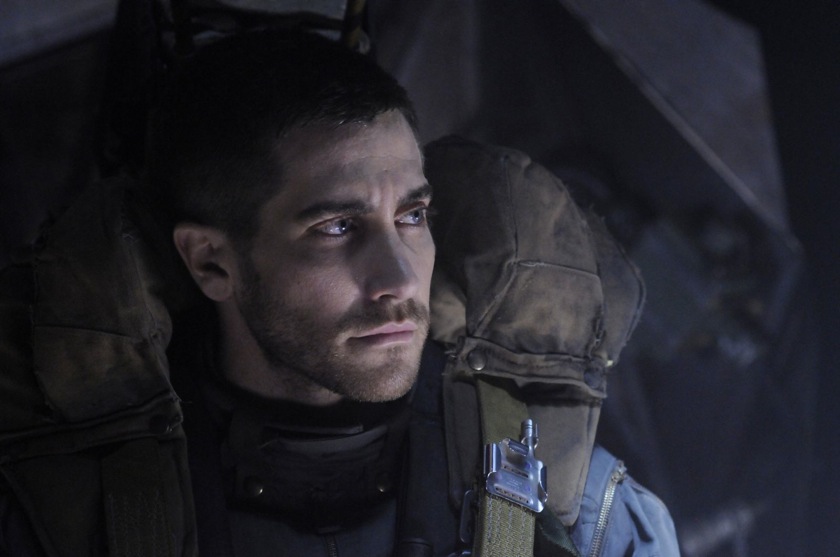
With his first feature, Moon, director Duncan Jones established himself as a filmmaker capable of creating the kind of fascinating, challenging science fiction we associate with Golden Age writers like Asimov, Bradbury, and Leiber.  With Source Code, his second feature, Jones delivers a science fiction thriller offering an intriguing premise, riveting execution, and a satisfying denoument.  Jones not only sticks the landing, he sticks the entire film.

Here’s the setup:  Captain Colter Stevens is an Army helicopter pilot who awakens strapped in a kind of time machine.  This machine comes with a twist: it puts him in the body of another man, and it can only send him to one 8-minute stretch in the man’s life: the 8 minutes before he dies.  Colter’s mission: discover who’s responsible for killing the man and everyone on the commuter train the man happened to be riding when it exploded. 

Go.  Fail.  Die.  Try again.

It’s a great premise, mixing aspects of Groundhog Day, “Quantum Leap,” and Day of the Jackal.  Jones fleshes it out with a strong cast, starring Jake Gyllenhaal (a favorite since October Sky), Michelle Monaghan, Vera Farmiga, and Jeffrey Wright.  He complements them with direction and photography that reveal enough to keep us oriented and in the game, but hide enough to keep us questioning and worrying our nails.

And it works.  We share Colter’s disorientation, his desperation.  We want what he wants, we feel what he feels, and we walk out of Source Code exhilarated, satisfied, and ready to live those 90 minutes over again.

With Moon and Source Code, Duncan Jones is officially two for two.  I can’t wait to see where he goes for number three.

Friday, April 13, 2012

Rango


Rango is a great Western.  It’s a great kids’ movie.  It’s just plain great.

This beautifully animated film both ribs and pays homage to the Western, and particularly the spaghetti Western.  It’s a tale of an evil boss and a new sheriff, and it references enough classics of the genre to keep the aficionado in deep clover.  More importantly, it tells its own Western story, and it does so well enough to capture the imaginations of children for whom it represents their first exposure to the genre.

Johnny Depp voices the titular Rango, a chameleon who dreams of adventure and heroism.  When he wanders into an Old West town populated with (beautifully rendered) desert creatures, he tries to blend in.  After all, that’s what chameleons do.    Next thing he knows, he’s the sheriff.  Now, if he can only figure out how to work that gun …

And away we go.  Rango has gunslingers, saloons, jailbreaks, and even a plucky belle struggling to save her ranch.  It also has great music, funny jokes, and the most beautiful animation I’ve enjoyed since Kung Fu Panda.  I loved it, my wife loved it, and my kids loved it.  Now, if only I can get ‘em to watch Stagecoach.

Sunday, April 08, 2012

Blood and Bone


Blood and Bone is a simply constructed, competently shot fight movie.

Michael Jai White plays Isaiah Bone, an ex-convict trying to get by in LA.  He fights in elaborately staged “underground” matches whose production values would make Don King burn with envy.  Of course, he catches the eye of the local top thug, played with relish by the underappreciated Eamonn Walker (who nailed the role of Howlin’ Wolf in the underseen Cadillac Records.).  Oooh, there’s gonna be fightin’.

Ok ok ok.  You don’t queue up a movie like Blood and Bone to revel in intricate plotting and razor-sharp dialogue.  How is the fightin’?  It’s fine, really, but nothing spectacular.  Michael Jai White is a competent martial artist, but his choreographer lets him down with simple matches that lack spectacle.  I rocked along well enough for an hour and a half, but the only fight I remember as of this writing is the very first one.  I hoped for more from Blood and Bone.