Showing posts with label science fiction. Show all posts

Saturday, June 21, 2014

Edge of Tomorrow


Funny and exciting, Edge of Tomorrow is a great time at the movies.

Here's the setup: it's basically Groundhog Day in the middle of an alien invasion, with Tom Cruise forced to live the same fate-of-humanity battle over and over again. While Groundhog Day saw Bill Murray's self-absorbed weatherman learn how to be a decent human being, Edge of Tomorrow sees Tom Cruise learning both Decency 101 and how to defeat the alien menace.

So, if you're the kind of moviegoer who saw Groundhog Day and thought, “This movie needs more 'splosions,” then Edge of Tomorrow is the movie for you. I have that thought during nearly every movie I see. I loved it.

What makes Edge of Tomorrow work? Front and center, there's Tom Cruise offering yet another performance to remind us that he's a much better actor than everyone seems to think. His protagonist begins the film as a smooth, self-centered coward, and Cruise sells that characterization while keeping us on his side. Much of the film's second act is comprised of Cruise's character getting killed in a variety of ways, and he sells that with a series of high-pitched yelps, screams, and “Oh, mans” that remind us more of Loony Tunes than Starship Troopers. By the time the third act rolls around and our hero has finally matured into, well, our hero, the film has so won us over that we really don't mind that it's rehashing Pacific Rim.

What else makes it work? First, Emily Blunt offers first-class supporting work as the Angel of Verdun, a war hero from an earlier battle who (because of sci-fi stuff) experienced the same time-loop there that our hero is experiencing here. She becomes his mentor and (age inappropriate) love interest, and the movie has fun with the idea that she's meeting him for the first time nearly every time he resurrects (in some of his cycles, Cruise skips meeting her and attends to other business instead). Second, Bill Paxton is perfection in a uniform as the sergeant major who turns up near the beginning of each new time loop. He's authoritative and commanding, yet somehow goofy enough to maintain the film's light, entertaining tone.

Director Doug Liman keeps the film moving briskly, hits the right character notes, and makes his world seem lived-in and authentic. Perhaps more importantly, he has a great sense of geography. Even during chaotic battle scenes, he gives the audience enough information to never lose track of who is doing what to whom, and where and why. The production values are top-notch, the monster designs excellent, and the whole thing a pleasure.

Bottom line: if you like big-budget sci-fi adventure with a sense of humor and lots of 'splosions, then Edge of Tomorrow is for you. As for me, I loved it. I can't wait to see it with my kids.

Thursday, February 07, 2013

Another Earth


Another Earth is an intimate drama with a science-fiction hook. The drama: a young woman's released from jail after killing a man's family through a drunken driving accident. She tries to make amends. The hook: a parallel Earth, from a sliver of the multiverse very like our own, appears in the sky the night of the accident. It floats there, out in space, the physical manifestation of the fantasies of those who dwell in the world of might-have-been.

The film, co-written by star Brit Marling, works on the level of intimate drama alone. The tragic thing about many DUI arrests and fatalities is that the culprits aren't evil: they're often just regular people who exercised poor judgement on a given night. Marling's just-released convict falls under this category. She's consumed with guilt and depression and wants to make amends. The man, sensitively played by William Mapother, wallows in depression and alcohol and needs someone to help him pull himself together.

At this point, you probably think you know what's going to happen.  You're about half right. The other half is the enigma posed by that new planet in the sky, that other Earth. Is it a world where the accident never happened? Would you go there, if you could? What might you find?

All this is handled delicately, sensitively, and much better than I'd anticipated. The second-act reveal plays much more provocatively than I'd expected, leading my wife and me to enjoy a long conversation exploring whether, if we were in the the man's shoes, we could ever forgive. We concluded that we could not, but I'll leave it for you to discover what he concludes and what that means.

Don't see Another Earth in installments or while doing chores. This a film about mood, and it needs time and space to create a mood in you. If you give it the attention it deserves, I'm confident that you'll find it worth your time.

Monday, April 16, 2012

Source Code


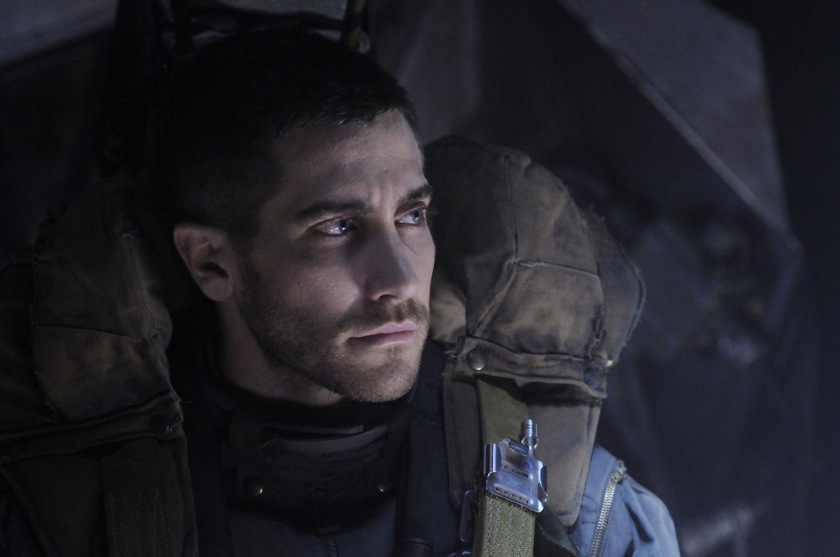
With his first feature, Moon, director Duncan Jones established himself as a filmmaker capable of creating the kind of fascinating, challenging science fiction we associate with Golden Age writers like Asimov, Bradbury, and Leiber.  With Source Code, his second feature, Jones delivers a science fiction thriller offering an intriguing premise, riveting execution, and a satisfying denoument.  Jones not only sticks the landing, he sticks the entire film.

Here’s the setup:  Captain Colter Stevens is an Army helicopter pilot who awakens strapped in a kind of time machine.  This machine comes with a twist: it puts him in the body of another man, and it can only send him to one 8-minute stretch in the man’s life: the 8 minutes before he dies.  Colter’s mission: discover who’s responsible for killing the man and everyone on the commuter train the man happened to be riding when it exploded. 

Go.  Fail.  Die.  Try again.

It’s a great premise, mixing aspects of Groundhog Day, “Quantum Leap,” and Day of the Jackal.  Jones fleshes it out with a strong cast, starring Jake Gyllenhaal (a favorite since October Sky), Michelle Monaghan, Vera Farmiga, and Jeffrey Wright.  He complements them with direction and photography that reveal enough to keep us oriented and in the game, but hide enough to keep us questioning and worrying our nails.

And it works.  We share Colter’s disorientation, his desperation.  We want what he wants, we feel what he feels, and we walk out of Source Code exhilarated, satisfied, and ready to live those 90 minutes over again.

With Moon and Source Code, Duncan Jones is officially two for two.  I can’t wait to see where he goes for number three.

Tuesday, March 13, 2012

Real Steel


Real Steel.  It’s a fighting movie without any actual fighting.  Yes, enormous animated robots duke it out in various venues, but they’re just robots.  This could be a movie about slot car racing or flying model airplanes.

Here’s the deal: it’s the near future.  Hugh Jackman plays a derelict drifter, one whose sole possessions appear to be a semi truck, a rock ‘em sock ‘em robot, and a 6-pack of cheap beer.  Oh, and he must have a full gym and a nutritionist and a personal trainer and some actual motivation in there, too, because I’ve never heard of a derelict drifter in the kind of shape this guy’s in.  Anyway, he drives from town to town, putting his ‘bot in small-time bouts for chump change and making bets he can’t cover.  He’s bad at it.  Enter a long-lost son.  Time to grow up.  Time to make something of himself.  All that.  You’ve seen it before.

Look, Jackman’s a super-talented man, Dakota Goyo, who plays the son, is a super-talented boy, and it’s hard to screw up the “man-child grows up and bonds with his kid” storyline.  But that storyline is really just a framework for the film’s showcase battles between various androids, and I couldn’t bring myself to care about them.  Not because I didn’t care about Jackman père et fils, but because a fight in which the contestants neither tire nor feel pain is no fight at all.  I’m not holding myself out as an expert fighter, here – I’m basically going on memories of Plebe boxing at USNA.  But I remember how I felt after only three rounds, when it was all my opponent and I could do to keep our gloves up and lob feather-light jabs at one another.  Real Steel’s robots can’t know what that’s like, so I couldn’t care about them.  And since I couldn’t do that, well, the movie’s marquee moments fell flat.

I think Jackman and Goyo could have carried a movie about a down-on-his-luck boxer who needed someone to believe in him.  The very conceit of Real Steel, however, left me with no skin in the game.

Tuesday, February 28, 2012

In Time


In Time is a workmanlike dystopian haves vs. have-nots science fiction picture. 

Here’s the story: in a few hundred years, someone figures out how to halt the aging process at 25.  To stop overpopulation, at 25 a one-year counter starts ticking off on the person’s arm.  Once that counter goes to zero, the person drops dead.  As with any economic system, people separate into haves and have-nots.  Everyone seems more or less ok with this, until one man (Justin Timberlake) trips to the fact that the haves are rigging the system.

It’s a neat premise that follows in the grand tradition of science fiction as social commentary and popular entertainment.  Add that Timberlake is a likeable film actor and that both his love interest/accomplice (Amanda Seyfried) and antagonist (Cillian Murphy) know how to hit their marks, and you have a fine picture.

So, what’s the difference between “workmanlike” or “fine” and “good?”  Ambiguity.  Vision.  Creativity.  In Time feels like a low-budget third draft.  It’s all too simple and clear to be actually “good,” and the use of time as a metaphor for money stops being interesting after about ten minutes.  Toss in a future LA whose very best neighborhood appears to be the Wilshire District around 7:00 am on a Sunday and technology that’s only about $100,000 worth of production budget cooler than our own, and you wind up with “workmanlike” and “fine.”

And yet, workmanlike and fine are, well, fine.  I don’t recommend that you go out of your way to see In Time, but if dystopian haves vs. have-nots science fiction is your thing, well, have at it.

Monday, September 14, 2009

The Mutant Chronicles


Where do you go after a movie like 8 1/2? When you've just had a gourmet meal, what do you eat the next time you get hungry?

You go to a genre picture like THE MUTANT CHRONICLES for the same reason you go to McDonald's after that gourmet meal. When you've had a transcendent experience, you need to reset. Otherwise, you won't give perfectly fine but otherwise average fare its due. You'll be measuring it against that masterpiece, and it'll come up short.

And THE MUTANT CHRONICLES is as greasy a burger as you could want after the feast of 8 1/2. It's poorly written, poorly edited, poorly scored, poorly acted, and poorly conceived. It's an uncomfortable mishmash of WWI, zombies, and apocalyptic science fantasy set in a steampunk world that doesn't understand that automatic weapons create more and worse tissue damage in less time than swords. It has lame prophecies, halfhearted fu, and John Malkovich reading his lines from the back of a prop. It's just plain bad in every way, a nice counterpoint to 8 1/2 and a good way to ensure that the subsequent pictures on my Netflix queue get a fair shake.

So, yeah, I'm recommending it, after a fashion. If you spend all your time in the best restaurants, you need to remind your palette what bad tastes like. THE MUTANT CHRONICLES does the trick.

Wednesday, June 17, 2009

Timecrimes


TIMECRIMES is like a puzzle, a carefully constructed device that can baffle or amuse and makes perfect sense when you put it all together. It's funny, thrilling, genuinely interesting, and an all-around good time at the movies.

Here's the deal: Héctor's a regular guy. He just got a vacation home, so he's doing pretty well, but he's kinda schlubby and doesn't seem all that bright. His idea of a good time is sitting on the lawn and enjoying the view through his binoculars. Héctor doesn't know that there's a research facility nearby. He doesn't know that they're working on a time travel device. He doesn't know that everything's about to change.
And away we go on a tightly plotted time-travel thriller that accomplishes everything it sets out to do. I believed in the characters, I believed in the situation, and I enjoyed and appreciate the smart, tight writing that made this exercise in paradox an hour and a half well spent.

Friday, April 17, 2009

Frequency


FREQUENCY is not a great movie, but it has a great core and two central performances that sell it.

Here’s the setup: through the magic of sunspots and HAM radio, NYPD detective John Sullivan finds himself able to communicate with his father, NYFD firefighter Frank Sullivan. Where John’s sitting, it’s 1999. Where Frank’s sitting, it’s 1969. Frank doesn’t believe that it’s his son on the other end of that radio transmission. But when John tells his father all about the fire he’ll fight the next day, and about how he’ll die in it unless he goes against his instinct and zigs when he’d normally zag, Frank’s intrigued. The next day, of course, the son’s prophecies come true and the father believes.

OK, and this is where the movie gets me. Frank comes home, kisses his wife (who tells him she heard he had a close call), and goes upstairs to look in the now 7-yr-old son who, 30 years in the future, will save his life by warning him yesterday. Dennis Quaid, who plays Frank, looks at the sleeping child with an expression that captures everything I feel when I look in on my boys, then adds appreciation and respect for the man this boy will grow up to become. He goes downstairs, contacts his son on the magic radio, and tells him he loves him. “I love you, too, pop.” Then, in the 1969 timeline, the boy comes downstairs, half asleep. Quaid tells him to get dressed: tonight, together, they’re going to master the challenge of riding that bike once and for all.

Waterworks, I’m tellin’ ya. Waterworks. I get choked up even writing about it. Yeah, there’s this whole plot about a serial killer (and really, what ‘90s movie didn’t work a serial killer in there somewhere) and the unexpected consequences of messing with the timeline and chasing and shooting and all that stuff. There’s also a lot of time travel hokum that’s basically just asking the audience to believe in magic and go with it. But the core of FREQUENCY, the love between a father and his son and a boy and his dad, resonates so powerfully with me that I overlook the weaknesses and spend all my time locked into the performances of Dennis Quaid and Jim Caviezel. What man doesn’t want to be the father Dennis Quaid is in this movie? What man doesn’t want to have the father Dennis Quaid is in this movie? What man doesn’t want his son to grow up to be the kind of guy Jim Caviezel is in this movie?

This picture works, and it speaks to me in a deep and powerful way. Whenever I need to test to make sure the plumbing still works, I need only to spin this one up to make the water flow. FREQUENCY may not be a great movie, but it hits its mark.

Wednesday, August 06, 2008

Planet of the Apes


The 1968 "Planet of the Apes" is first-class science fiction. It does all the things science fiction is supposed to do: it creates a believable world, populates it with interesting characters, and uses those characters in that world to comment on the issues of the day.

During its development phase, it's clear that "Planet"'s creative team took the time to think their ape society through. The team created a coherent and believable timeline, architecture, and culture, which led to an immersive experience for me and my spawn. Then they cast the apes with quality actors such as Roddy McDowell, Kim Hunter, Maurice Evans, and James Whitmore, all actors able to generate authenticity even when acting behind masks. And of course, Charlton Heston can carry a movie in his sleep. "Get your hands off me, you damn dirty apes!" has moved into the lexicon, but it's dramatically effective because we believe in Heston's desperation and fury, even as we see the perspective of the apes.

These elements can lead to a good movie, but "Planet of the Apes" is good science fiction because it also works as a fable of science versus superstition. Further, I was impressed with the way it turns in upon itself, questions its own premise. Sure, there are some hamfisted "Never trust anyone over 30" moments, but "Planet" is smarter than I'd given it credit for.

And then, of course, there's the ending. Perhaps the best thing about watching this movie, for me, was watching my son describe it to his mom later that evening. "And then he went around the corner and he saw the (spoiler deleted) and said (spoiler deleted). Because it was (spoiler deleted). Isn't that cool?!? Isn't it?!? Isn't it?!?"

How awesome can you get?

Wednesday, May 28, 2008

THX-1138


THX-1138 is solid, ‘70s experimental science fiction. It presents with an antiseptic Orwellian world and one man, THX-1138, who begins to realize that there’s more to life than he’s been led to believe. Robert Duvall plays THX-1138, and it’s a masterful, understated performance. THX lives in a society in which emotion is discouraged, and Duvall is a master of showing us the deep currents swirling beneath his character’s calm exterior.

Where THX-1138 triumphs in the performance of its lead, however, it flounders in its actual story. Though the film begins with an intriguing vision of a dystopic future, it ends as one extended chase, going from foot to high-speed vehicle to foot again. Nothing really happens during this chase, story-wise. THX doesn’t learn anything about himself, nor does he develop in any way. It’s as if the film didn’t know where to go, but figured audiences love chases and that would do as well as anything.

So, should you see THX-1138? If you’re a fan of George Lucas, whose first science fiction feature this was, then I suppose you should. If you’re a fan of Robert Duvall, then you definitely should. If you’re neither, it may be worth your while if you find it on cable. That’s good enough, I suppose.

Sunday, January 06, 2008

The Last Starfighter


THE LAST STARFIGHTER is better than STAR WARS. It's as much better than STAR WARS as Robert "A pool table! Dontcha understand?" Preston is than Alec "Man, there's nothin' I love more than buildin' bridges!" Guinness.

The movie opens with a young Lance Guest, trailer park teen, defeating a video game called "Starfighter." Wouldn'tcha know it, the thing's actually a recruiting tool for some interstellar navy, and guess who's doing the recruiting? That's right, Robert Preston: a guy who could sell sand to Arabs, sell salt water to Tahitians, sell a woman as a male female impersonator to French club-goers! We're talking about an alien emissary and mentor-figure with more charisma in his hairpiece than the entire cast and crew of STAR WARS has en toto. When Robert Preston tells you to go man up a spaceship and save the galaxy, buddy, you go.

Pay no attention to the fact that the film's special effects make Season One of "Babylon 5" look like the new "Battlestar Galactica." Pay no attention to the fact that Villain #1 is just plain silly. Instead, groove on the excellent prosthetic work, the sense of goofy fun, the awesome closing line of Villain #2, and the fact that, unlike Luke Skywalker, Lance Guest's Alex Rogan is actually going to close the deal with the romantic lead. Oh, and groove on Robert Preston in his final Big Screen role, hamming it up, having a great time, and, yes, saving the galaxy.

THE LAST STARFIGHTER is a success. It does all the things it sets out to do, and it hits all the right notes in so doing. This is a neat movie.

Monday, October 02, 2006

The 6th Day

THE 6TH DAY combines bad filmmaking with bad science fiction to make the worst film I’ve seen in months.

In THE 6TH DAY, Arnold Schwarzenegger plays a charter jetcopter pilot who gets in the crosshairs of an evil corporate mastermind with a god complex. Thus begins your basic chase-thriller, but with a twist: the picture is set in the near future, and the evil corporate mastermind likes to clone people for fun and profit. Is Schwarzenegger’s clumsily named Adam a clone or an original edition? Will he live long enough to bring down the evil mastermind’s dastardly scheme? Have you ever been to the movies before?

THE 6TH DAY is bad filmmaking on so many levels that I’m having difficulty deciding where to begin. Do I start with the horrifically glaring product placements that make suspending disbelief impossible? How about the mechanical, by-the-numbers script that telegraphs absolutely everything that will occur in acts two and three in the first fifteen minutes? Of course, there’re always the wooden performances, ghastly set design, and glaring continuity errors, but that seems like piling on. Tell you what – let’s handle this by focusing in one bad judgment that’ll give you a sense of the wrong-headedness of the rest of the production. The evil corporate mastermind (Aside: Ever notice how studio films, which are paid for by corporations, love to use corporations as villains? Do you find the hypocrisy as insulting as I do?) needs a brilliant scientist to actually do his work. THE 6TH DAY employs Robert Duvall in the role, and it’s about the worst choice imaginable. Duvall is making an entirely different movie than everyone else involved in this train wreck, and his character’s pathos, humanity, and fundamental decency so overcome the weakness of his arc and dialogue that he single-handedly shows us what might have been. Like the men in the Plato’s Cave Analogy, we’d have been better off ignorant: Duvall’s brilliance makes everything around him look like nothing more than shadows on a wall, and his casting reflects the same kind of poor judgment that permeates every facet of the production.

THE 6TH DAY is bad science fiction because it steals whole concepts and conceits from other works without bothering to credit them or toss them a nod in any way. Additionally, it weasels out of crafting a compelling vision of the future by telling us that it's taking place in "the near future - sooner than you think." Of course, what vision it does muster looks just like everyone else’s vision of the future - silly wigs, but with more product placement. And its technology – well, it’s simply counterintuitive and unbelievable.

What a disappointment.

Thursday, September 14, 2006

Returner

I thought RETURNER was reasonably entertaining. Had I stumbled on the movie while flipping through the channels on a hotel TV, I probably would have enjoyed it (Hey, it worked for BIKER BOYZ.). While trying to keep my eyes open on the Metro after staying up too late watching season one of "Arrested Development," however, I just couldn't get into it.

While the movie has a fun premise, I found the villain to be ridiculously unbelievable and not nearly as cool as he thought he was. The fight scenes cut so clumsily between actors and doubles that they took me out of the moment, the Western cast was ridiculously bad, and the film's climactic moment depends on audience agreement that Transformers are, in fact, cool. Transformers weren't cool when I was a kid, and they aren't cool now.

Still, RETURNER has a breathless quality to it that's undeniable. After a wild night of dinner in a hotel restaurant and setting the alarm clock, it'd be a treat to find this movie on the Sci Fi channel.

Sunday, August 06, 2006

The Chronicles of Riddick

(Mild Spoilers)

Here's the problem with THE CHRONICLES OF RIDDICK: by the end of PITCH BLACK, RIDDICK's titular character has reconnected with humanity.

TCR tells us that the guy was never human to begin with, thus negating the point of the first film. Additionally, for a guy who is supposed to be an antihero, Riddick does the right thing again and again and again. How do you root for the bastard when the bastard is, in fact, a cuddly teddy bear?

In TCR, Vin takes on a group called the Necromongers, who are basically the Borg without Alice Krige. Lots of stuff blows up, we learn that Vin is a master of gymkata, and the good guys, ultimately, win, sorta.

I liked PITCH BLACK and I was all set to like the sequel, but this just didn't do it for me. Bummer.

Saturday, August 05, 2006

Pitch Black


There's no way I'm going to argue that 'Pitch Black' is a good movie. The editing is amatuerish, the plot's holes threaten to overwhelm it, the monsters behave inconsistently, and the movie goes from horror picture to bughunt with such alacrity that I doubt the creators even knew what kind of picture they were trying to make.

I liked it.

'Pitch Black' starts with a bang, which is just what I was in the mood for. An interstellar transport encounters a meteor shower and lots of things go wrong very quickly, culminating in a fiery crash that pegged my "cool 'splosions" meter right from the get-go. The survivors are your usual lot of deadmeats and heroes, and it's easy to figure out who's going to be which pretty early on. See, here's the problem: there's monsters on this here planet, and our characters have to figure out how to survive. Oh, there's another problem: Vin Diesel. His character, a guy named Riddick, is a killer with a heart of coal who has the one thing the group needs to survive on this planet (where, by the way, the coming night should last about a year): surgically-created super night vision. Do they trust him? Does he trust them?

So, there's your setup, and it's a great way to launch a solid 112 minutes of fun. Yes, this a movie that's supposed to mostly happen at night, but that sports an awful lot of ambient light. Yes, it's the kind of movie in which a character will flick a lighter to look around, and a strategically placed key light will snap on a split-second before the flame appears. And yes, it's the kind of movie that manages plenty of shots down the lead actress's shirt for no other reason than to remind us that yes, she is a woman. It's brainless, it's silly, and it's utterly predictable.

I'm glad I watched it.