Friday, August 15, 2014

Guardians of the Galaxy


After a brief prologue, Guardians of the Galaxy kicks off with likable star Chris Pratt basically re-creating the opening sequence of Raiders of the Lost Ark while boogieing to '70s soft rock. So far, so good. Then, Michael Rooker shows up as a blue-faced alien scoundrel. This you must know: while the presence of Michael Rooker is not a guarantee of quality, it is a guarantee of awesomeness. Boom. I'm in.

Soon enough, here comes Zoe Saldana, reigning queen of the big-budget science fiction adventure, put into immediate conflict with Doctor Who's Karen Gillan. We are cooking.

Guardians of the Galaxy doesn't squander its early goodwill. It takes its simple MacGuffin chase of a plot and layers it with yet more endearing characters; clever homages to films as diverse as Pulp Fiction, Slither, Footloose, and Howard the Duck; and loads and loads of well-played banter. All of this adds up to a light, fun, and exciting space opera that had my whole family laughing out loud and rocking along for a solid two hours.

As I write about it, however, I find that I'm having trouble sinking my teeth into it.  It's bouncy.  It's fun.  I'll enjoy seeing it again when it hits Netflix.  But it doesn't give me much to think about.  It's the cotton candy of movies.

That said, I like cotton candy.  Guardians of the Galaxy worked for me.

Wednesday, August 06, 2014

Robot & Frank

When someone goes out of his way to recommend a film to me, I hesitate to see it. What if I think it stinks and I hurt that person's feelings?

Someone went out of his way to recommend Robot & Frank to me. 

Here's the story: it's the near future. Dracula (Frank Langella) has given up his vampirism and is now a sad, lonely old man with dementia. The highlight of his week is walk to the local library, where he flirts with librarian Janet Weiss (Susan Sarandon). Oh, to be young and living in a castle again!

Anyway, Langella's son (James Marsden) worries about him, so he buys him a semi-anthropomorphic robot to help out around the house. Langella regains his vigor and decides to reembark on a previous career (with the robot's help): high-end jewel thief.

That's about the time I fell asleep. When I woke up, the third act was getting started. I gutted it out, but I never got into the film.

I fell asleep because Robot & Frank never gave me a reason to care about Frank, beside the fact that he was played by an actor who had once delivered one of cinema's greatest Transylvanian counts. Since I didn't care about him, I didn't care about what happened to him. When I returned to the film after my short doze, nothing happened to change that fact.


Sorry, buddy. I wish had liked it.

Friday, August 01, 2014

Seven Psychopaths


Seven Psychopaths is violent, funny, and a great time at the movies.

Here's the setup: screenwriter Colin Farrell has a deadline and no screenplay. I know – this sounds like every bad Creative Writing assignment that begins with “The writer sat at his desk, staring at the clock and wiping flop sweat from his brow.” But what if the next paragraph read, “Then Sam Rockwell turned up. He was the writer's best friend, and he ran a Hollywood dognapping operation with small-time crook Christopher Walken. They had a problem?”

Your reaction to that last sentence was predicated on your appreciation for Sam Rockwell and Christopher Walken, both of whom Can Do No Wrong (CDNW). Each of these guys are usually the best thing about whichever movie they're in, and they're both great here. That said, Seven Psychopaths is really the “How Awesome is Sam Rockwell?” movie, so Walken only dials it up to ten in this one. This is one of Seven Psychopaths' many smart moves: by giving Rockwell space to do his thing, it actually makes us appreciate Walken more. Further, Seven Psychopaths makes Farrell a straight man in service to Rockwell's over-the-top performance, and the former shows a remarkable gift for subtle comic timing.

[Aside: It has taken me a while to warm up to Farrell. He was fine in a pretty straightforward role in the odious Tigerland, then someone in Hollywood decided he was going to be the Next Big Thing and got him cast in travesties like Daredevil. He disappeared for a while, then came back strong with InBruges, Fright Night, and Seven Psychopaths. The man has a long way to go to claim CDNW status, but he's back on my radar.]


Of course, this is a film called Seven Psychopaths; so psychopaths do turn up, operatic volumes of blood do get spilled, and a good time is had by all. All this, plus a clever script, terrific performances, and laugh-out-loud moments make Seven Psychopaths my biggest and most pleasant surprise of the summer.

Tuesday, July 29, 2014

Four Brief Takes

The Incredible Burt Wonderstone

Hey do you like movies which invite you to spend 90 minutes laughing at (rather than with) their characters? Me neither. Unfortunately, that's The Incredible Burt Wonderstone in a nutshell. Despite a real knowledge of and fondness for magicians and their craft, the film can't overcome its fundamental mean-spiritedness.

Incredibly, Burt Wonderstone couldn't pull so much as a chuckle out of thin air. I should have cleaned out my house's raingutters, instead.

Elysium

Elysium is Matt Damon's shot at a Big Concept, Big Budget science-fiction adventure. Unfortunately, the Big Concept is that Rich People are Bad, which is laughable coming from a studio owned and run by rich people.

Sanctimony, however, isn't Elysium's greatest flaw. That honor gets divided between dullness and ugliness. Elysium is dull because its hero takes so long to get from “self-absorbed jerk” to “hero” that we've lost empathy by the time he's made the transition. It's dull because its villains are so villainous that they aren't even interesting. It's dull because its internal contradictions glare so brightly that they keep the audience from suspending disbelief. And it's dull just because it drags. Elysium is ugly because – heck, I don't know, maybe director Neil Blomkamp (of the remarkable District 9) just likes ugliness.

This is a tedious, dull, annoying, ugly film.  Pass it by.

The Wolverine

I saw The Wolverine about a week ago, and I've already forgotten nearly everything about it other than a ridiculous hand-to-hand battle with a cyborg samurai.  It's as if the movie had never even existed.

Taken 2

If you liked Taken, you'll like Taken 2. It's an unapologetic rehash of the first film, set this time in Istanbul. Hey, I liked Taken. I like Istanbul. I got my money's worth.

Wednesday, July 23, 2014

The Bridges at Toko-Ri


The Bridges at Toko-Ri is the best movie I've seen this summer.

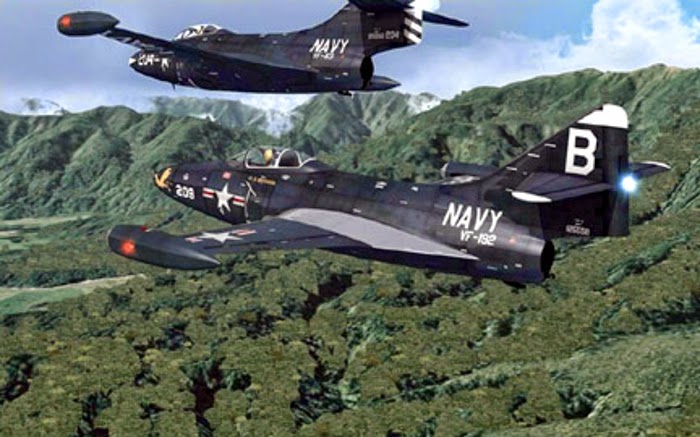
Adapted from the novel by WWII Sailor James Michener, The Bridges of Toko-Ri tells the story of LT Harry Brubaker, a Reservist called to active duty to fly and flight in the Korean war. It's a serious film, one that grapples with the realities of family separation, mortal peril, and profound loyalty that are the weft and warp of naval aviation. The Navy cooperated in its production, granting access to USS ORISKANY and USS KEARSARGE, as well as extensive opportunities to film its mighty F9F-2 Panthers in flight. Its star, William Holden, had a personal link to the material: his late brother, a naval aviator, had given his life in the Pacific.

Pedigrees, however, don't guarantee a great film. The Bridges of Toko-Ri succeeds not because of its authenticity, but because it's a thrilling and gripping tale. It begins in the best possible way, with a helo bubba (played by Mickey Rooney) pulling a jet bubba (Holden) out of the water following an ejection. As a former Navy helo bubba, I could have spent the next ninety minutes watching Rooney rescue people. That's not the way the world works, however: the world cares about jet bubbas.

This particular jet bubba has a beautiful wife (Grace Kelly), two charming daughters, and every reason to get home alive. The Bridges at Toko-Ri is built around the early warning, planning, execution, and aftermath of a mission that puts that eventuality very much in doubt: an airstrike on a cluster of North Korean bridges deemed vital to the war effort. Because the film walks us through all the steps in the runup to and execution of this mission, we in the audience get time to bond with its characters both at sea and ashore. Because the film takes pains to achieve maximum authenticity in its depiction of life afloat and airborne, we get to live vicariously in another world at another time. Because the mission itself is so hazardous, and filmed so well, we get to spend the last half-hour of the film on the edges of our collective seats, rooting for Holden's character to make it back to Grace and the girls.

This is a great film. It's close enough to real life to stand in for historical footage (though the F9F-2 wasn't flown in the Korean War – the filmmakers had to work with what they had). Its characters are compelling enough to make us care about them. Its story is tight enough to keep us on the hook for two hours and reel us in at the climax. The Bridges at Toko-Ri belongs at the top of your queue.

Friday, July 18, 2014

Chef


Funny and kind, Chef is a feel-good movie that sent me home with a smile on my face.

In the film, John Favreau plays a workaholic chef. He's divorced. He doesn't spend enough time with his son. He works for a restaurateur who's a businessman first and an epicurean second. He's miserable. When he loses his job and must start anew with a dilapidated food truck, things seem about as bad as they can get.

And then he remembers how much he loves cooking good food for people who appreciate it. Oh, and he bonds with his son, finds happiness, and so forth (That last sentence isn't a spoiler unless you've never been to the movies before.).

Think of Chef as cinematic comfort food, the motion picture equivalent of a grilled-cheese sandwich. Now, a grilled-cheese sandwich can be Velveeta on Wonder Bread hot off the Foreman Grill, or it can be a carefully chosen mix of cheeses on fresh-baked bread and grilled -just so- on a hot skittle with hand-drawn butter. Chef is the latter. It's genuinely, laugh-out-loud funny not just in its acting, but in its composition and editing. It boasts characters of depth and heart, people you'd be happy to call your friends. It photographs food and the process of its preparation with delight. It's just a joy, and it's putting a smile on my face even now, as I write about it days later.


See Chef and be happy.

Tuesday, July 15, 2014

RED 2; Oblivion

RED 2


I enjoyed RED, the movie about Dame Helen Mirren machine-gunning baddies while wearing a slinky white evening gown.

RED 2 is more of the same, but it suffers from its lack of novelty. There are new baddies and a new evening gown, but the entire film basically exists to showcase older actors shooting younger ones while tossing off one-liners that make us worry more for their mental health than their physical safety. It's still fun, but it's not much of a surprise this time around. You may want to give this one a pass.

===

Oblivion


Oblivion is a beautifully crafted, high-concept sci-fi action picture – the kind of thing I usually go for.

In the film, Tom Cruise plays a drone repairman in a post-apocalyptic hellscape. By night, he lives in a beautiful, modern outpost. By day, he braves the wilderness to find downed (alien-hunting) drones, fix them, and sic them on any Morlock-like aliens they should happen to find.

And away we go. As I said, I enjoy this kind of thing. And I enjoyed it well enough, but something about it seemed rote. Cruise ran away from an explosion. Cruise was forced to choose between improbably beautiful, age-inappropriate women. Cruise saved the world and earned a respectful head-nod from a reluctant ally. You know – the usual. The big concept was the metaphor for American drone wars in a part of the world that's basically a pre-industrial hellscape. And that was it.

I'm not saying that Oblivion was bad. Generally speaking, Tom Cruise doesn't make bad movies. It just seemed limp, uninspired. If you're in the mood for a Tom Cruise science fiction film, go see Edge of Tomorrow again. Now, that's a movie!

Saturday, June 21, 2014

Edge of Tomorrow


Funny and exciting, Edge of Tomorrow is a great time at the movies.

Here's the setup: it's basically Groundhog Day in the middle of an alien invasion, with Tom Cruise forced to live the same fate-of-humanity battle over and over again. While Groundhog Day saw Bill Murray's self-absorbed weatherman learn how to be a decent human being, Edge of Tomorrow sees Tom Cruise learning both Decency 101 and how to defeat the alien menace.

So, if you're the kind of moviegoer who saw Groundhog Day and thought, “This movie needs more 'splosions,” then Edge of Tomorrow is the movie for you. I have that thought during nearly every movie I see. I loved it.

What makes Edge of Tomorrow work? Front and center, there's Tom Cruise offering yet another performance to remind us that he's a much better actor than everyone seems to think. His protagonist begins the film as a smooth, self-centered coward, and Cruise sells that characterization while keeping us on his side. Much of the film's second act is comprised of Cruise's character getting killed in a variety of ways, and he sells that with a series of high-pitched yelps, screams, and “Oh, mans” that remind us more of Loony Tunes than Starship Troopers. By the time the third act rolls around and our hero has finally matured into, well, our hero, the film has so won us over that we really don't mind that it's rehashing Pacific Rim.

What else makes it work? First, Emily Blunt offers first-class supporting work as the Angel of Verdun, a war hero from an earlier battle who (because of sci-fi stuff) experienced the same time-loop there that our hero is experiencing here. She becomes his mentor and (age inappropriate) love interest, and the movie has fun with the idea that she's meeting him for the first time nearly every time he resurrects (in some of his cycles, Cruise skips meeting her and attends to other business instead). Second, Bill Paxton is perfection in a uniform as the sergeant major who turns up near the beginning of each new time loop. He's authoritative and commanding, yet somehow goofy enough to maintain the film's light, entertaining tone.

Director Doug Liman keeps the film moving briskly, hits the right character notes, and makes his world seem lived-in and authentic. Perhaps more importantly, he has a great sense of geography. Even during chaotic battle scenes, he gives the audience enough information to never lose track of who is doing what to whom, and where and why. The production values are top-notch, the monster designs excellent, and the whole thing a pleasure.

Bottom line: if you like big-budget sci-fi adventure with a sense of humor and lots of 'splosions, then Edge of Tomorrow is for you. As for me, I loved it. I can't wait to see it with my kids.

Wednesday, June 11, 2014

Ted


Ted is a hilarious 10-minute sketch crammed into an excruciating 106-minute movie.

Here's the sketch: a lonely boy wishes that his teddy bear would come to life and be his best friend forever. The wish comes true and the boy and his bear grow into two lazy, irresponsible, couch-bound weed monkeys. The bear says and does lots of vulgar stuff, which is funny coming from a teddy bear. That's about it.

This makes for an amusing first act. Mark Wahlberg is game for just about anything as the grown-up slacker, and the animators who created the bear do phenomenal work. The joke wears thin by the second act, however. By the third, we're checking our watches and wondering if we have any socks that need folding.

What's bad about it? First, Wahlberg is horribly miscast as the aforementioned couch-bound weed monkey. While he's a fine actor who's willing to work for a laugh, the fact is that he looks like a bodybuilder. I submit that it's impossible to be both a lazy, irresponsible, couch-bound weed monkey and a bodybuilder. Bodybuilding requires dedication, discipline, and a work ethic. Every time the movie showed me Wahlberg's character sprawled out on the couch, with a beer to one hand and a bong to the other, all I could think was, “Shenanigans. This guy looks like he spends his time drinking protein shakes and doing hammer curls. I'm just not buying it.”

And the love interest? I felt actively sorry for Mila Kunis in this picture. Not only was she trying to play a character wholly in love with an unlovable man, she looked so thin that I wanted to shout, “Hey, Wahlberg, how about sharing one of your protein shakes with this poor woman? She looks like she's about to collapse!”

The score is boring. The cinematography is boring. The direction is lackluster. While watching this film, I felt that I was making a conscious choice to fritter away my precious time on this earth. Yes, I laughed during the first act, and I think Ted's premise would make for a terrific “Funny or Die” short. But as a feature film? Ted is worse than bad: it's boring. I feel cheap just for taking the time to write about it.

Saturday, June 07, 2014

Godzilla (2014)

I'm going to preface this review with a little personal background. It'll help if you know where I'm coming from.

Some of my earliest and fondest memories include spending Friday nights with my sister, camped out in our family VW Van in the driveway. Our father would run out a portable tv on an extension cord, and my sister and I would eat popcorn and watch Creature Feature in our own little world. On many of those Friday evenings, the creature of the week was Godzilla, another monster from Toho Studios' stable, or some combination thereof.

When I had kids, I made a family tradition of hanging out on the couch on Friday nights and watching Japanese monster movies. There was something about those artifacts of the '60s and '70s, that combination of giant monsters and visible costume-zippers, that spoke to children. We had a video game for the original X-Box that was basically Mortal Kombat, but with giant Japanese monsters. I can't imagine how many times I've heard an offscreen announcer intone something like, “Space Godzilla versus Mecha Gigan! Monsters, fight!”

When I was a C-130 pilot, I used to travel to Tokyo quite often. I'd always stop by the same toy store near Ueno Park to pick up some Bandai Godzilla dolls. By the time I'd made my last trip, our 3 boys had a collection including nearly every Godzilla monster, as well as quite a few creatures from the Gamera films. These are not carefully preserved collector's items. These are battered and worn everyday toys, the stuff of the imaginations of the next generation of Ellermanns.

My point is that I didn't come to this movie as a casual consumer of summer fare. I came to this movie as a guy who has seen every single Godzilla movie, even the really bad ones. I came to this movie ready to see it as part of a long, long series of sequels, reboots, and reimaginings. I came to this movie ready to be entertained.

I got my money's worth.

The first two major players Godzilla presents are Sally Hawkins (Made in Dagenham, Happy-Go-Lucky) and Ken Watanabe (Letters from Iwo Jima). Next, we see Bryan Cranston (Breaking Bad) and Juliette Binoche (Trois couleurs: Bleu). Later, we get Elizabeth Olsen (Martha Marcy May Marlene) and David Strathairn (Temple Grandin). 'All right,' I thought. 'Even if this movie is terrible, a whole bunch of legitimately excellent actors are getting big, blockbuster paydays out of it. That's a win, right there.' Eventually, we learn that the hero is a Navy EOD (Explosive Ordnance Disposal) lieutenant. 'Hey,' I thought, 'I have a buddy who wrote a book based on his timeas an EOD bubba. This is cool!' Basically, the movie got me onboard pretty early.

Having done that, Godzilla works hard to keep me, the fan, on board. Its secondary monsters (called MUTOs, a marginally more creative moniker than, say Mechagodzilla) leave trails similar to those of the larval giant-moth creatures of Mothra. Godzillla himself gets his first reveal at sea, thoughtlessly making naval vessels bob in the ocean like so many rubber duckies. At one point, our hero rescues a little Japanese boy who looks straight out of Godzilla vs. Megalon. Ken Watanabe gets to pretend he's Takashi Shimura and intone classic Godzilla movie lines like, “Man believes he controls nature, but he is stupid, proud, and wrong. Nature always restores balance.” Jet fighters fly ridiculously low to the ground, only to get swatted out of the sky (as opposed to shooting from a safe altitude and distance). Cities get leveled, flooded, and irradiated. A good time is had by all.

And Godzilla, man, this Godzilla is great. The film retains the classic roar. Godzy dispatches one of his enemies with a move cribbed directly from Godzilla: Final Wars. The reveal of his atomic fire breath is so awesome that it had my now - 14-yr-old son bouncing in his chair with delight. Perhaps best of all, this Godzilla takes a page from the later Showa era, when the King of Monsters served mainly as a defender of the natural order (and, by extension, humanity). I walked into Godzilla expecting a standard rehash of the original Gojira. I got something like that, but with a heaping helping of Invasion of the Astro Monster. What a pleasant surprise.

'All right,' you're thinking, 'this guy likes Godzilla movies. Godzilla is, obviously a Godzilla movie, so he likes it. But will I like it? Is it actually, y'know, good?'

Well, taken in the broader context of contemporary American popular film, Godzilla's just ok. It has a terrible score, wastes the talented Elizabeth Olsen in an underwritten part, and takes a mighty long time to get to the rompin' stompin' giant monster action. Taken in the context of the mostly-terrible (beloved, but terrible) films that preceded it, however, it's marvelous. It looks gorgeous, it respects its unique filmic tradition, and it sets up a world in which we can look forward to continued sequels. It's everything you could ask for from a Godzilla movie.

I (and my progeny) approve.

PS You may enjoy the Godzilla movie reviews I've written since starting this blog in 2006:


Godzilla 1998 (written by my then – 10-yr-old) 
Godzilla vs. Gigan (written by my then - 11-yr-old) 
Godzilla vs. Megaguirus (written by my then – 12-yr-old) 


Sunday, May 18, 2014

Frozen

We were roughly twenty minutes into Frozen, watching the brown-haired sister (voiced by Kristen Bell) sing a duet with her beau, when I realized my kids weren't showing me a movie. They were showing me a Broadway musical disguised as a movie. About ten minutes after that, while watching Idina Menzel's Ice Queen belt out a full-throated (and Oscar-winning) “Let it Go,” I realized they were showing me a particularly good Broadway musical disguised as a movie. They ate it right up, and so did I.

Here's what makes Frozen a particularly good Broadway musical disguised as a movie: the songs, the story, the sets and costuming, and the performances.

Robert Lopez and Kristen Anderson-Lopez wrote the songs. Between them, they boast 'The Book of Mormon,' 'Avenue Q,' 'The Wonder Pets,' 'Winnie The Pooh,' and 'In Transit.' Robert Lopez has an Emmy, a Grammy, an Oscar, and a Tony. These people know what they're doing, and what they're doing in Frozen is writing show tunes. These songs have great hooks, catchy choruses, and singability written all over them – just try listening to “Fixer Upper,” sung in the movie by a chorus of Scandinavian rock trolls, and not imagining a bunch of 12-year-olds in homemade costumes. I dare you. And if you happen to be one of the few people who still haven't heard Frozen's big anthem, “Let it Go,” well, get ready for an ear worm that'll play in a constant loop for days.

The story has a story of its own.  Re-pitched in the wake of Disney's successful The Little Mermaid, an adaptation of Hans Christian Andersen's The Ice Queen had been knocking around the Mouse House since 1943. The picture got a green light in 2011, and the story went through multiple iterations involving many people before it got to the version we see today. And that version? It's a near-perfect combination of family tension, romantic interest, villainy, and magic. Best of all, it does unexpected things with those elements. The family tension is about two sisters who love each other so much that it's simultaneously pushing them apart and pulling them together. The romantic interest zigs one way, then zags another, then zigs and zags a few more times, helping the audience mirror the conflicted feelings of the protagonist. The villainy, well, it's wonderful. There's Alan Tudyk (CDNW), voicing a character that's just a perfect weasel. And there's -well, you're going to have to see it for yourself. And the magic? It delights in that it plays more like something from an X-Men movie than a fairy tale. But those are just the elements. Frozen's unique charm springs from the way it lulls the audience with its first act simplicity, setting up all the pieces and archetypes for a pleasant if predicable story, then combines and recombines those pieces in unexpected ways while taking the story in fresh directions. I am used to watching children's movies for execution over story. Frozen offers both.

The sets and costuming are the result of a combination of extensive research, artistic sensibility, and technical brilliance. Animators visited Norway to get a sense of Scandinavian architecture, wilderness, and maritime culture. It's one thing to look at pictures of a fjord; it's quite another to see one for oneself. They traveled to Wyoming to understand how people move in deep snow in a variety of different styles of dress, from ball gowns to traditional Nordic furs. They visited a Canadian ice hotel to see how ice architecture really works. Then, they took all this and combined it with Ice Queen designs from the Disney archives, their own original artwork, and technical tools like Matterhorn, a snow-animation program written specifically for this film. The result? A beautiful, organic, seamless world that enriches its story, adds depth to its characters, and maintains the illusion of reality throughout the film's running time.

Of course, the whole thing breaks down if the performances don't resonate. In addition to the aforementioned Tudyk (CDNW), Idina Menzel provides a speaking voice for the Ice Queen that's both strong and vulnerable. Perhaps more importantly, Menzel (who boasts an impressive Broadway resume) has extraordinary singing pipes. The Frozen soundtrack provides a great example of this by including renditions of “Let it Go” performed by Menzel in the film and the pop singer Demi Lovato for a radio audience. Menzel blows Lovato clean off the record, bringing a clarity and technical proficiency that somehow reminds me of Nat King Cole.  And the rest of the cast? Well, not a single voice or inflection broke the movie's spell. We're talking about top-drawer stuff.

All of this adds up to a little more than a movie, and a little more than a really good Broadway musical disguised as a movie. It adds up to an extraordinary film, both entertaining and beautiful, that I'll be happy to watch again and again. Way to hit one out of the park, Disney.

Saturday, May 03, 2014

Men in War

Korea. 1950. North Korean armor and heavy infantry roll down the Peninsula as if the South Korean Army weren't even there. Task Force Smith, pulled from occupation troops fat from the good life in Tokyo, goes to the Peninsula and attacks at Osan. Under-armed, under-trained, and under-supported, they'll soon be pushed back to the Pusan perimeter; there to hang on and await the reinforcements steaming across the Pacific.

This is the world of Men in War, a deceptively simply picture about a lost platoon, a headstrong sergeant, a shell-shocked colonel, and a jeep. The platoon wants to rendezvous with Big Army. The sergeant wants to take care of his colonel. Everyone wants the jeep. And away we go.

Men in War boils down to the conflict between the platoon's lieutenant, an improbably old and grizzled Robert Ryan, and the sergeant whose only goal is to get his near-vegetative colonel to the rear. The lieutenant is the audience's proxy, leading by example, advocating human decency, and reeling in horror at the realities of warfare. The sergeant serves as a foil for the idealistic officer, but his brand of cynical survivalism comes at a price.

The film sells this premise through the performances of Ryan (in real-life, a former USMC drill instructor*) as the lieutenant and Aldo Ray as the sergeant. These guys look dirty and smelly and scared, and I believed every syllable of every line of dialogue they uttered. The rest of the supporting cast all kind of blend into the background, but that's ok. This is a morality play, and too many points of view muddy the waters.

That said, Men in War never loses sight of the fact that this conflict takes place in the context of a larger conflict, and it never stops being a gripping war movie. It orients the audience to the platoon's fatigue level, morale, supply situation, and position relative to Big Army.  It conveys North Korean positions, troop strength, and doctrine without resorting to bland exposition. Most importantly, it keeps the audience dialed in on everything from the overall operational situation to the placement of individual land mines. This enhances the film's verisimilitude, lending urgency to its patrols, skirmishes, and battles.

In other words, here's a film about, well, men in war that appears to have been created by people who actually understand warfare. It makes for an engrossing and challenging viewing experience, one well worth the time of both the military history aficionado and the general-interest film buff. I loved it.


*Thanks for that, Jim!

Monday, April 21, 2014

The Hunger Games: Catching Fire


The Hunger Games: Catching Fire is an outstanding example of big-budget Hollywood filmmaking. It offers an engaging story, an outstanding cast, and production design that's second to none.

The story picks up from the first Hunger Games movie, opening with a beautiful shot of Katniss Everdeen (Jennifer Lawrence) silhoutted against a sunrise, quiver on ther back and bow in her hand as she scans a nearby riverbank for game. Struggling with PTSD and trying to get back to normal, our heroine is in no condition to enter the whirl of celebrity life as a Hunger Games survivor. Enter it she must, however, and she soon finds herself the nexus of a nascent revolution.

This is just the first act, but it does an outstanding job of reorienting the audience to its world, laying down the story's themes, and setting up the larger conflicts playing behind the scenes of the smaller scale, yet no-less important, conflicts awaiting our heroine as she's thrust back into the world of the games and forced to compete again. In effect, it shifts the focus of the franchise from “Teenager sticks it to the The Man” to “Scrappy rebel comes to grips with her new status as a leader.” It's wonderful, and wonderfully realized. And we haven't even met most of the supporting cast.

Speaking of which, look at that cast: Amanda Plummer (who Can Do No Wrong), Donald Sutherland, Elizabeth Banks, Stanley Tucci (CDNW), Jeffrey Wright (CDNW), Philip Seymour Hoffman, Toby Jones, and Woody Harrelson, just to name a few. Folks, these are the big guns: the top-shelf talent a studio is willing to pay for when it knows it has an almost certain hit. They do not disappoint, and neither does Lawrence (CDNW), once again proving that she's as capable of carrying a major studio sci-fi action franchise as she is anchoring a moving and horrifying modern noir (That last sentence brought to by Winter'sBone, which you should see right away.). That said, I'd like to take a moment to single out the always wonderful Stanley Tucci (What? You haven't seen Big Night? What's wrong with you?). Here, he plays a television personality who's all spray-on tan, ultra-white teeth, silly hair, and bull$#!^. Watch him closely, however. Beneath the veneer, his character is a consummate professional who happens to be extraordinarily good at his job. It's a layered, subtle performance for a character who could easily be nothing but a two-dimensional placeholder. That's what the best can bring.

But wait – there's more. This film's costume, makeup, and set design, as well as its computer-generated animation, is seamless, beautiful, and brilliantly realized. It delivers the spectacle one expects of a major blockbuster combined with the care and artistry required to deliver a convincing, organic, yet slightly alien world. This picture is nothing short of marvelous, and marvelous to behold.

In my review of TheHunger Games, I wrote that I looked forward to the further adventures of Katniss Everdeen. Catching Fire did not let me down. Bring on more sequels!

Friday, April 18, 2014

Sleepless Night

Sleepless Night is a French thriller about a cop who may be corrupt, who may be stupid, and who must be indestructible. Unfortunately, what he is not is a fully-realized character.

Here's the setup: French action star Tomer Sisley (Well, he was born in Berlin, but his movies are French. It's the EU, people!) is a cop who has stolen a bag of narcotics. The original owner wants it returned, so he's kidnapped Sisley's son. Now, all Sisley has to do is rescue his son, evade the Internal Affairs officers who are hunting for him, and get home safely. Where must he accomplish these tasks in one (you guessed it – sleepless) night? A nightclub so loud, so labyrinthine, so crazy that nobody runs when various good – or – evildoers pull guns and start shooting.

That's fun stuff, and it offers well-staged fights, plenty of twists and turns, and almost everything one could ask for from a film entitled Sleepless Night. But there's a hollowness at the center of Sleepless Night that saps the film of its energy: at no time does the viewer feel he or she is watching real people. The cop is just that – a cop of questionable integrity who turns into a fighting machine when his son is threatened. The thugs are just thugs, the kingpins kingpins, and the child in distress just a child in distress. One can't shake the feeling that this film could have been more, had it dared to give us people rather than notecards.

Ah, well. They can't all be winners.

Monday, April 14, 2014

Captain America: The Winter Soldier

Captain America: The Winter Soldier fuses the paranoid political thriller and the superhero action showcase. That it does so well, in part and in total, is a remarkable achievement.

Here's the setup: Cap & Black Widow (Chris Evans and Scarlett Johansson) are the two most attractive people in government service. They're also a superhero team that flies around the world doing secret missions for SHIELD. SHIELD is basically the DHS, but competent, international, and much better funded. SHIELD, however, may have a hidden agenda. Will Cap & BW sort things out in time?

Well, yeah, of course they will. That's not the point. The point is how well the film tells their story. Robert Redford (as, basically the Secretary of SHIELD) and Samuel L. Jackson (as himself) carry the political thriller aspects of the picture with aplomb. Evans & Johansson, who team up with Anthony Mackie (of the criminally underrated Abraham Lincoln: Vampire Hunter) to battle Frank Grillo (Warrior) and Sebastian Stan (Black Swan), make a great action duo. They combine athleticism with real acting chops, selling both their battles and their dialogue.

That said, the real star here is the story. It's like a finely tuned machine, shifting from character beats to action set-pieces and back again smoothly and gracefully. It parcels out information at just the right pace to allow us to keep up, and it hangs together well enough that it still makes sense a few days later.

In short, this is a successful motion picture. It clips along briskly, it's well engineered, it involved me in the lives of its characters, and it kept me engaged the entire time.

But that isn't what I'll remember about it.

I'll remember two particular moments (the second of which is a spoiler). The first is minor piece of set-dressing. When Redford's character opens his kitchen refrigerator, the astute viewer will notice that he stocks his fridge with Newman's Own marinara sauce. That's a nice touch. The second is the most powerful scene in the movie. Villain Frank Grillo, all muscles, veins, and menace, is pointing his gun at the back of a computer technician's head, commanding him to enter a code that will make bad things happen. The technician, whom I'm guessing is played by Aaron Himelstein, squirms with terror. Nevertheless, he refuses to enter the code. That's fine, but the part that sells the moment is that he doesn't refuse nobly, standing up to the meanie and telling him to get stuffed. He practically squeaks his refusal, trying to melt into his chair and probably $#!^ting his pants. It's the bravest damn thing I've seen in a movie all year.


Well done.

Monday, April 07, 2014

Valhalla Rising; Jurassic Park

Valhalla Rising


Valhalla Rising is Nicholas Winding Refn's tribute to Terrence Malick. A beautiful, almost langorous, film, Valhalla Rising isn't so much about compelling narrative as it is about atmosphere and mood. This is a film meant not to be seen, but absorbed.

Mads Mikkelsen (of the excellent Flame& Citron) plays One-Eye, a Viking slave who lives like a dog, released from his pen only to fight for the enrichment of his owners. After escaping, he falls in with a band of Christians on a journey to fight in the Holy Land. Things do not go well.

That's all you need to know. The rest of your rental (or streaming) choice will come down to two questions: 1. Do you like Terrence Malick? 2. Do you like Mads Mikkelsen? If you answer yes on both counts, hit “play.” If not, all the atmosphere and mood in the world won't keep you from checking your watch. Fortunately for me, I answer yes. I enjoyed Valhalla Rising.

Jurassic Park

Last week, my beautiful bride & I realized we hadn't seen Jurassic Park since its initial release. Worse, we hadn't shown it to our kids. We were bad parents!

Having rectified the situation, I'm happy to report that Jurassic Park holds up remarkably well. Though some of the actors' makeup calls attention to itself on a large HD screen, the dinosaurs look as realistic as ever, the story (which basically consists of a series of missions – Tour the park! Escape the pen! Get to the whatsit and turn on the thingamajig! Etc.) moves right along, and the whole endeavour is just as engaging, scary, and fun as ever. We loved it, our kids loved it, and we are good parents once more.

Saturday, March 29, 2014

Emperor

Emperor is a homework assignment.

By 'homework assignment,' I mean that the film faithfully recreates a place and time (Japan in the immediate aftermath of its surrender in WWII), dramatizes the experiences of actual people who lived through events there, and offers its audience an hour and a half of living history.

It even taught me a few things. While I've read many books on the War in the Pacific, I'm not sharp on what happened in its aftermath. Emperor, for example, taught me that MacArthur first landed in Japan at the Atsugi airfield, where I've served in many detachments as a Navy C-130 pilot. “A-ha,” I thought as I saw the film, “That's why there's a statue of MacArthur near the front gate!” It taught me about Brigadier General Bonnner Fellers (Matthew Fox), whom MacArthur ordered to investigate Emperor Hirohito's complicity in the war's commencement. It taught me about many of the members of Japan's ruling class, their relationships, and the power dynamics among them.

More importantly, it depicted the devastation of postwar Tokyo, a devastation that old, still, B&W photos can only suggest.

So, yes, Emperor is a homework assignment, but it's a good homework assignment. Tommy Lee Jones (whom you really should see in TheThree Burials of Melquiades Estrada) makes a fine MacArthur, the production values are top notch, and you're bound to learn something. I'd show it to my class.

Sunday, March 23, 2014

Planes; Cloudy with a Chance of Meatballs 2

Planes

As a pilot, I was primed to enjoy Planes. It features lots of details that aviation folk will understand, it tells an inoffensive “believe in yourself and all will be well” story, and it does as fine a job of skirting the horrifying realities of the post-singularity world it portrays as its predecessor, Cars.


Here's the setup: a crop duster wants to be a racing plane. It races. It wins. The kids pass out in a Red Vines -induced coma during the closing credits. Done.

And that's pretty much it. Planes is an inoffensive, effective entertainment with a nice eye for aviation detail. You could do worse.


Cloudy with a Chance of Meatballs 2

Hey, do you like puns? Do you like visual puns? Do you like food-related visual puns?

If so, then Cloudy with a Chance of Meatballs 2 is for you. It's pretty much one pun after another, and your enjoyment of the film will vary directly with your enjoyment of that kind of humor. Personally, I like that kind of thing and, while it didn't make me laugh out loud, Cloudy with a Chance of Meatballs 2 put a smile and my face and kept it there for 95 minutes.

The story? It doesn't matter, as it only exists to keep things moving along between gags. The performances? Professional. The animation? Great fun in conception, acceptable in execution. The entire package? A perfectly fine way to spend an evening on the couch with your little one(s).

Friday, March 14, 2014

A Separation

Movies like A Separation are why I love movies.

Yes, shoot-em-ups are great, and everyone loves a well-executed romantic comedy. But films like A Separation remind us what the medium can do: it can surprise, instruct, entertain. It can make us better people.

A Separation begins crisply. We're in a judge's chamber in an Iranian city. It's intimate and unintimidating, at least on its face. A man and woman sit before the judge. She wants a divorce; he does not. The couple's emigration visa has finally come through, but he has cold feet. He doesn't know who will take care of his Alzheimer's-afflicted father.

“Why,” the judge asks the woman, “are you in such a hurry to leave?”

“Because I want my daughter to have a better life.”

“Your daughter can't have a good life here in Iran?”

“Well, yes, um, of course she can.”

And here it is, right in the opening scene: the central conflict between the spouses, the everyday (and manageable) fear of living in a totalitarian state, the grinding, crushing weights of conflicting responsibilities.

As the ripples of this couple's conflict spread, many around them will be faced with difficult emotional, religious, and legal dilemmas. Their young daughter will have to make tough choices as she balances her duties to her parents with her own judgement and needs. The woman they hire to look after the father as they sort things out must face cultural and religious challenges that would never occur to a Westerner (In one poignant scene, she calls a religious adviser to ask whether it's permitted for her to change the old man's soiled clothing.). Their families, friends, and co-workers will get wrapped up in the situation. Everyone gets hurt, and it's devastating.

There's more: I don't think I will ever set foot in Iran, much less an Iranian courtroom. Even if I could, it would be as a tourist, an escorted guest. Since I don't speak Farsi, I'd never understand what people were saying and I'd never get the flavor of their experience. A Separation gives me onscreen what I could never get in real life: an empathetic, detailed sense of what it would be like to be these people in this place; to eat in their kitchens, drive their cars, and sleep in their beds. It's wonderful, if just for that opportunity.

Most importantly, A Separation is a carefully written, devastatingly performed, beautifully shot film that surprises and challenges its audience at every turn. Yes, the film is basically a domestic drama. Nevertheless, it had me biting my nails and hanging on every word. It's domestic drama, but it's also great drama, the kind of movie that makes you forget about the passage of time.

In short, A Separation earns its Academy Award for Best Foreign Language Film. It is a masterpiece, and not to be missed.

Thursday, March 06, 2014

Room 237

Room 237 reminds me why my undergraduate education left me dissatisfied. I became an English major because I wanted to learn the nuts 'n bolts of what made great literature great. I wanted to learn about the craft. What I got, for the most part, were a lot of classes taught by would-be anthropologists or political theorists. They seemed more interested in trying to get me to parse George Eliot's ideology than figure out what it was that made her books great.

I went into Room 237, a documentary about The Shining, with the same hopes with which I'd enrolled as an English major. I wanted to learn some of the tricks of Kubrick's trade, discover how he created such a timelessly unsettling and horrifying motion picture. Instead, I got a bunch of people BS-ing about Kubrick's hidden conspiracy theorizing, his hidden messages about the Holocaust and the Indian Wars, and God knows what else.

I learned nothing. I learned nothing about why Kubrick chose to change key elements of Stephen King's novel in its transition to the screen. I learned nothing about why he plotted The Overlook's interior spaces as he did, or whether various impossibilities were oversights or techniques to disorient the viewer. I learned nothing about his choices in lighting, or framing, or music.

I just got a bunch of obsessives blathering about their pet interpretations for an hour and a half. I could have gotten that in any junior-level literature class in any state university in America.

Blah.