Showing posts with label war movies. Show all posts

Wednesday, July 23, 2014

The Bridges at Toko-Ri


The Bridges at Toko-Ri is the best movie I've seen this summer.

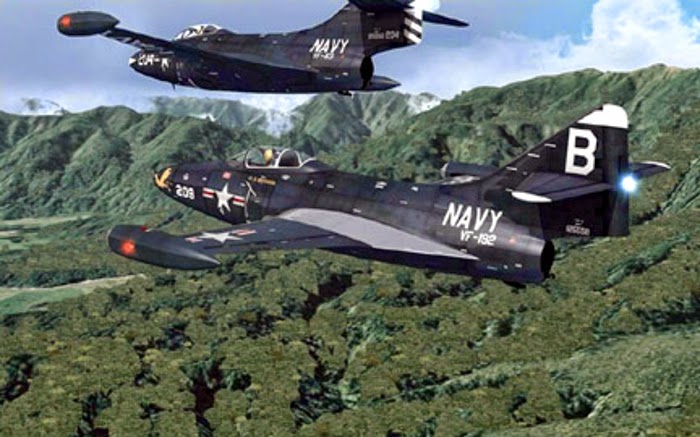
Adapted from the novel by WWII Sailor James Michener, The Bridges of Toko-Ri tells the story of LT Harry Brubaker, a Reservist called to active duty to fly and flight in the Korean war. It's a serious film, one that grapples with the realities of family separation, mortal peril, and profound loyalty that are the weft and warp of naval aviation. The Navy cooperated in its production, granting access to USS ORISKANY and USS KEARSARGE, as well as extensive opportunities to film its mighty F9F-2 Panthers in flight. Its star, William Holden, had a personal link to the material: his late brother, a naval aviator, had given his life in the Pacific.

Pedigrees, however, don't guarantee a great film. The Bridges of Toko-Ri succeeds not because of its authenticity, but because it's a thrilling and gripping tale. It begins in the best possible way, with a helo bubba (played by Mickey Rooney) pulling a jet bubba (Holden) out of the water following an ejection. As a former Navy helo bubba, I could have spent the next ninety minutes watching Rooney rescue people. That's not the way the world works, however: the world cares about jet bubbas.

This particular jet bubba has a beautiful wife (Grace Kelly), two charming daughters, and every reason to get home alive. The Bridges at Toko-Ri is built around the early warning, planning, execution, and aftermath of a mission that puts that eventuality very much in doubt: an airstrike on a cluster of North Korean bridges deemed vital to the war effort. Because the film walks us through all the steps in the runup to and execution of this mission, we in the audience get time to bond with its characters both at sea and ashore. Because the film takes pains to achieve maximum authenticity in its depiction of life afloat and airborne, we get to live vicariously in another world at another time. Because the mission itself is so hazardous, and filmed so well, we get to spend the last half-hour of the film on the edges of our collective seats, rooting for Holden's character to make it back to Grace and the girls.

This is a great film. It's close enough to real life to stand in for historical footage (though the F9F-2 wasn't flown in the Korean War – the filmmakers had to work with what they had). Its characters are compelling enough to make us care about them. Its story is tight enough to keep us on the hook for two hours and reel us in at the climax. The Bridges at Toko-Ri belongs at the top of your queue.

Monday, April 20, 2009

They Were Expendable


Gungy [guhnj] (adj) gung'y Navy Slang: To be particularly, perhaps ridiculously, motivated. Filled with love for the Naval Service and afire with patriotic fervor. "I just banged out five miles. I'm feeling gungy."

When I was a plebe at USNA, Saturday morning was "gunge day." After the morning run, we plebes would be permitted to sit on couches in the upperclass wardroom, hear some brief talk about a military subject, and watch a gunge movie. Something like 12 O'CLOCK HIGH or RUN SILENT, RUN DEEP or THE SANDS OF IWO JIMA. I was the guy who never really bought it, not really. Maybe it's the German in me, but I have this deep distrust for love of institutions; and rampant, "hail to the heroes" style patriotism makes me uncomfortable.

THEY WERE EXPENDABLE pushed gunge buttons I didn't even know I had. The opening credits include the ranks of people who worked on the film, including CAPT John Ford, USNR; CDR Robert Montgomery, USNR; CDR Frank Wead, USN (Ret); LCDR Joseph August, USN; and CAPTJames Havens, USMCR (Reservists represent!). The score weaves in chanties and traditional Navy songs I learned in Annapolis. The movie's first big action sequence, a Japanese airstrike on Subic Bay, made me want to want to be Robert Montgomery, commanding a squadron of PT boats in a desperate fight (Aside: if a movie can make an aviator want to be a surface warfare officer, it's gotta be something special!).

But THEY WERE EXPENDABLE, while certainly a gunge movie (it's wartime propaganda), doesn't tell the story of victory against impossible odds. It tells a story of loss, of underequipped and undermanned forces losing to a Japanese war machine that, at the time, appeared unstoppable. People sabotage their boats. The love interest is lost in Bataan. The heroes are ordered to flee, leaving their men behind to take their chances with the Japanese. And it's mostly handled in true military fashion. Shut up and do your job, and the best epitaph a man can hope for is that he did his.

Some of the film's elements don't fit, but they make sense when taken in historical context. When the men see MacArthur leave the Philippines, the film tries to sell it as an uplifting, patriotic moment. "There goes the great man," the PT sailors seem to think. While the reality is that line soldiers and sailors saw MacArthur's departure from the Philippines as a betrayal that helped earn him the nickname "Dugout Doug," the fact is that America needed heroes in the latter years of WWII, and there's no way a film of that period was going to show the American fighting man looking at the Great General with anything less than awe. The film also goes out of its way to wave the flag for those left behind. The flag waving doesn't fit in with the businesslike tone of the rest of the proceedings, but we should recall that this film was made in a time of total war, a time when America was preparing to fight its way back into the PI and rescue those whom we'd left behind.

Robert Montgomery, John Wayne, and Donna Reed are all fine here, with Wayne great fun as a fireball junior officer and Reed acting her butt off in pretty stock role. The action sequences are rousing and awesome, particularly when we recall that they were done with practical effects. This is a fine picture, a picture worthy of preservation, a gunge picture.

Now, if you'll excuse me, I have some pushups to do.

Thursday, December 06, 2007

Rescue Dawn


In RESCUE DAWN, Christian Bale gives another one of those performances that reminds that he's a quality, quality actor who happens to lack that certain something that makes us connect with him on a visceral level.

In the film, Bale plays Dieter Dengler, a real-life Navy pilot who has the misfortune of getting shot down over Laos on his very first mission. His story, from capture to rescue, feels believable on both technical and personal levels. The movie gets the Navy stuff right. It gets the aviation stuff right. It gets the personal interactions between Dengler and his squadronmates, captors, and fellow captives right. It's shot magnificently. The music is excellent. Even the supporting work by Steve Zahn and Jeremy Davies is absolutely (and career-enhancingly) first class.

But there's something about Bale. I never didn't buy him as Dengler, just as I accept him in all his roles. I never particularly liked him, either. Sure, I sympathised with him. I respected him. But if he were in my squadron, he isn't one of the guys I'd go out of my way to go on detachment with (but neither would I go out of my way to prevent it). And while that didn't take away from the character or the journey of that character, it detracted from my investment in Dieter Dengler. When he finally got rescued and I was supposed to feel relieved, or happy, or something, I felt nothing at all.

I can see them screening RESCUE DAWN at Survival, Evasion, Resistance, and Escape School. But though I respect the film, I can't say that I like it. But I'll keep watching Bale because I respect his craft and his dedication. Perhaps I'll connect with him in his next role.

Wednesday, July 18, 2007

Fixed Bayonets!


FIXED BAYONETS! lays it right out for you in the opening lines, when one GI opines, "It takes more than brains to be a general. It takes guts to lead." And that's pretty much your movie. When Corporal Denno (Richard Basehart) admits that he doesn't have the guts to lead men in battle and thanks God that there's a lieutenant and three sergeants between him and command, we know that it's Four Little Indians and then this guy's gotta find out what he's made of.

From the IMDB (corrected for grammar):

The premise of this film is factually based on Task Force Faith in the Korean War: In late November 1950, the Chinese struck along the Chongchon River and overran several ROK divisions, landing an extremely heavy blow on the flank of the remaining UN forces. The resulting withdrawal of the United States Eighth Army was the longest retreat of an American unit in national history. In the east, at the Battle of Chosin Reservoir (November 26–December 13) a 3,000 man unit from the US 7th Infantry Division, Task Force Faith, was virtually wiped out, with significant hand to hand fighting. The Marines fared better; though surrounded and forced to retreat, they inflicted heavy casualties on the Chinese, who committed 6 divisions while trying to
destroy the Marines.

Of the 2,500 troops trapped by the Chinese, about 1,500 eventually made it back to American lines, the majority of them wounded or badly frostbitten. Roughly 300 able-bodied survivors were formed into a provisional battalion which was attached to the Marines and fought with them in the breakout of the 1st Marine Division during the remainder of the Battle of Chosin Reservoir. Over 1,000 soldiers of Task Force Faith were killed or died in Chinese captivity.

In FIXED BAYONETS!, a 2-Star tells his colonels that he needs a platoon to cover his division's retreat, fooling the Chinese into
thinking that he hasn't retreated at all. CPL Denno's platoon draws the short straw, and from there it's all about 36 guys trying to stay alive in the snow while Denno doesn't so much shirk responsibility as hope it doesn't fall on his shoulders. It could be so much drek, but it's brought to life by a man uniquely qualified to do so: co-screenwriter and director Samuel Fuller.

From Wikipedia: During World War II, Fuller joined the Army. He was assigned to the 1st Infantry Division, and saw heavy fighting. He was involved in landings in Africa, Sicily, and Normandy. He also saw action in Belgium and Czechoslovakia. For his service, he was awarded the Bronze Star, the Silver Star, and the Purple Heart.

Fuller understands the Army, he understands combat, and he understands platoon dynamics, which lends FIXED BAYONETS! an authenticity I hadn't expected. It gives the story urgency and drama, and it helps to create a thoroughly engrossing military thriller, even if we are absolutely certain of how CPL Denno will respond when the chips are down. In this case, it isn't so much the destination as it is the journey, and FIXED BAYONETS! is the closest you can get to winter in Korea without getting frostbite.

This is an excellent movie.

Monday, January 22, 2007

The Great Raid

Poor James Franco. The guy hasn't had a hit in some time, and he must be running out of studio goodwill by now. THE GREAT RAID hasn't helped.

THE GREAT RAID is actually two movies: a Franco - starring "mission" picture a la THE BRIDGE AT REMAGEN and a Joseph Fiennes - starring "POW" picture about the tribulations of the guys stuck in WWII's infamous Cabanuatan POW camp. The former is pretty good, while the latter had me looking at my watch. Fortunately, the movie shifted back and forth betweeen the two often enough that I knew the good part would always be coming back.

Had THE GREAT RAID been about only the Great Raid, it could have been a bang-up picture and, perhaps, Franco may have gotten a hit. As it is, the thing's too unfocused and it easily drops into the "forgettable" pile.