The Bridges at Toko-Ri
is the best movie I've seen this summer.
Adapted
from the novel by WWII Sailor James Michener, The Bridges
of Toko-Ri tells the story of LT
Harry Brubaker, a Reservist called to active duty to fly and flight
in the Korean war. It's a serious film, one that grapples with the
realities of family separation, mortal peril, and profound loyalty
that are the weft and warp of naval aviation. The Navy cooperated in
its production, granting access to USS ORISKANY and USS KEARSARGE, as
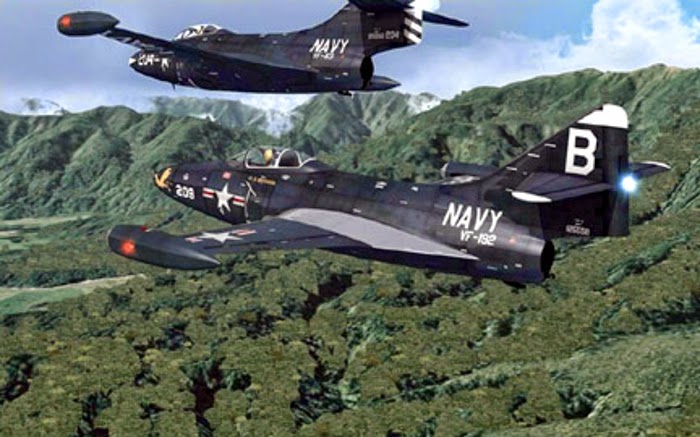
well as extensive opportunities to film its mighty F9F-2 Panthers in
flight. Its star, William Holden, had a personal link to the
material: his late brother, a naval aviator, had given his life in
the Pacific.
Pedigrees,
however, don't guarantee a great film. The Bridges of
Toko-Ri succeeds not because of
its authenticity, but because it's a thrilling and gripping tale. It
begins in the best possible way, with a helo bubba (played by Mickey
Rooney) pulling a jet bubba (Holden) out of the water following an
ejection. As a former Navy helo bubba, I could have spent the next
ninety minutes watching Rooney rescue people. That's not the way the
world works, however: the world cares about jet bubbas.
This
particular jet bubba has a beautiful wife (Grace Kelly), two charming
daughters, and every reason to get home alive. The Bridges
at Toko-Ri is built around the
early warning, planning, execution, and aftermath of a mission that
puts that eventuality very much in doubt: an airstrike on a cluster
of North Korean bridges deemed vital to the war effort. Because the
film walks us through all the steps in the runup to and execution of
this mission, we in the audience get time to bond with its characters
both at sea and ashore. Because the film takes pains to achieve
maximum authenticity in its depiction of life afloat and airborne, we
get to live vicariously in another world at another time. Because
the mission itself is so hazardous, and filmed so well, we get to
spend the last half-hour of the film on the edges of our collective
seats, rooting for Holden's character to make it
back to Grace and the girls.
This is a
great film. It's close enough to real life to stand in for
historical footage (though the F9F-2 wasn't flown in the Korean War –
the filmmakers had to work with what they had). Its characters are
compelling enough to make us care about them. Its story is tight
enough to keep us on the hook for two hours and reel us in at the
climax. The Bridges at Toko-Ri belongs at the top of your queue.


