MY BEST GIRL is an excellent picture.
Here's the setup: Mary Pickford plays Maggie Johnson, a stock clerk at Merrill's Department Store. When Charles Rogers's Joe Grant hires on, sparks fly and it isn't long before the two are hopelessly in love. But there's trouble: Joe Grant is actually Joe Merrill, scion of the wealthy merchant family, and he's engaged to a high-society girl. Will Pickford and her working-class sensibility triumph over the objections of Merrill's family and the dicates of upper-crust society? Does the sun rise in the morning?
Ok, so the storyline isn't exactly unique to the genre. What sells this movie, however, is Pickford's brilliant comic performance as the put-upon Maggie, a young woman trying to fulfill her responsibilites while carving out a little happiness for herself. Pickford is a mistress of the doubletake, and she excells at keeping the film's comic tone alive through all its twists and turns. When she shifts gears and goes for straight drama in the climax, we buy it and ride along with her. MY BEST GIRL absolutely hooked me.
Monday, September 25, 2006


Sunday, September 24, 2006
Will Success Spoil Rock Hunter?
WILL SUCCESS SPOIL ROCK HUNTER? begins with the familiar Fox logo and opening music, but with a twist: Tony Randall stands in the lower-left corner of the screen, playing along with the music. After the flourish, Randall takes center stage and introduces the movie, setting a flippantly po-mo tone that HUNTER manages to maintain throughout its running time.
HUNTER has such a simple and durable premise that 'Bewitched' worked it for eight seasons: an adman fears losing his job unless he can land that big contract. In this case, Tony Randall plays the leading nebbish and Jayne Mansfield plays the poor man's Monroe who holds the keys to his success. The jokes come nonstop, and some of them actually manage to be funny.
HUNTER depends on the audience's acceptance of Mansfield as some kind of feminine ideal. I find her to be phenomenally annoying, and her greatest talent appears to be her ability to get upstaged by every player around her, including her dog. That's not all bad, and even works when she's delightfully upstaged in the finale. Nevertheless, this movie feels tissue-paper thin. Of course, that can work in a comedy, and WILL SUCCESS SPOIL ROCK HUNTER? rocked along in its reasonably amusing groove right through to the end. I chuckled a few times, laughed out loud at the climax, and generally felt like I got my money's worth.
HUNTER has such a simple and durable premise that 'Bewitched' worked it for eight seasons: an adman fears losing his job unless he can land that big contract. In this case, Tony Randall plays the leading nebbish and Jayne Mansfield plays the poor man's Monroe who holds the keys to his success. The jokes come nonstop, and some of them actually manage to be funny.
HUNTER depends on the audience's acceptance of Mansfield as some kind of feminine ideal. I find her to be phenomenally annoying, and her greatest talent appears to be her ability to get upstaged by every player around her, including her dog. That's not all bad, and even works when she's delightfully upstaged in the finale. Nevertheless, this movie feels tissue-paper thin. Of course, that can work in a comedy, and WILL SUCCESS SPOIL ROCK HUNTER? rocked along in its reasonably amusing groove right through to the end. I chuckled a few times, laughed out loud at the climax, and generally felt like I got my money's worth.
Friday, September 22, 2006
Oldboy
The more I think about OLDBOY, the more I like it.
I knew the movie's premise going in: a guy's imprisoned for 15 years with no explanation, no words from his captors, and no clue why such a fate has befallen him. Upon gaining his freedom, he sets out to exact his revenge. Armed with this knowledge, I expected a Korean version of the THE COUNT OF MONTE CRISTO, only with much worse food. Initially, OLDBOY reinforces this expectation, even referencing the novel at one point. Before long, however, the film subverts both the Monte Cristo story and many of the tropes of popular narrative film, taking us to wholly unexpected places. Events pile on events, decisions on decisions, and soon we find ourselves in a story that has more in common with Aeschylus than Dumas. Gripping, provocative, and thoughtful to the end, OLDBOY succeeds on every level.
I knew the movie's premise going in: a guy's imprisoned for 15 years with no explanation, no words from his captors, and no clue why such a fate has befallen him. Upon gaining his freedom, he sets out to exact his revenge. Armed with this knowledge, I expected a Korean version of the THE COUNT OF MONTE CRISTO, only with much worse food. Initially, OLDBOY reinforces this expectation, even referencing the novel at one point. Before long, however, the film subverts both the Monte Cristo story and many of the tropes of popular narrative film, taking us to wholly unexpected places. Events pile on events, decisions on decisions, and soon we find ourselves in a story that has more in common with Aeschylus than Dumas. Gripping, provocative, and thoughtful to the end, OLDBOY succeeds on every level.
Thursday, September 21, 2006
Cavite
So two guys wrote up a script, bought a digitial camera and a couple of tickets to the Philippines, and set out to make a movie. They called it CAVITE.
CAVITE has a workable premise: a man is forced to do accede to a criminal's wishes to saave his family. The twist is that the criminal is an Abu Sayyef terrorist, the man is a secular Filipino muslim, and the setting is Cavite, a city somewhere near Manila. It's a reasonably effective, though shakily shot, thriller. Its protagonist wins our sympathy, its antagonist seems brilliant and effective, and the picture goes through all the paces of the modern thriller.
Unfortunately, CAVITE isn't particularly thrilling. We can see what it's trying to do, and we can pity it for not quite succeeding. Its protagonist, while sympathetic, isn't comopelling. it antagonist, while brilliant and effective, is supernaturally so. Think of CAVITE as a particularly good student film or fun project, and you may enjoy it. Approach it with the standards you'd apply to a professional trail, and you'll probably come away disappointed.
CAVITE has a workable premise: a man is forced to do accede to a criminal's wishes to saave his family. The twist is that the criminal is an Abu Sayyef terrorist, the man is a secular Filipino muslim, and the setting is Cavite, a city somewhere near Manila. It's a reasonably effective, though shakily shot, thriller. Its protagonist wins our sympathy, its antagonist seems brilliant and effective, and the picture goes through all the paces of the modern thriller.
Unfortunately, CAVITE isn't particularly thrilling. We can see what it's trying to do, and we can pity it for not quite succeeding. Its protagonist, while sympathetic, isn't comopelling. it antagonist, while brilliant and effective, is supernaturally so. Think of CAVITE as a particularly good student film or fun project, and you may enjoy it. Approach it with the standards you'd apply to a professional trail, and you'll probably come away disappointed.
Wednesday, September 20, 2006
Picnic at Hanging Rock
The first and most important thing film must do is entertain. Whatever its insights, whatever its contribution to the art form, a given film must hook and hold the viewer throughout its running time. Granted, this prerequisite assumes a degree of subjectivity, as that which hooks and holds one viewer may distract and bore another. I can live with that.
Roger Ebert talked me into viewing PICNIC AT HANGING ROCK. In one of his Great Movies columns, the critic paints a portrait of a mysterious, haunting, perceptive film that both hypnotizes and engages the viewer. I found it tedious and uninvolving. I simply did not care about its characters, it milieu, its insights, or much else about it. Perhaps it's the class warrior in me: why should I care about rich Victorians? Perhaps its the chronological ethnocentrist in me: why should I care about the geographically and chronologically limited ramifications of Victorian sexual and sociological norms? Perhaps it's the animal in me: I saw the movie at five in the morning, while waiting for an airplane to get fixed so I could take it flying - I didn't care much about anything other than getting another cup of coffee. And another. And another. Oh, and maybe a donut.
PICNIC AT HANGING ROCK may well be a stunning masterpiece, but it didn't hook me and it definitely didn't hold me. Ah, well.
Roger Ebert talked me into viewing PICNIC AT HANGING ROCK. In one of his Great Movies columns, the critic paints a portrait of a mysterious, haunting, perceptive film that both hypnotizes and engages the viewer. I found it tedious and uninvolving. I simply did not care about its characters, it milieu, its insights, or much else about it. Perhaps it's the class warrior in me: why should I care about rich Victorians? Perhaps its the chronological ethnocentrist in me: why should I care about the geographically and chronologically limited ramifications of Victorian sexual and sociological norms? Perhaps it's the animal in me: I saw the movie at five in the morning, while waiting for an airplane to get fixed so I could take it flying - I didn't care much about anything other than getting another cup of coffee. And another. And another. Oh, and maybe a donut.
PICNIC AT HANGING ROCK may well be a stunning masterpiece, but it didn't hook me and it definitely didn't hold me. Ah, well.
Tuesday, September 19, 2006
Kontroll
KONTROLL begins with a representative from Budapest's subway system, self-consciously reading from a clipboard as he voices his belief that audiences will see the film's depiction of the subway and its denizens as allegorical, rather than literal. Additionally, he states that he was happy to have permitted the film's use of the subway, as the young writer & director, Nimrod Antal, was profoundly concerned with issues of good and evil.
I don't know if that guy is an actor or not, but what a great way to set up a movie. By announcing that it's an allegory about good and evil, the film distances us from an immediacy it might otherwise have. Why is this a good thing? Well, our rational side is willing to overlook a disjointed story, a lack of compelling characters, and the production's unremitting ugliness because it's on the lookout for allegories of good and evil. Rather than reflect that a particular sequence doesn't move the story along or provide any real insight into its participants, it's thinking, "What does this mean?"
Here's the setup: Bulscu (Sandor Csanyi) is the leader of an underdog squad of Kontrollers, ticket checkers on Budapest's honor-system subway. He's smart, attractive, likeable, and sleeps on the floors of deserted platforms in the middle of the night. He appears to have no real home, and he may be a schizophrenic killer. With a setup like that, you'd be right to expect a straight-up thriller. Antal takes his story in a different direction, however, using his premise to examine the lives of people who exist at the fringes of society. It's an interesting experiment, and the conceit gives the shoestring production a thematic justification for looking as scruffy as its characters.
Is it interesting? Yes. Does it make one forget about the passage of time? Yes. Is it good? I'm not sure. I'm still trying to figure out what it means.
I don't know if that guy is an actor or not, but what a great way to set up a movie. By announcing that it's an allegory about good and evil, the film distances us from an immediacy it might otherwise have. Why is this a good thing? Well, our rational side is willing to overlook a disjointed story, a lack of compelling characters, and the production's unremitting ugliness because it's on the lookout for allegories of good and evil. Rather than reflect that a particular sequence doesn't move the story along or provide any real insight into its participants, it's thinking, "What does this mean?"
Here's the setup: Bulscu (Sandor Csanyi) is the leader of an underdog squad of Kontrollers, ticket checkers on Budapest's honor-system subway. He's smart, attractive, likeable, and sleeps on the floors of deserted platforms in the middle of the night. He appears to have no real home, and he may be a schizophrenic killer. With a setup like that, you'd be right to expect a straight-up thriller. Antal takes his story in a different direction, however, using his premise to examine the lives of people who exist at the fringes of society. It's an interesting experiment, and the conceit gives the shoestring production a thematic justification for looking as scruffy as its characters.
Is it interesting? Yes. Does it make one forget about the passage of time? Yes. Is it good? I'm not sure. I'm still trying to figure out what it means.
Monday, September 18, 2006
Brick
I enjoyed the heck out of BRICK. The movie does so many things right, it's hard not to.
First, we have the location. It's hard to imagine a less threatening, more sterile city than San Clemente, CA. It's the kind of clean-scrubbed, utterly dull town that made me itchy to get out of California. BRICK makes San Clemente feel like the scariest city on Earth, all the more so for its surface sheen of wholesomness.
Second, we have the dialogue. It's a stylized form of speech, a noirish banter that no one would actually use, but which we wish they did. The speech could easily descend into self-parody or throw off the entire picture, but it does just the opposite: it takes us into a parallel world that's familiar enough to be relatable but just different enough to be unsettling.
Fourth, we have the performances. I didn't recognize any of the players, but knew going in that the protagonist is the kid from ANGELS IN THE OUTFIELD, all grown up. They were terrific, and not in the terrific-for-kids sense. The cast took to the stylized dialogue and fanciful situation and played it dead straight, giving the proceedings a tension and danger that even one wink would've have dissipated.
Fifth, we have the music. IMDB credits Nathan Johnson and Larry Seymour with the score, and they do a masterful job here. The music, like the dialogue, isn't normal. It fits its milieu, however, keeping us off-balance and tense. While it did call attention to itself, it did so in the most positive way, making me seriously consider purchasing a score for the first time in a very long time.
Rian Johnson, a first-time filmmaker, did BRICK on a shoestring and edited it with his home computer. With a debut like this, I can't wait to see what this guy can do with a little studio money behind him.
What a treat.
First, we have the location. It's hard to imagine a less threatening, more sterile city than San Clemente, CA. It's the kind of clean-scrubbed, utterly dull town that made me itchy to get out of California. BRICK makes San Clemente feel like the scariest city on Earth, all the more so for its surface sheen of wholesomness.
Second, we have the dialogue. It's a stylized form of speech, a noirish banter that no one would actually use, but which we wish they did. The speech could easily descend into self-parody or throw off the entire picture, but it does just the opposite: it takes us into a parallel world that's familiar enough to be relatable but just different enough to be unsettling.
Fourth, we have the performances. I didn't recognize any of the players, but knew going in that the protagonist is the kid from ANGELS IN THE OUTFIELD, all grown up. They were terrific, and not in the terrific-for-kids sense. The cast took to the stylized dialogue and fanciful situation and played it dead straight, giving the proceedings a tension and danger that even one wink would've have dissipated.
Fifth, we have the music. IMDB credits Nathan Johnson and Larry Seymour with the score, and they do a masterful job here. The music, like the dialogue, isn't normal. It fits its milieu, however, keeping us off-balance and tense. While it did call attention to itself, it did so in the most positive way, making me seriously consider purchasing a score for the first time in a very long time.
Rian Johnson, a first-time filmmaker, did BRICK on a shoestring and edited it with his home computer. With a debut like this, I can't wait to see what this guy can do with a little studio money behind him.
What a treat.
Saturday, September 16, 2006
Blade: Trinity
It helps if you go into BLADE: TRINITY with low expectations. You'll need them. Exepect Wesley Snipes to deliver a one-note performance. Expect ridiculously pathetic vampires who couldn't terrorize a Sunday-school class. Expect choppily edited fight scenes that make it virtually impossible to recognize what's going on half the time. Oh, and expect lots and lots of intrusive product placements - seriously, if there was an award for product placement, BLADE: TRINITY would win, downtown.
If you do all this, you'll probably enjoy BLADE: TRINITY. The movie delivers pretty much exactly what you'd expect: cheesily menacing vampires, lots of people jumping around and kicking other people in the face, and a throbbing soundtrack that's always reminding you to have fun, fun, doggonit! With the exceptions of Parker Posey, gamely trying and failing to portray a menacing vampire leader, and Ryan Reynolds, who seems to think he's in BORDELLO OF BLOOD, the actors and stuntmen are just fine. The production values areprofessional, and the whole thing comes off as a reasonable entertaining exercise.
Just know that you're going to get pretty much exactly what you expect.
If you do all this, you'll probably enjoy BLADE: TRINITY. The movie delivers pretty much exactly what you'd expect: cheesily menacing vampires, lots of people jumping around and kicking other people in the face, and a throbbing soundtrack that's always reminding you to have fun, fun, doggonit! With the exceptions of Parker Posey, gamely trying and failing to portray a menacing vampire leader, and Ryan Reynolds, who seems to think he's in BORDELLO OF BLOOD, the actors and stuntmen are just fine. The production values areprofessional, and the whole thing comes off as a reasonable entertaining exercise.
Just know that you're going to get pretty much exactly what you expect.
Friday, September 15, 2006
Point Blank
POINT BLANK is such a guy movie, they soaked the film stock in testosterone before putting it in the camera. Then they punched the lens a couple of times, just to toughen it up. This is a movie about money, broads, guns, cars, respect, and power: the source material for Mel Gibson’s PAYBACK, but with twice the grit. What a picture.
On the off chance that you’ve never before encountered either PAYBACK or POINT BLANK, here’s the setup: Lee Marvin’s been double-crossed and left for dead by a, erm, business associate who uses the money from a grab-and-go to buy his way in to the local mob. Marvin wants his money back, and there’s your movie. But this isn’t just a Bronsonesque revenge thriller; that’d be pedestrian. It’s a full-on neo-noir picture featuring femmes fatale, double- and triple- crosses, and shadowy figures who’d never waste their time telling you it’s Chinatown – buy a map, you pansy.
John Boorman directed POINT BLANK as only his second feature, but you wouldn't know it. The movie feels like the work of an old pro, and Boorman's crisp, no-nonsense direction keeps things stripped down to their basics, letting the players shine and the story move. And those players do shine. Lee Marvin had always cultivated the persona of a man who eats steel and shits bullets, and he puts that persona to excellent use here. When he tells a man, “I’m going to kill you,” we believe it - and we thank God that he isn’t coming after us, too. Angie Dickinson, who plays a woman straight out of a Dashiell Hammet novel, hits all the right notes: smooth and harsh, seductive and dangerous. She's perfect: pure movie magic in, well, nothing at all. And the villains - don't get me started.
In fact, everything about this movie is great. Even the print on this particular edition is perfect. It looks and sounds crisp, and it has every earmark of a painstaking restoration. Not only is POINT BLACK fun to watch, it’s beautiful, too. Yep, in your face and unblinking, POINT BLANK is one of the best guy movies out there. Enjoy.
is such a guy movie, they soaked the film stock in testosterone before putting it in the camera. Then they punched the lens a couple of times, just to toughen it up. This is a movie about money, broads, guns, cars, respect, and power: the source material for Mel Gibson’s PAYBACK, but with twice the grit. What a picture. On the off chance that you’ve never before encountered either PAYBACK or POINT BLANK, here’s the setup: Lee Marvin’s been double-crossed and left for dead by a, erm, business associate who uses the money from a grab-and-go to buy his way in to the local mob. Marvin wants his money back, and there’s your movie. But this isn’t just a Bronsonesque revenge thriller; that’d be pedestrian. It’s a full-on neo-noir picture featuring femmes fatale, double- and triple- crosses, and shadowy figures who’d never waste their time telling you it’s Chinatown – buy a map, you pansy.
John Boorman directed POINT BLANK as only his second feature, but you wouldn't know it. The movie feels like the work of an old pro, and Boorman's crisp, no-nonsense direction keeps things stripped down to their basics, letting the players shine and the story move. And those players do shine. Lee Marvin had always cultivated the persona of a man who eats steel and shits bullets, and he puts that persona to excellent use here. When he tells a man, “I’m going to kill you,” we believe it - and we thank God that he isn’t coming after us, too. Angie Dickinson, who plays a woman straight out of a Dashiell Hammet novel, hits all the right notes: smooth and harsh, seductive and dangerous. She's perfect: pure movie magic in, well, nothing at all. And the villains - don't get me started.
In fact, everything about this movie is great. Even the print on this particular edition is perfect. It looks and sounds crisp, and it has every earmark of a painstaking restoration. Not only is POINT BLACK fun to watch, it’s beautiful, too. Yep, in your face and unblinking, POINT BLANK is one of the best guy movies out there. Enjoy.
Thursday, September 14, 2006
Returner
I thought RETURNER was reasonably entertaining. Had I stumbled on the movie while flipping through the channels on a hotel TV, I probably would have enjoyed it (Hey, it worked for BIKER BOYZ.). While trying to keep my eyes open on the Metro after staying up too late watching season one of "Arrested Development," however, I just couldn't get into it.
While the movie has a fun premise, I found the villain to be ridiculously unbelievable and not nearly as cool as he thought he was. The fight scenes cut so clumsily between actors and doubles that they took me out of the moment, the Western cast was ridiculously bad, and the film's climactic moment depends on audience agreement that Transformers are, in fact, cool. Transformers weren't cool when I was a kid, and they aren't cool now.
Still, RETURNER has a breathless quality to it that's undeniable. After a wild night of dinner in a hotel restaurant and setting the alarm clock, it'd be a treat to find this movie on the Sci Fi channel.
While the movie has a fun premise, I found the villain to be ridiculously unbelievable and not nearly as cool as he thought he was. The fight scenes cut so clumsily between actors and doubles that they took me out of the moment, the Western cast was ridiculously bad, and the film's climactic moment depends on audience agreement that Transformers are, in fact, cool. Transformers weren't cool when I was a kid, and they aren't cool now.
Still, RETURNER has a breathless quality to it that's undeniable. After a wild night of dinner in a hotel restaurant and setting the alarm clock, it'd be a treat to find this movie on the Sci Fi channel.
Wednesday, September 13, 2006
Y Tu Mama Tambien
There's a lot to like about Y TU MAMA TAMBIEN. It tackles serious concerns in a serious way, it gives us honest and multidimensional characters, and it manages to infuse the tropes of the road trip movie with a pathos and insight not normally found in the genre. Unfortunately, however, it failed to capture my imagination.
Y TU MAMA TAMBIEN is a story about two young men and one fully adult woman. It blends coming of age, sexual maturation, and class concerns seamlessly, but it does so on a level so accessible that it opens itself to accusations of oversimplicity. Yes, we get that the young need to find themselves, intellectually and physically - we've been there. Yes, we get that rich and poor inhabit entirely different worlds - what else have you got? And yes, we understand that the world is soaked in tragedy - so what? This is a movie that, on first viewing, seems far too easy to decode. Perhaps there's more to it, but I saw this one solo and am stuck with my own impressions.
While Y TU MAMA TAMBIEN's insights may seem all too obvious, the film still earns significant credit for fully realizing its characters. Sure, the adolescents are horny kids, but they're horny kids with real hearts, concerns, and questions about themselves and their place in the world. Sure, the woman is the very personification of the madonna-whore, but she's given a level of humanity and an internal (and internalized) journey that's far more profound than that normally found in coming of age films. I didn't really like these people. I didn't really relate to these people. But I believed in these people. And that ain't bad.
Y TU MAMA TAMBIEN is basically a road trip movie, but it's a movie that understands the tedious nature of the road trip, that uses the tropes of the genre to great effect, and that feels for every character on the screen. As its trio of protagonists pass through their various challenges, the film uses those challenges and situations to explore the nature of maturing sexuality and, hell, maturing period. This film "gets it" in a way that so many do not.
So, why did Y TU MAMA TAMBIEN fail to capture my imagination? It clobbered my out of the trap with its lfrequent voice-overs. It's as if the film didn't trust me to intuit pathos and, instead, beat me over the head with it. See this nice spot? People died there long ago. See these nice people? Those nasty capitalists will drive them from their home soon. OK, ok. I get it. Life is hard. Additionally, I had a philosophical problem with some of the movie's assumptions, especially the assumption that freer sex leads to greater happiness. Granted, the film did address the issue forthrightly in its denoument, but even that felt like it was too little, too late.
So, there it is. I respect Y TU MAMA TAMBIEN. I admire Y TU MAMA TAMBIEN. But I don't particularly like Y TU MAMA TAMBIEN. I guess you can't have it all.
Y TU MAMA TAMBIEN is a story about two young men and one fully adult woman. It blends coming of age, sexual maturation, and class concerns seamlessly, but it does so on a level so accessible that it opens itself to accusations of oversimplicity. Yes, we get that the young need to find themselves, intellectually and physically - we've been there. Yes, we get that rich and poor inhabit entirely different worlds - what else have you got? And yes, we understand that the world is soaked in tragedy - so what? This is a movie that, on first viewing, seems far too easy to decode. Perhaps there's more to it, but I saw this one solo and am stuck with my own impressions.
While Y TU MAMA TAMBIEN's insights may seem all too obvious, the film still earns significant credit for fully realizing its characters. Sure, the adolescents are horny kids, but they're horny kids with real hearts, concerns, and questions about themselves and their place in the world. Sure, the woman is the very personification of the madonna-whore, but she's given a level of humanity and an internal (and internalized) journey that's far more profound than that normally found in coming of age films. I didn't really like these people. I didn't really relate to these people. But I believed in these people. And that ain't bad.
Y TU MAMA TAMBIEN is basically a road trip movie, but it's a movie that understands the tedious nature of the road trip, that uses the tropes of the genre to great effect, and that feels for every character on the screen. As its trio of protagonists pass through their various challenges, the film uses those challenges and situations to explore the nature of maturing sexuality and, hell, maturing period. This film "gets it" in a way that so many do not.
So, why did Y TU MAMA TAMBIEN fail to capture my imagination? It clobbered my out of the trap with its lfrequent voice-overs. It's as if the film didn't trust me to intuit pathos and, instead, beat me over the head with it. See this nice spot? People died there long ago. See these nice people? Those nasty capitalists will drive them from their home soon. OK, ok. I get it. Life is hard. Additionally, I had a philosophical problem with some of the movie's assumptions, especially the assumption that freer sex leads to greater happiness. Granted, the film did address the issue forthrightly in its denoument, but even that felt like it was too little, too late.
So, there it is. I respect Y TU MAMA TAMBIEN. I admire Y TU MAMA TAMBIEN. But I don't particularly like Y TU MAMA TAMBIEN. I guess you can't have it all.
Monday, September 11, 2006
Akeelah and the Bee
Concerning AKEELAH AND THE BEE's poor box office showing, Elizabeth wrote that "a large pt. of this audience probably has already seen SPELLBOUND." That's what put me off the movie, but I finally broke down under the pressure of its positive reviews and queued it up. I enjoyed the heck out of it.
AKEELAH AND THE BEE faithfully adheres to the sports movie / inspirational tale formula, but that formula has been around so long because it's so unerringly effective. Akeelah is a spelling prodigy from a rough part of L.A. who follows her dream to the National Spelling Bee in Washington, D.C. Will she grow? Will she find worth in her own eyes and the eyes of others? Will she win? Come on - you've been to the movies before. More importantly, does it work? Yes, as a matter of fact. It does.
Keekee Palmer is fine as Akeelah, and Angela Basset and Laurence Fishburne both do fine work here. The movie even offers a few treats to the SPELLBOUND crowd, working some familiar faces from that excellent documentary into the fictionalized version of the Bee, but the star of this movie is the formula. And it always hits its mark.
AKEELAH AND THE BEE faithfully adheres to the sports movie / inspirational tale formula, but that formula has been around so long because it's so unerringly effective. Akeelah is a spelling prodigy from a rough part of L.A. who follows her dream to the National Spelling Bee in Washington, D.C. Will she grow? Will she find worth in her own eyes and the eyes of others? Will she win? Come on - you've been to the movies before. More importantly, does it work? Yes, as a matter of fact. It does.
Keekee Palmer is fine as Akeelah, and Angela Basset and Laurence Fishburne both do fine work here. The movie even offers a few treats to the SPELLBOUND crowd, working some familiar faces from that excellent documentary into the fictionalized version of the Bee, but the star of this movie is the formula. And it always hits its mark.
Double Indemnity
Double Indemnity has been on my Netflix queue forever. Actually, it's been sitting in the "pending release" portion, as no one had been willing to pony up for a DVD release. Finally, Turner Classic Movies stepped up and released a beautiful print of the film. It was worth the wait.
Not only does Double Indemnity look great, it sounds great. Billy Wilder and Raymond Chandler put together a cracking good script with quotable lines, and Fred MacMurray and Barbara Stanwyck deliver them with gusto. This is a fun movie in a couple of ways.
Here's the setup: Fred MacMurray is morally flexible insurance man Walter Neff. While making a routine sales call, he meets Barbara Stanwyck, who plays Phyllis Dietrichson. It's a classic Stanwyck performance: she's sexy, she's hard-edged, and, oh, she's bad news as only Chandler can imagine bad news. Before long, Walter's masterminding a complex insurance scam / murder plot, but it won't be long before everything goes awry. I'm not giving anything away, incidentally - the movie begins with a shot and bleeding Walter confessing to a dictaphone.
Since, like Sunset Blvd., Double Indemnity begins by giving away the fate of its protagonist, the question isn't whether the movie will surprise and astonish us. The question is whether it'll make us enjoy the journey. Will it? Well, it depends. Do you like noir? Do you like, MacMurray, Stanwyck, and Edward G. Robinson? More simply, do you like movies? If you can answer "yes" to any of the above, I bet you'll like Double Indemnity.
EDIT: A friend who works for TCM assures me that this DVD was a Universal, not TCM project from the get-go. I was thrown off by the film's introduction, which features Robert Osbourn on the TCM set. I must still have been thinking about that anklet.
Not only does Double Indemnity look great, it sounds great. Billy Wilder and Raymond Chandler put together a cracking good script with quotable lines, and Fred MacMurray and Barbara Stanwyck deliver them with gusto. This is a fun movie in a couple of ways.
Here's the setup: Fred MacMurray is morally flexible insurance man Walter Neff. While making a routine sales call, he meets Barbara Stanwyck, who plays Phyllis Dietrichson. It's a classic Stanwyck performance: she's sexy, she's hard-edged, and, oh, she's bad news as only Chandler can imagine bad news. Before long, Walter's masterminding a complex insurance scam / murder plot, but it won't be long before everything goes awry. I'm not giving anything away, incidentally - the movie begins with a shot and bleeding Walter confessing to a dictaphone.
Since, like Sunset Blvd., Double Indemnity begins by giving away the fate of its protagonist, the question isn't whether the movie will surprise and astonish us. The question is whether it'll make us enjoy the journey. Will it? Well, it depends. Do you like noir? Do you like, MacMurray, Stanwyck, and Edward G. Robinson? More simply, do you like movies? If you can answer "yes" to any of the above, I bet you'll like Double Indemnity.
EDIT: A friend who works for TCM assures me that this DVD was a Universal, not TCM project from the get-go. I was thrown off by the film's introduction, which features Robert Osbourn on the TCM set. I must still have been thinking about that anklet.
Sunday, September 10, 2006
Layer Cake
I liked LAYER CAKE from the very beginning, but the ending made me love it.
LAYER CAKE, written by J.J. Connolly, directed by Matthew Vaughn, and starring Daniel Craig, works from an ancient formula. You know the one: the drug dealer / jewel thief / pickinick basket swiper wants to get out of the game, but first must make One Last Score. So, how does LAYER CAKE rise above its formula? It doesn't, really. Rather, the movie executes it so well that one can't help but be caught up in the twists, turns, doublecrosses, and mounting desperation Daniel Craig's dealer feels as he tries to outsmart the dangerous idiots who surround him.
I've never seen Daniel Craig before, but let me tell you: this guy's got it. I believed that this guy could could be simultaneously brilliant and stupid. I believed that he was a thinker, a leader, the kind of guy who could survive the drug trade well into his thirties. Craig doesn't have to carry the entire movie, however. The supporting cast (featuring Colm Meaney, Michael Gambon, & Sienna Miller) is spot-on, the music's note-perfect, the editing is great (look for some creative and fun transitions), and the dialogue's fun to listen to.
And the ending, oh that ending. Pow! What a winner.
LAYER CAKE, written by J.J. Connolly, directed by Matthew Vaughn, and starring Daniel Craig, works from an ancient formula. You know the one: the drug dealer / jewel thief / pickinick basket swiper wants to get out of the game, but first must make One Last Score. So, how does LAYER CAKE rise above its formula? It doesn't, really. Rather, the movie executes it so well that one can't help but be caught up in the twists, turns, doublecrosses, and mounting desperation Daniel Craig's dealer feels as he tries to outsmart the dangerous idiots who surround him.
I've never seen Daniel Craig before, but let me tell you: this guy's got it. I believed that this guy could could be simultaneously brilliant and stupid. I believed that he was a thinker, a leader, the kind of guy who could survive the drug trade well into his thirties. Craig doesn't have to carry the entire movie, however. The supporting cast (featuring Colm Meaney, Michael Gambon, & Sienna Miller) is spot-on, the music's note-perfect, the editing is great (look for some creative and fun transitions), and the dialogue's fun to listen to.
And the ending, oh that ending. Pow! What a winner.
Saturday, September 09, 2006
Howards End
Back in college, a girl I was seeing dragged me to A ROOM WITH A VIEW. The movie, all 36 hours of it, was painfully, excruciatingly long. I promised myself I'd never see another Merchant-Ivory picture again. Well, time dimmed the promise, as it often does, and I queued up HOWARDS END a short while ago.
I liked it. I really liked it. If I had to boil down my reasons, I'd find Emma Thompson's Margaret Schlegle. She begins the movie an engaged, joyful, dynamic woman. As time wears on and her choices tell on her, we see that she's put herself in an ever-shrinking box. We've seen that type of character before, but Thompson's triumph comes from her endowing Margaret with the self-awareness to know whom she is, whom she was, and whom she may become.
Thompson's dedication to her character's full humanity is of a part with the entire film's approach to its characters, its settings, and its situations. HOWARDS END is populated with real people, with real problems, who make real decisions. At no point do we hear the plot's gears grinding, and at no point do we lose our investment in these people. Time with HOWARDS END is time well spent.
But I still won't give A ROOM WITH A VIEW another go. Life's too short.
I liked it. I really liked it. If I had to boil down my reasons, I'd find Emma Thompson's Margaret Schlegle. She begins the movie an engaged, joyful, dynamic woman. As time wears on and her choices tell on her, we see that she's put herself in an ever-shrinking box. We've seen that type of character before, but Thompson's triumph comes from her endowing Margaret with the self-awareness to know whom she is, whom she was, and whom she may become.
Thompson's dedication to her character's full humanity is of a part with the entire film's approach to its characters, its settings, and its situations. HOWARDS END is populated with real people, with real problems, who make real decisions. At no point do we hear the plot's gears grinding, and at no point do we lose our investment in these people. Time with HOWARDS END is time well spent.
But I still won't give A ROOM WITH A VIEW another go. Life's too short.
Friday, September 08, 2006
The Life Aquatic with Steve Zissou
I like the combination of the real and the fanciful in THE LIFE AQUATIC WITH STEVE ZISSOU. Elegance, insight, and grace infuse the (only?) real element of the film, the inner life of Steve Zissou; while the fanciful element shines with vision, creativity, and an edge toward fancy.
Steve Zissou is a man in the process of losing his illusions. His business is crumbling, his partner is leaving, and his crew yearns for the days when he had the energy to make illusions seem real. As the movie pares this character down to his vital core, it creates an increasingly fantastical world for him to inhabit. How fitting that his moment of enlightenment should come in the most fantastical scene of them all.
Holy cow, did I like this movie.
Steve Zissou is a man in the process of losing his illusions. His business is crumbling, his partner is leaving, and his crew yearns for the days when he had the energy to make illusions seem real. As the movie pares this character down to his vital core, it creates an increasingly fantastical world for him to inhabit. How fitting that his moment of enlightenment should come in the most fantastical scene of them all.
Holy cow, did I like this movie.
Thursday, September 07, 2006
The Ruling Class
THE RULING CLASS is two movies with a common theme. Unfortunately, I didn't care for either one.
The first movie is an English country farce in which Peter O'Toole, who firmly believes that he's Jesus Christ, returns from his voluntary stay at a lunatic asylum to assume the title and holdings of 14th Earl of Gurney. The 13th Earl was a big fan of autoerotic asphyxiation, a compulsion that's played for every laugh it can get. That's right, folks: accidental suicide as comedy gold. Somebody approved this. Anyway, O'Toole shows up, private crucifix and all, and proceeds to turn life upside down at the Gurney estate. There's your first movie.
The second movie is a horror picture complete with seduction, murder, and the undead. Gurney visits a House of Lords that's filled with cobwebs, ghouls, and lawyers, and it's supposed to get under our skin. But it doesn't, really. It just falls flat, and it falls flat because it's such a hamhanded hammering at the two movies' common theme that it had me wishing the producers had just printed up a circular to hand out at entrances to the Tube.
The common theme is this: the English class system is bad. It values lineage over ability, and it makes for a ridiculous social and political construct. There: I've just save you two hours.
Now, I don't mind message movies. I do, however, mind movies that are nothing but message, particularly if it's a message I don't care about. I'm not English. I don't care about the English class system. While I'd be happy to watch a movie about people who happen to be a part of that system, I'm not too excited about a two hour commentary on the system itself. My excitement reaches new lows when said movie's comedic bits aren't funny (I didn't so much as crack a smile.) and its horrific bits aren't scary (I didn't feel even the slightest chill.).
What a disappointment.
The first movie is an English country farce in which Peter O'Toole, who firmly believes that he's Jesus Christ, returns from his voluntary stay at a lunatic asylum to assume the title and holdings of 14th Earl of Gurney. The 13th Earl was a big fan of autoerotic asphyxiation, a compulsion that's played for every laugh it can get. That's right, folks: accidental suicide as comedy gold. Somebody approved this. Anyway, O'Toole shows up, private crucifix and all, and proceeds to turn life upside down at the Gurney estate. There's your first movie.
The second movie is a horror picture complete with seduction, murder, and the undead. Gurney visits a House of Lords that's filled with cobwebs, ghouls, and lawyers, and it's supposed to get under our skin. But it doesn't, really. It just falls flat, and it falls flat because it's such a hamhanded hammering at the two movies' common theme that it had me wishing the producers had just printed up a circular to hand out at entrances to the Tube.
The common theme is this: the English class system is bad. It values lineage over ability, and it makes for a ridiculous social and political construct. There: I've just save you two hours.
Now, I don't mind message movies. I do, however, mind movies that are nothing but message, particularly if it's a message I don't care about. I'm not English. I don't care about the English class system. While I'd be happy to watch a movie about people who happen to be a part of that system, I'm not too excited about a two hour commentary on the system itself. My excitement reaches new lows when said movie's comedic bits aren't funny (I didn't so much as crack a smile.) and its horrific bits aren't scary (I didn't feel even the slightest chill.).
What a disappointment.
Tuesday, September 05, 2006
My Dinner with Andre
I don't think I can approach MY DINNER WITH ANDRE with anything like a critical eye. (Yeah, yeah, I know. Since when have I had a critical eye?) Here's the problem: Andre is a dead ringer for a friend of mine named Dan. He looks the same. He dresses the same. He speaks in the same cadences. He's deeply, profoundly engaged with life, and he loves to share his ideas with his friends, even when he exasperates them.
Dan's been dead for three years, now. I miss him. MY DINNER WITH ANDRE was, in a weird way, like getting an extra couple of hours with the guy. I don't know when I'll see the movie again, but it's good to know that it's out there. Maybe when I'm ready for another conversation.
Technical note: the disk I saw was of a very bad print. If there's a special edition out there, you might want to go with that.
Dan's been dead for three years, now. I miss him. MY DINNER WITH ANDRE was, in a weird way, like getting an extra couple of hours with the guy. I don't know when I'll see the movie again, but it's good to know that it's out there. Maybe when I'm ready for another conversation.
Technical note: the disk I saw was of a very bad print. If there's a special edition out there, you might want to go with that.
Monday, September 04, 2006
The Pianist
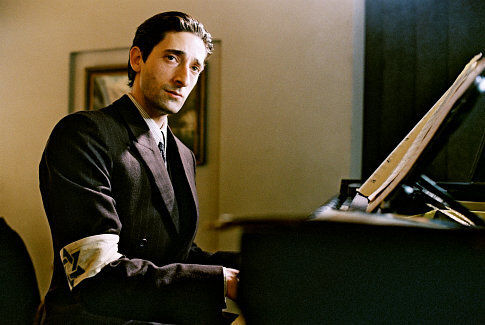
I got a postcard from Germany the other day. The photo was of people wearing silly folk costumes against a beautiful background. The message read, "Liebe grüsse und alles gute sowie viel freude mit eurem neuen familien!" While watching The Pianist this morning, that postcard kept coming back to me. It represented the latest variation on perhaps the greatest cognitive dissonance in my life: that between my wonderful, loving German friends and relatives, the culture and language I associate with holidays and early childhood; and the monsters the Germans became under the iron rule of the Nazi party. I've read the books and seen the movies and had the conversations, but the question still remains: how is it possible that my people were once those people?
Consequently, watching THE PIANIST was like getting punched in the face for two and a half hours. The movie follows an affluent young Jewish man of Warsaw, the titular pianist, as he scrambles to survive the coming, then occupying, then disintegrating German horde (played, incidentally, by actors who look like me and my relatives). We see him assisted and betrayed, in denial and disillusioned, as his world literally crumbles around him. Adrien Brody delivers a star-making performance, fully investing his character with all the humanity he deserves. His oppressors, the Nazis and their collaborators, are also fully realized in their monstrosity. It's a brilliantly made film, perhaps someone with more distance would enjoy the heck out of it. For me, it was agony. I have no desire to see it again.
Sunday, September 03, 2006
Blood Simple
I enjoyed BLOOD SIMPLE for its audacity, for the skill with which is was made, and for the memorable performance of M. Emmet Walsh, a character actor whom I'd seen a million times but whose name never stuck until now. (Run, sentence, run!)
BLOOD SIMPLE, the Coen brothers' first movie, is a Texas noir with a sleazy bartender, a sleazy bar owner, a sleazy bar owner's wife, and a sleazy detective. That's a lot of sleaze, and the amazing thing about this movie is how it makes you care about these people as they betray, slay, and dismay one another through the course of the picture's tight 96-minute running time. There isn't a thing about this movie I don't like, from its performances to its photography to its pacing to the labyrinthine story. This picture's a treat.
BLOOD SIMPLE, the Coen brothers' first movie, is a Texas noir with a sleazy bartender, a sleazy bar owner, a sleazy bar owner's wife, and a sleazy detective. That's a lot of sleaze, and the amazing thing about this movie is how it makes you care about these people as they betray, slay, and dismay one another through the course of the picture's tight 96-minute running time. There isn't a thing about this movie I don't like, from its performances to its photography to its pacing to the labyrinthine story. This picture's a treat.
Subscribe to:
Posts (Atom)