Showing posts with label Claudia Cardinale. Show all posts

Friday, December 16, 2011

The Leopard


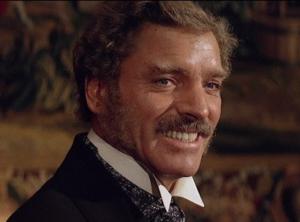
In The Leopard, Burt Lancaster delivers perhaps a career-best performance as Prince Don Fabrizio Salina, a giant among the Sicilian nobility of the 1860s.  The world is changing around the prince, who adapts as best he can.  But that’s not interesting.  What’s interesting is how the Salina adapts to not just the greater world of 1860s Italy, but to his realization that his moment, and the moment of all he holds dear, is passing.  It’s beautiful and powerful and some stuff even blows up.  I don’t know what more you could want in a movie.

Prince Salina bears the mantle of his great house, rules his corner of the island, and arranges the lives of his family to ensure the survival of his legacy.  This isn’t easy, as the island boils with revolution and capitalism challenges feudalism in all the ways that matter.  When the most promising member of the next generation (who isn’t a direct descendant) falls in love with a rich but common girl of the town, how can the Prince both adapt today and make way for tomorrow?

He can do so with vigor, style, and a take-charge intelligence that Lancaster conveys with absolute authority. Alain Delon plays the scion and Claudia Cardinale the commoner, and one finds it difficult to imagine a fitter actor to play their better, their mentor, and (in a sense) their rival.  You’ll see this film and it’ll dazzle you with its costumes and sets and scenery and, well, Sicilian – ness, but you’ll take away Lancaster as the The Leopard, perhaps the last feudal lord in Europe.  He’s a little frustrated, a little sad, a little resigned, but he’s nowhere near out of tricks and he’ll amaze and impress you.

If you think of Burt Lancaster only as “the guy from those old pirate movies,” think again.  Watch this film and stand by to be impressed.

PS  In a nifty little coincidence, I’m posting this from the balcony of a hotel room in Sicily, where cool breezes blow across the cedars and the blood oranges hang ripely in the trees.  This is a magnificent island.

Friday, February 25, 2011

Rocco and His Brothers


When I go to Sicily, I see Southern California before it was developed.  I see rolling hills, groves of orange trees, acres of vineyards.  I see a place very much like paradise.  For postwar Sicilians, however, the island was more of a semifeudal hellhole where landholders and padrons divided the fruits of their toil.  For postwar Sicilians, the Crossroads of the Mediterranean was a place to leave.

Rocco and His Brothers, a film by Luchino Visconti, tells the story a Sicilian family that leaves.  The father has died and the mother brings four of her sons to Milan to make a new life under the leadership of Vincenzo, the fifth and oldest of the brothers and a young man who’s establishing himself in the northern city.

He is not happy to see them.  He can barely provide for himself.  Away we go.

To get this movie, I think one must accept that it isn’t a movie that about Sicilians.  Rather, it’s a Sicilian movie.  It has Sicilian attitudes toward family, toward women, toward obligation.  As the members of the family embark on their careers and make their way (or not) in the North, their unique cultural point of view defines everything about them.  When one of the brothers outrages another’s girlfriend, it’s the girlfriend that pays because family comes first.  When someone comes home with blood on his hands, the family’s first instinct is to hide the crime because family comes first.  This outlook so permeates the film that I, as an outsider, found it difficult to relate to these people.  Rocco and His Brothers throws me a bone by giving me one brother who sees things in a more recognizable moral framework, but he’s the family outlier: I got the sense that he’s the one who makes everyone else uncomfortable at dinner.

Is Rocco and His Brothers engrossing?  Yes.  Is it technically adept?  Yes.  Will it leave you scratching your head and wondering what the hell makes Sicilians tick?  Absolutely.  Just don’t go to the island to find out for yourself.  I want to keep it like California before the development.

Tuesday, September 08, 2009

8 1/2


8 1/2 may the best film ever made.

If not, it is the best film about art ever made. Released in 1963, it would have been as relevant in 1889, the year after ROUNDHAY GARDEN SCENE, as it would be if it premiered tomorrow. It's a film that encompasses everything that art is about, or at least is supposed to be about. It's about the tension between truth and fiction, between art and commerce, between awareness and narcissism. And it's about everything that life is about. It's about commitment and betrayal, about memory and currency, reality and fantasy. It's about who we are and who we want to be, about ourselves and our self-constructs. It is, simply put, magnificent. It is the apotheosis of film and the indictment of the thin gruel we, as filmgoers, so regularly accept.

OK, so that's what it looks like when my mind is blown.

But this feels like a film I could see a thousand times. Not only is it a multisensual feast, but it probes, really probes, into the beating heart of life in a way no film I'd previously seen ever has. The photography complements the music complements the finely crafted story complements the performances complements the ideas that form the core of the work. 8 1/2 reveals Fellini at the height of his power, grappling with elemental dilemmas that have confronted man since he became self-aware. Mastroianni is incomparable. Cardinale and Aimée are revelatory. Every single thing about this picture is perfect. My only regret is that I've waited this long to see it.

Sunday, August 12, 2007

Big Deal on Madonna Street


"Big Deal on Madonna Street" is a heist movie with a twist: our thieves are a gang of loveable but hopeless incompetents who couldn't steal a handbag from an old lady. It's supposed to be funny, and it does elicit a chuckle here and there, but it's never quite as funny as it wants to be. Ah, well.

Thursday, April 26, 2007

Once Upon a Time in the West


If you happened to be riding the Red Line this morning, you may have noticed a guy in a suit gazing into his laptop with a big, goofy grin spread across his face. The guy was me, and the goofy grin was in response to the final showdown in Sergio Leone's fabulously entertaining ONCE UPON A TIME IN THE WEST. This is a western that loves westerns, and that love is no more evident than in this faceoff. The adversaries are perfect: the villain tall, thin, dressed in black, and evil as can be; the hero short, burly, dressed in tattered and sun-bleached clothes, utterly implacable. They're both at the top of their game, and their grudging respect for one another shows in their complete and total focus. Ennio Morricone's music swells, the camera moves, and if you aren't completely carried away in the joy of film, well then, you just plain don't like movies.

The movie starts slowly, letting tension build as a gang of toughs, led by the formidable Jack Elam, takes over a remote rail outpost and awaits a coming train. Who or what is on that train, and what will it mean? When you see, and when you see what happens next, you're going to know whether or not you're in for the rest of ONCE UPON A TIME IN THE WEST, because if it doesn't hook you, nothing will.

This may be the most lavish of the spaghetti westerns, as Leone had Paramount's backing for the production. He used some of his money to hire first-class actors such as Henry Fonda, Charles Bronson, Claudia Cardinale, Gabriele Ferzetti, and Jason Robards. Fonda plays one of the most evil men I've ever seen on screen, and he is uttely delightful. Bronson thoroughly redeems his work in this (http://www.youtube.com/watch?v=CV3gA7hNItY&eurl=), and he gives Clint Eastwood a serious run for his money in the Man With No Name sweepstakes. Claudia Cardinale is beautiful, strong, vulnerable, and makes us believe in her journey from "tough but lost" to "budding grande dame." Ferzetti, a familiar face to fans of Italian media, mixes craft, cunning, and weakness into a dangerous combination; and watching him think, struggle, and think some more is a joy. Finally, there's Robards like I've never seen him before: dangerous, charismatic, noble, and fun - and he gets the best theme music.

ONCE UPON A TIME IN THE WEST's most attractive feature, isn't its stars, however. It's its own swooning, ecstatic love for film in general and westerns in particular. This movie embraces every noble archetype, every heaving bosom, every bleak panorama, every plywood town, and every deadly bullet with a delirious joy that can't help but capture our imaginations. I loved, loved, loved this movie. It may well be the best picture I've seen so far this year.