Tuesday, September 11, 2012

Searching for Bobby Fischer

Joe Mantegna.  Joan Allen.  Ben Kingsley.  Lawrence Fishburne.  David Paymer.  William H. Macy.  Laura Linney.  Anthony Heald.  Dan Hedaya.  Austin Pendleton.  Tony Shalhoub.  Even if you don’t know anything else about it, this cast should be enough to get you to queue up Searching for Bobby Fischer.

Setting the cast aside for the moment, Searching for Bobby Fischer is a wonderful film, and one I revisit every few years.  In fact, I’m surprised I haven’t written about it before.  Bobby Fischer, as you may recall, was the greatest chess prodigy of his time.  He was (and is) also a deeply maladjusted man who went on to lead what appears to be a very unhappy life.  Josh Waitzkin, who is real, was a chess prodigy whose family spared him that fate.  This is their story, based on the book by his sportswriter father, Fred.

It’s a story about Josh, and the pull he feels among the various adults who try to mold him, to teach him, to love him, to push him.  More importantly at this stage in my life path, it’s about parenthood and helping your child grow into himself without forcing him to grow into you.  Fred (Mantegna, in the role that made me a lifetime fan), you see, is awestruck by his son’s talent.  He tells a teacher (Laura Linney, just starting out), “He’s better at this than I have ever been at anything in my life.  He’s better at this than you’ll ever be, at anything.”  Joan Allen, as Bonnie Waitzkin, fears for what her husband and the men he trusts might unwittingly do to her son.  And Josh (the fine Max Pomeranc, who has not gone on to pursue a career in acting) just wants to have fun, play chess, be a kid, and please his parents.

The film cuts to the secret heart of parenting, which is that nobody actually knows what they’re doing.  All we have are our own experiences of childhood, maybe some books we’ve read, and our instincts.  We as parents have our passions and our ambitions.  We can get carried away.  Sometimes, we can’t find the line between our children’s best interests and our own.  Fred blows right through it, and Bonnie, as a good partner must, reels him back.

The film works as a life lesson, but it also works as a simple narrative.  Josh seems real, as do the people in his life.  Josh's chess education and matches feel important and thrilling, even for those of us without a deep appreciation of the game.  The conflicts build from the characters, as opposed to being inflicted on them because good screenplays are supposed to have conflict. This is a compelling film, one that has me laughing, crying, and thrilling, as appropriate,on queue.

But back to the "life lesson" stuff: Searching for Bobby Fischer offers real wisdom, and it has taught me different lessons as I've moved along my life path.  I love this movie, and I look ford to discovering what it has to teach me when I'm a grandfather.

Sunday, September 09, 2012

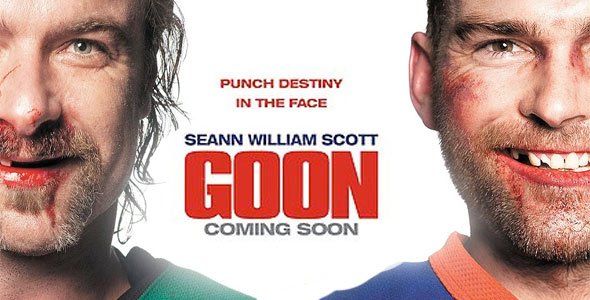
Goon


Goon is a funny, violent, vulgar, sweet, formulaic, and endearing film about a guy who finds his calling in punching other people in the mouth.

Seann William Scott plays Doug Glatt, not the sharpest arrow in the family quiver.  Dad's a doctor, Brother's a doctor, and Mother is disappointed in him.  He's athletic, he knows how to throw a punch, and he works as a bouncer.  It's honest work, sure, but nothing to brag about down at the synagogue.  Glatt is a fundamentally nice and decent guy, and there's no fulfillment in strong arming weaklings.

Everything changes when he attends a minor-league hockey game with his best friend (Jay Baruchel, the voice of Hiccup in the surprisingly good How to Train Your DragonHe wrote and directed this movie.) and finds himself standing up for his buddy when a heckled player climbs into the stands to throw a few punches.   Glatt knocks the guy out, attracts the attention of the home team's coach, and he's on his way.  Finally, he has the chance to be part of something, to work in an organization that values his talents, and to beat up worthy opponents.

From there, the film follows the structure of your basic sports story, complete with an on-ice showdown with the leagues reigning master enforcer (Liev Schreiber, proving yet again that a great actor in a small role can raise the game of an entire film.).  But thats just the structure.  The joy in this film comes from the wickedly funny writing, the spot on delivery, and the real affection it shares for the damaged people of and around minor-league hockey.

I laughed all the way through Goon, and I was delighted to learn that theres an actual Doug Glatt out there, busting heads as an officer with his local police department and, hopefully, banking his royalties from this film.  Goon was released to little fanfare, but its a winner.  Queue it up.

Friday, September 07, 2012

The Friends of Eddie Coyle

My brilliant friend Marilyn turned me on to The Friends of Eddie Coyle with this review.  She has graciously allowed me to reprint it here for you.  I second her advice:  see it and be glad.


The Friends of Eddie Coyle.  1973.  Robert Mitchum, Peter Boyle, Richard Jordan.  Directed by Peter Yates

Robert Mitchum is Eddie "Fingers" Coyle, a minor gangster in Boston's criminal underclass, whose occupation, when the film opens, is supplying guns to his friends, who are engaged in more serious illegal activities.    Coyle is also preoccupied by a  past job in New Hampshire that may get him 3 to 5 years in prison.   He has always been a stand up guy who refused to rat out his friends or partners, and he assumes those he knows and does business with--his friends--are the same.  That simple belief--that trust--what he calls "right" is,  as one viewer said, his fatal flaw, especially in the world he inhabits.    When, in desperation, he goes against it, he discovers he is on a slippery slope. 
Trust and betrayal are major themes in this film.   Based on George V. Higgins' novel, the film is a  convincing look at those, like Coyle, who matter of factly go about their every day business, which happens to be crime.    They meet in bars and parking lots and deserted gravel pits and bowling alleys and parks.  And their dialog!   It's like hearing real conversations;  it has meaning and weight, not a word rings false.   When Coyle tells a gun supplier how he got the nickname "Fingers" he is both philosopher and teacher.   As he says (paraphrased), "if you mess up, neither one of us will be able to shake hands."   And when Peter Boyle speaks allegorically about eliminating pigeons because they ruin perfectly good suits, he is pragmatic and chilling. 

Mitchum's performance as Eddie Coyle can only be described as phenomenal.  Neither tough hero nor gung ho marine, he is a baggy eyed, aging felon with his hair falling over his forehead, who is worried about  his family and trying to find a solution to his problem.   Like any small time businessman, he goes about his daily routine, moving around Boston and its environs with a kind of weary purpose.  He makes deals and phone calls, talks to his friends, meets contacts, gets drunk at a hockey game.   It's his way of life.   There are a few actors who seem so natural it's hard to believe they are acting, that they are not, in fact, the characters they portray.  Mitchum is one of them (Spencer Tracy is another).  Every gesture Mitchum makes as Eddie Coyle, every word, every look, is believable,  true, sadly real.    His Boston accent also sounds perfect...at least to this Texas ear.   Peter Boyle, too, is excellent, with his still, expressionless face, his Mona Lisa smile, his observer's passive eye.   Steven Keats is remarkable in a breakout role as the tough young gun dealer who, as it turns out, is a little too ambitious.   Then there is the too often underrated Richard Jordan, outstanding in a low key performance as Foley, whose dealings with the Boston underworld are open to question.    There are other great characters and performances in this film, in which the "Friends" of the title is both pointed and ironic. 
When I read Chuck Hogan's Prince of Thieves (a scene in that book seems to have been taken right out of this film, by the way), I was intrigued by his portrayal of Boston, which is meant to be and is another character in the book.   I looked forward to seeing The Town (the title under which PofT was filmed)  in order to see the places Hogan made so vivid.    That film was inevitably compared--not very favorably--with The Friends of Eddie Coyle, which critics say got the real Boston and its citizens--as opposed to historic Boston or touristy Boston--more nearly right than any other film.   Though I've never been to Boston, I think they must be right.    According to the DVD commentary by Peter Yates, every single scene of The Friends of Eddie Coyle was shot on location, including interior shots in banks, private homes, and a bar.   That authenticity, along with a great story/screenplay and a marvelous cast, makes this film even more compelling.   The cryptic plot, the dialog, Mitchum's performance, and Boston itself make it worth watching repeatedly.    See it and be glad. 

Wednesday, August 29, 2012

The Artist

The Artist, a surprising film from the people who brought us the outstanding comedies OSS 117: Cairo, Nest of Spies and OSS 117: Lost in Rio, gives us Jean Dujardin in the serious role of George Valentin, a star of the silent era.  Cairo co-star Bérénice Bejo plays the girl he helps, and who winds up helping him when the movies transition to sound.  It won Best Picture last year, and it’s a fine introduction to silent film for those who may feel put off by the medium.

Dujardin, Bejo; and supporting actors John Goodman, James Cromwell, Penelope Anne Miller, and the wonderful Beth Grant; provide a sense of familiarity and the comfort of modern acting technique to this mostly silent, beautifully black-and-white film.  Their casting gives us the “in” to ease our adaptation to the silent mind-set, in which we gather all we really need to know by reading the faces and all we’d like to know by reading the placards.  And the story?  Well, the story’s fine.  We enjoy Dujardin’s early triumph in the Silent Era.  We smile and thrill when Bejo hits the scene and begins her rise.  We feel Dujardin’s despair when he feels that life has passed him by.  And … well, see for yourself.

I loved this film’s celebration of the Silents, films that still have the power to entertain and move us.  I loved this film’s look and feel.  I loved its cast, I loved its story, and I loved its resolution.  I loved The Artist.  Here’s looking to more great work (and more silly comedy) from these people in the future.

Sunday, August 26, 2012

Tucker & Dale vs. Evil


My 12-yr-old has been badgering me to let him watch some classic slasher movies just so he can see what they’re all about.  I’m thinking of caving, if for no other reason than to prepare him for Tucker & Dale vs. Evil.

Tucker and Dale (Alan Tudyk and Tyler Labine) are a couple of well-meaning best friends.  They’re also hillbillies.  They dress like hillbillies, they talk like hillbillies, and they’re thrilled to be spending their vacation at their newly-purchased vacation home, a creepy cabin on a lake in the woods decorated with old news clippings of ancient horrors, wind chimes made of bone, and deadly booby traps.  Something tells me they bought the place sight unseen.

The College Kids are your stock group of College Kids off for a weekend of camping, drinking, dope, and sex.  Had they been Norwegian college kids, they’d have wound up contending with Nazi zombies in the snow.  As it is, all they have are Tucker and Dale.  When they see the two pulling one of their own into their canoe and paddling off, they assume their friend’s been abducted by evil hillbilly psychos and the fight’s on.  Tucker and Dale, of course, had simply been out fishing, saved the girl from drowning, and were taking her back to their new cabin to nurse her back to health.

And so begins a surprisingly funny, surprisingly gory horror-comedy in the vein of Evil Dead 2 and Slither.  The College Kids think they’re fighting for their lives and go about creatively killing themselves through oddball accidents, the hillbillies think they’ve stumbled upon some weird murder-suicide cult, and the recovering girl just wants to help sort things out.  By the time Actual Evil rears its ugly head and literally binds the girl in a sawmill, we’ve laughed and cringed and grooved along so happily that we’re actually sorry the climax is upon us.  The underappreciated Tudyk is just great, Labine hits all the right notes, and damsel in distress Katrina Bowden is lovely as the sweet College Kid with a surprising background.

Tucker & Dale vs. Evil is charming and gory and funny and altogether successful.  My 12-yr-old may not yet be ready for this kind of film; when he is, I look forward to sharing it with him.

Thursday, August 16, 2012

Beasts of the Southern Wild


Beasts of the Southern Wild is a refreshing, thought provoking, and wholly original film. 

Hushpuppy is six.  She lives in a place called The Bathtub, which I took to be a postapocalyptic community somewhere in the bayous of Louisiana (Its true nature is revealed later in the film, but I’ll leave that for you to discover.).  She lives in a shack about fifty feet from the shack of her father, Wink, who is definitely an alcoholic and possibly insane.  The whole place is just one big storm away from disappearing under the brackish waters of the bayou, never to return.  Legend has it that the ice caps are melting and, when they do, giant beasts called aurochs will emerge from their long sleep and consume everything in their path.

This may not sound like the setup for a beautiful and moving picture.  Yet, there it is.  Beasts of the Southern Wild is shot beautifully, even when it’s shooting scenes of squalor and fear.  The Bathtub and its population have their own shoddy dignity, and Hushpuppy carries the resourcefulness and self-possession of backwoods royalty.  She’s only six years old, and she thinks and acts like a six-year-old, but she’s a leader.

The film itself unfolds in its own time, in its own way.  There is a three-act story here, but you have to look for it.  Beasts of the Southern Wild feels more like a chronicle of time, place, and person than a plot.  As I burrowed into The Bathtub and came to understand its denizens, I came to feel at home.  As events played out in reasonable succession, I came to care about Hushpuppy and the people around her.  As the film concluded, I was almost sorry it was over.  This doesn’t imply that Beasts of the Southern Wild is a feel-good movie or that it shrinks from despair.  It’s just that the film feels true, and worthwhile, and beautiful.  Time with Beasts of the Southern Wild is time well spent.

Monday, August 13, 2012

Sherlock Holmes: A Game of Shadows


Sherlock Holmes: A Game of Shadows amounts to 129 minutes of missing Steven Moffat, Benedict Cumberbatch, and Martin Freeman.  Where the BBC’s brilliant “Sherlock” series of telefilms offers puzzling plots, delightful verbal interplay, and a sly (and often ribald) sense of humor, Sherlock Holmes: A Game of Shadows is mostly just loud.  Where “Sherlock” gives us Moriarty as a comic, twisted genius, Game of Shadows lazily offers us Moriarty as just another Bond villain.  Where “Sherlock”’s unique visual style amuses and intrigues us, Game of Shadows only makes us wonder exactly how much cocaine director Guy Ritchie blew through while shooting and editing this film.

Here’s the story: it’s about a year since the events of the first film, Sherlock HolmesHolmes and Watson reunite to bring the nefarious Professor Moriarty to justice after the villain tries to have Dr. & Mrs. Watson killed for no apparent reason.  Lots of stuff blows up.  Noomi Rapace appears because she was hot after The Girl with the Dragon Tattoo and The Girl Who Played with Fire and it seems like a good career move.  More stuff blows up, there are some fistfights, and a bunch of people get shot, all in slow motion.  The Bond villain reveals his Bond villainesque plan, and his henchman reveals a disappointing lack of sterling silver dental work.  More ‘splosions and fights and shooting, and even more slo-mo.  We reflect that Robert Downey, Jr. doesn’t look remotely like an otter.  The film draws to an utterly unsurprising conclusion.  The End.  Next.

Hey, kudos to Guy Ritchie for (a) achieving his unique and singular vision, and (b) finding a studio to underwrite his coke habit.  But Sherlock Holmes: A Game of Shadows just isn’t much fun.  It needs more wit.  It needs more style.  Aww, the heck with it: it needs Moffat, Cumberbatch, and Freeman.  They own the franchise now. 

Friday, August 10, 2012

Viva Riva!


Viva Riva! is the first Congolese film I’ve seen.  It tells the story of Riva, a small-time operator and scumbag trying to outrace a bunch of other scumbags who want his MacGuffin.

The MacGuffin, in a Congolese twist, is a tanker-truck full of stolen gasoline.  Gasoline, you see, is in short supply, and prices are only going up.  Who wants it?  Why, the criminals from whom he stole it.  Who’s going to help him keep it or sell it?  Who’s going to try to take it away?  Who’s going to win?  Sit back, ladies and gentlemen, and enjoy the show.

Your enjoyment, I think, will depend on the degree to which you sympathize with Riva.  Unfortunately, I didn’t care for him one bit.  In fact, I found him odious in nearly every way, not only for the damage he did to himself (which is his business) but for the damage he did to everyone who cared about him and all of their families.  Additionally, he wasn’t charming or invitingly evil – he was just a scumbag, with scumbag tastes and scumbag plans.  I couldn’t even root for a good guy to put him in his place, as Viva Riva! is a film about people of varying degrees of badness.

That said, this is a professional film, one that could easily have been created by a more mature national production industry.  It provides a window into life in Kinsasha that most of us would not otherwise enjoy.  It moves briskly and earns its ending.  Viva Riva! did not work for me, but you might love it.

Sunday, August 05, 2012

The Hunger Games


The Hunger Games is a ridiculous film made plausible through its singularity of vision and the brilliant casting of Jennifer Lawrence, an actress who is rocketing her way toward Can Do No Wrong (CDNW) status.

The film is a take on the conceit of Battle Royale, which was a take on The Most Dangerous Game.  In The Most Dangerous Game and all the films that copy it, people are the quarry for hunters either rich or alien, which is basically the same thing as far as the films are concerned.  In Battle Royale, contemporary Japanese high school kids are trapped on an island and must hunt one another until only one remains.  In The Hunger Games, a random selection of teenagers from the provinces of a dystopian future America are forced to fight for survival amongst themselves in a high-tech dome that happens to replicate our heroine’s home environment of Appalachia.

By backing off from Battle Royale’s unflinching brutality, The Hunger Games allows the audience to maintain a kind of distance.  We know that kids are killing kids, but Battle Royale puts the horror front and center through grisly, unsettling practical effects.  The Hunger Games, on the other hand, shows us enough to get the point across while keeping enough back to maintain its tone as a grim adventure, vice nightmare-inducing horror show.  Further, The Hunger Games creates distance through its setting in a ridiculous future, one in which the ruling class prances about in laughable costumes and makeup that we barely accept only because its members are portrayed by gifted professionals such as Stanley Tucci and Elizabeth Banks. 

It keeps the distance in check through its conviction.  The film never winks at the audience, it builds and maintains its world consistently, and it shines in the casting of its star, Jennifer Lawrence.  Lawrence, who broke out in the magnificent independent film Winter’s Bone and showed that she could hold her own with performers like Kevin Bacon and Michael Fassbender in the tentpole X-Men: First Class, brings an earthy realism and courage to her role as Katniss Everdeen, a young woman who volunteers to compete in the eponymous games in place of her younger sister.  She comes across as smart and resourceful and completely engaged, and she takes us along with her because if she buys in, why shouldn’t we?

The result is a successful film, one that creates a consistent world, populates it with interesting people, and makes us care about what happens to them.  I understand that The Hunger Games is to be the first of a franchise.  I look forward to the further adventures of Katniss Everdeen.  This film made me believe in her.   

Friday, August 03, 2012

21 Jump Street & The Best Exotic Marigold Hotel


21 JUMP STREET

Funny, exciting, and kinda sweet, 21 Jump Street is my biggest surprise of the summer.  The story’s nicely constructed and does a fine job of walking the line between schmaltzy and savvy.  Jonah Hill does a fine job, co-star Channing Tatum reveals a surprising gift for comedy, and the Third Act peril and action beats don’t overwhelm the generally light tone.


THE BEST EXOTIC MARIGOLD HOTEL

The Best Exotic Marigold Hotel is basically BBC porn.  It puts together beloved actors from the British drama scene, gives them arcs that reward our love for them, and pays it all off with a tear-jerking finale that sends us out the door with smiles on our faces.

I mean, look: we’re talking about a feel-good movie starring Bill Nighy, Judi Dench, Tom Wilkinson, Maggie Smith, Penelope Wilton, etc, plus Dev Patel as the eponymous hotel’s part-owner and manager.  These are all people we’re happy to spend time with for an hour and a half, and they’re happy to make us laugh, cry, and feel like we’re getting our money’s worth.  I know I did.

Monday, July 30, 2012

Three Noirs


Odds Against Tomorrow is a heist movie, a noir movie, and a racial parable all wrapped up in one.  Ed Begley is the disgraced former NYPD detective.  Robert Ryan is the hard-bitten ex-con who’d prefer to stay clean, but doesn’t mind a little dirt.  Harry Belafonte is the degenerate gambler who owes a lot of money to some very bad people.

Begley works out the score and recruits his accomplices, but there’s a problem: yan is a vocal racist and won’t trust Belafonte.  How will they work together when things inevitably veer off plan?

It’s a great premise, but it suffers in execution.  The film spends all but the last fifteen minutes setting up the characters and heist, but this leaves very little time for nuance when things go wrong.  I’d have appreciated more time in the crime, more reversals and counter-reversals.  As it was, I could see right off how things were going to go, and after that it was just waiting for the gears to turn.  I wanted to love Odds Against Tomorrow, but I found myself spending most of the film wishing it’d hurry up and the last few minutes wishing it would slow down.  Ah, well.
...
In Crime Wave, Gene Nelson is an ex-con trying to stay clean.  Ted de Corsia and a young Charles Bronson (as Charles Buchinsky) are escaped cons looking for a hideout and a big score.  Sterling Hayden is the police lieutenant out to get them all.  This is film noir, so there’s no telling what’s going to happen.

While Crime Wave counts as minor noir (Definition: anything I haven’t heard of before a friend turns me on to it), it’s successful.  Filmed almost entirely on location in ‘50s Los Angeles, it takes us to a place we can never (re)visit and makes us feel at home.  It gives us menacing villains, conflicted, heroes, and hard-boiled cops, and it puts them in a story with enough tension and surprise to keep us on edge and delight us to the end.

Crime Wave is a B-side to films like The Maltese Falcon and Out of the Past, but it’s a solid B-side.  If you have a hankering for a new noir, Crime Wave will scratch the itch nicely.
...
Decoy comes as part of a double bill on the same DVD as Crime Wave.  Unlike Crime Wave, which is tense and rewarding, Decoy is dull.

Here’s the deal: some guy in a suit shoots a dame.  Why?  Hey, why not?  It’s ‘50s: everybody wears a suit.  The film goes on to tell us why he shot the dame, but we don’t really care.  Why not?  Because we don’t care about the dame.  Sure, she’s good-looking enough, but she lacks that star quality, that indefinable something that makes us wonder what she’s thinking and what she’s going to think about next, that the part requires.

Sure, there’s another hard-boiled cop (Sheldon Leonard, hamming it up), an innocent, a devilish plot, and perhaps the most fatale femme in the history of the genre.  But the cop’s a jerk, the innocent is a terrible actor, the plot is simplistic, and the femme makes you wonder if she got the part by sleeping with somebody (right up ‘til you learn that she was married to the director).

Ultimately, Decoy just isn’t very good, and that’s too bad.  I was all set to like it.


Wednesday, July 25, 2012

Yankee Doodle Dandy


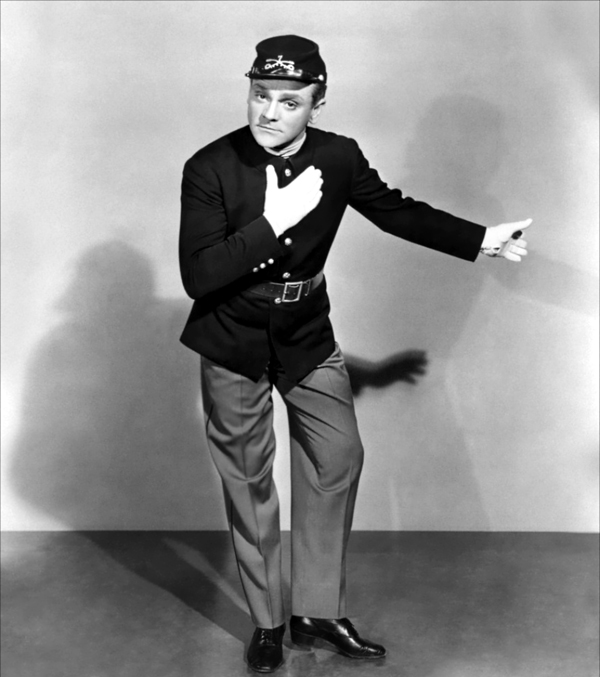
Yankee Doodle Dandy is one of the best movies ever made.  Not greatest, mind you: as far as I know, it didn’t do much to change or advance the medium of film.  But it’s one of the best because it’s so energetic, so ebullient, so flag-wavingly patriotic, and so much fun that you can’t help but love it.

James Cagney plays George M. Cohan, a man who grew up performing with his family in vaudeville.  As he matured, he developed into a pillar of the Broadway scene.  He wrote, produced, and starred in hit after hit, and he penned canonical American music such as “Give My Regards to Broadway,” “Yankee Doodle Dandy,” and “Over There.”  As the film tells it, he was also a swell guy.

This is a musical biography long on production numbers and Horatio Alger allusions, and it works due to Cagney’s effervescence.  And here’s the amazing thing: prior to this film, Cagney had been known as a ‘tough guy’ actor, with hits such as The Roaring Twenties and Angels with Dirty Faces.  When he sang and danced and mugged his way across the screen, audiences were as amazed as we would be if Jason Statham revealed that he’s been studying tap for the last twenty years and has the moves to prove it.  The film won Cagney an Academy Award for Best Actor and, though he went on to play tough guys once more in classics like White Heat, it changed Hollywood’s view of him forever.

But that’s neither here nor there.  For us, Yankee Doodle Dandy offers a delightful story, characters we can get behind, and production numbers we can remember for years to come.  As an added bonus, it has such a great ending that it motivates us to be better than ourselves.

This is a wonderful film.  If you haven’t, you owe it to yourself to see Yankee Doodle Dandy.

Sunday, July 15, 2012

Red Tails


Red Tails tells the combat story of the 332nd Fighter Group, an Army Air Corps unit notable for the fact that its pilots were graduates of the Tuskegee Airmen program.  It was an all-black unit assigned, initially, to undemanding flying well back from the fight in the European theater.  The film dramatizes their commanding officer’s fight to get them in the war, and it lauds their remarkable success once he succeeded.  It’s a great story and one worth reading.  Unfortunately, Red Tails isn’t a particularly good film.

Even though Red Tails looks professional and its air combat sequences are sure to thrill anyone with an interest in that sort of thing, the film simply can’t overcome its leaden screenplay and one-note performances.  Its villains, American and German, are ridiculous stereotypes who induce more groans than fist-shaking.  Its heroes end the film no more heroic than they began it.  Everyone speaks dialogue so clunky that we spend half the running time wondering how much better the film could have been with a first-class screenwriter.  Nobody changes, nobody grows.  A bunch of stuff happens to a bunch of good guys.  At the end of the film, they’re just a bunch of good guys who went through a lot of stuff.

This is a shame, really, because Red Tails is such a labor of love.  Producer George Lucas worked for years to get this film made, finally fronting his own money to pay for its production and distribution.  Some shots in the film are direct recreations of archive photos of the 332nd.  This film clearly worships them men it depicts but, by presenting them so unidimensionally, it short-serves them.

I wanted to like Red Tails.  I’ll probably show it to my boys and I hope they love it.  But its characters aren’t rich enough, its story not complex enough to do justice to the real-life heroes it lionizes.  Too bad.

Friday, July 06, 2012

Cell 211


Cell 211 is a Spanish thriller about a young man in an impossible situation.  Though unpredictable, it’s also a movie that makes sense.  Nothing happens without a reason, decisions flow from prior decisions, and characters behave consistently with their backgrounds and circumstances.  It’s a tense film, one that kept me engaged and trying to outthink it throughout its running time.  I enjoyed the heck out of it.

Here’s the story: Juan is a young man with a family who is on a tour of a local prison prior to his first day of work there as a guard.  Unexpectedly, he finds himself in the middle of a riot and passes himself off as a new inmate, one assigned to Cell 211.  What follows is an hour and a half of Juan trying to survive, prison authorities trying to find a way to both get him out and end the riot, and the prisoners’ leader weighing how much he can trust the new guy while negotiating an improvement in prison conditions.

The leader is a vicious killer, but he’s smart and adaptable.  Thus, the tension: how long can Juan keep him fooled?  How far is he willing to go to maintain his act?  What’s going to happen next?

Tension mounts without straining our credulity and without resorting to deux ex machinas.  The film has a careful eye for group dynamics on both sides of the bars.  By the end, we’re no longer entirely sure what anyone stands for, and the lines between good and bad have been blurred without resort to treacle or silliness.  And we bite our nails, then bite some more.  Cell 211 isn’t going to change your life.  It isn’t going to move you in the manner of a Kinyarwanda.  But it will grip you and entertain you and leave you shaken.  I'll take that any time.

Tuesday, July 03, 2012

Kinyarwanda


Kinyarwanda ranks among the best films I’ve seen this year.

This is a film about the Rwandan genocide.  Unlike the fine Hotel Rwanda, which uses the story of one courageous man as a device to explore the horror, Kinyarwanda tells overlapping and intersecting stories about people on all sides of the genocide.  And unlike CrashKinyarwanda handles its transitions and reveals with delicacy and grace.  Like Munyurangabo, this is a film that rewards repeat viewing, though it’s so heartbreaking that I understand should anyone wish to forego the experience.

It’s easy to write a page about the failings of a film like John Carter, but it’s hard to write more than a few paragraphs about a film like this.  I can only tell you that it’s perfect and that it moved me.  I can only press it into your hands, implore you to overcome your hesitation if it isn’t “your kind of movie,” and ask you to trust me.  Kinyarwanda is powerful and brilliant and entirely successful in every way.  Trust me.

Saturday, June 30, 2012

John Carter


I was all set to give John Carter a fair shot.  I like and respect the previous work of its director, Andrew Stanton, I’m always up for a science fiction adventure, and the love interest is pretty.  For its part, John Carter did its best to wow me.  It had all the elements of an exciting story, it introduced cool creatures and civilizations, and it ended in a rousing battle of good vs. evil.  Unfortunately, the film felt flat.  It put me off right at the beginning, and I never could bring myself to invest in what was happening onscreen.

John Carter begins with two false starts.  They make sense by the time the closing credits roll, but they made me hesitate to commit once the main story got underway.  Once the story does get moving, we’re introduced to the eponymous Carter, realize it’s a year or two after the close of the Civil War, and learn that Carter was a Confederate cavalry officer in that war.  Judging by his conduct toward the U.S. Army officer who wants his help for something, we gather that he has a deep hatred for the Union and the soldiers who fought for it.

Ok, you lost me right there.  The Confederate cause, which they labeled “states’ rights,” was actually the right of states not only to choose to enslave human beings, but to extend the Peculiar Institution to newly chartered states and territories.  Screw anyone and everyone who was on board with that program.  [Personal aside #1: I have children in Florida public schools.  The Ellermann family position on the Civil War does not go over well.]  [Personal aside #2: I can’t wait to leave.]  John Carter didn’t bother to give its protagonist exculpatory dialogue, so I began the story in opposition to him.  When he finds himself on Mars and clapped into chains, I thought, “Serves him right.”

Dominic West, whom everyone who has seen ‘The Wire’ thinks is a great guy, plays the antagonist.  He’s a Martian warlord who’s supposed to be really evil, but is no more evil than any number of other conquerors in history.  Had John Carter allowed him to Rickman it up and have some fun, we might have enjoyed him.  He plays the material straight, however, which made our only grounds for opposition the fact that he meant to unify his planet. 

Unfortunately, I never had a reason to oppose his conquest beyond a general sense of “conquest is bad.”  The “good guy” city-state, led by the great Ciaran Hinds and represented by the remarkably attractive Lynn Collins, didn’t show me why it was better than Westville.  In fact, it was led by a moron and had a princess who was willing to sacrifice untold numbers of her subjects’ lives to avoid marrying someone she didn’t like because “that’s no way to live.”  Sure thing, lady.  Tell it to the widows and orphans of the men you sacrificed on the altar of your quality of life.  The other sentient race we met, which also feared Western domination, was brutish and nasty and could have used a little Baltimore justice.

And away we go, I guess.  John Carter does a fish-out-of water thing when Carter first arrives on the planet, then kicks over to a reluctant hero narrative with space monsters and a princess whose costume design could have used a little more Frazetta and little less drapery.  It has sword fights and laser beams and betrayals and heroics and all the hallmarks of a grand adventure, but I never had a dog in the fight.

I’ve seen Stanton run rings around stories like this in Toy Story, Finding Nemo, and WALL-E. Next time around, here’s hoping he returns to form and gives us heroes we can root for, villains we can love to hate, an adventure we can get into, and some depth of meaning.  Unfortunately, John Carter simply does not deliver.

Friday, June 29, 2012

Tigerland


Tigerland is your mark one, mod zero movie about a rebellious military draftee sticking it to The Man.  Unlike Catch-22, which has something to say about the arbitrary nature of life and death or M*A*S*H, which is laugh-out-loud funny, Tigerland only succeeds in showcasing a petulant jerk and trying to make a hero of him.

Colin Farrell plays the jerk, a Vietnam-era draftee trying his best to fail out of infantry school.  He’s amused to find himself in the middle of a “platoon movie,” complete with earnest writer, redneck sociopath, doo-wop group, reluctant hero, and even good- and bad-guy sergeants (As with most platoon movies, Tigerland is actually about a squad.  Platoons consist of 36 people, squads 12.  36 characters are just too many for most films to handle.). He intentionally misses targets on the range.  He sabotages equipment.  He undermines his unit’s training at every opportunity.  Of course, he’s a natural soldier and a brilliant leader and could save lives in country if only he’d apply himself.  I was supposed to root for him.  Instead, I spent the film thinking, “I’m sure glad we don’t have a draft any more.”

See, the problem with a draft is that it forces a military organization to deal with people who don’t want to be there.  It’s hard enough to train, motivate, and discipline volunteers.  Once you have to waste time corralling troublemakers you can’t simply release for fear of opening a floodgate of calculated insubordination, you can’t get that time back for teaching your people they skills they need to survive and execute your mission.

So I never bought into the movie.  I didn’t accept its “screw the Army” ethos.  I didn’t believe in its characters any more than it did (The Reluctant Hero actually says, “What do you think I am, the Reluctant Hero?” I rolled my eyes.).  I spent more time ruminating on the draft than I did caught up in the narrative.  Tigerland just did not work for me.

Friday, June 22, 2012

Prometheus


I have mixed feelings about Prometheus.  I love its look, its feel, its ambition.  I appreciate its casting of serious, high-quality actors.  However, its screenplay needed a few more passes before it was ready to go into production.

Prometheus weds a big budget to a high concept.  Its sets are magnificent, its world dazzling.  I saw this film in 3-D, mostly because an old friend of mine was one of the camera techs, and the effects were more immersive than distracting.  Add the casting of proven performers like Charlize Theron, Idris Elba, Michael Fassbender, and Guy Pearce, and this looks and feels like elite work.  The concept, well, we’re talking about finding the origin of human life on Earth, and the film’s characters have the kind of existential questions director Ridley Scott tackled in his classic Blade Runner: “Where do we come from?  Why are we here?  Why can’t we have more time?”  While we have mixed feelings about the answers the film provides or withholds, we have to credit the production with going after them.

Prometheus gets so many things right that it’s a shame the picture can’t keep our suspension of disbelief alive.  As the audience in a science fiction movie, we walk in willing to believe in technologies that defy the known laws of physics.  We can’t, however, believe in people that don’t act like people or in organisms that can, say, grow without eating.

One of the great things about Ridley Scott’s Alien was that it took things a while to get going.  We go to know the crew of the Nostromo not by having them stand up and recite their bios, but just by following them around for a while.  Once we knew them, we cared about them and believed in their story.  Prometheus gives us an implausible roll call followed by a mission briefing PowerPoint set after the ship has reached its destination, and –bang- we’re into the action.  We in the audience are left thinking, “Really?  These people are just now meeting each other for the first time?  Did they not chat while they were loading their stuff aboard back on Earth?  Oh, and how is it possible that any scientist would sign up for a long, potentially career-derailing, mission without knowing what’s involved?”  So we’re left with thumbnail sketches:  there are Redshirt One, Redshirt Two, Redshirt Three, and Redshirt Four, plus the actors whom we recognize.  Once they’re on Planet Danger, they begin acting in ways that violate even what little we do know about them: the biologist who signed up for a space journey freaks out at the prospect of alien life, then actually tries to pet a scary space-snake.  The geologist runs away from someplace he finds terrifying, only to seek refuge in the exact same place for no real reason.  These examples come right off the top of my head, and the more I think the more I recall.  How can I believe in the plight of these people if I don’t believe they’re people?   (Note: Michael Fassbender’s android character is the most consistent and fully realized of the bunch.  It’s possible that the film’s saying the android is more human than the humans, but that’s the kind of thing you think of later.  While you’re watching the film, you’re thinking, “This doesn’t make sense.”  From there, it’s a short step to “I call BS.”)  And then there’s the funky biology: creatures in this universe appear to have the ability to metabolize thin air.  Humans in this universe can undergo massively invasive abdominal surgery, then run, climb, fight, and singlehandedly rappel fifty feet without tearing open the wound and bleeding out.  And the list goes on.

And that’s the thing about Prometheus.  Those big ideas?  They’re really cool.  That art direction?  That set, costume, and creature design?  Really really cool.  The performances?  The world-class cast acts the heck out of the material, and Michael Fassbender continues his steady march toward Can Do No Wrong status.

But the writing isn’t there.  The characters feel like characters, and the revelations provide more WTH moments than “Oh, wow!” moments.  Prometheus excels at all the “elite filmmaking” stuff, but it stumbles on the fundamentals.  This could have been a great, fascinating, entertaining and wonderful classic that melded the best of Alien and Blade Runner into a rousing, challenging, enriching whole.  Instead, it’s a beautiful failure.  I wanted to love Prometheus.  I was ready to love Prometheus.  I couldn’t love Prometheus.

Sunday, June 17, 2012

Gamera: Attack of Legion


Here's another one from my 12-yr-old, Ian:


This movie was a successful sequel to Gamera: Guardian Of The Universe.  Some slight CGI was used, but the monsters were still classic guys in suits or string puppets. Unlike Gamera: Guardian Of The Universe, this movie did not bore me with dialogue, and has a good balance between action and talking.

I liked this movie as much as I liked Gamera vs. Guiron. Godzilla movies without too much dialogue are rare and think Gamera fits into the Godzilla genre. So rent this, grab a soda, and enjoy.

Tuesday, June 12, 2012

Edward James Olmos Double Feature!


The Green Hornet is one of those movies in which the villain shoots his right-hand man for no good reason, only to have his second-tier henchmen drag the body away and charge into battle.  You've got to wonder how that works.  I mean, let's say you're a henchman.  You're talking to your headhunter and weighing competing offers from Hank Scorpio and the villain from this movie.  Scorpio offers a free dental plan and contributes to your 401(k).  This guy offers you a speedy climb up the ladder, followed by a quick and violent death if you happen to catch him on a bad day.  I don't know about you, but I'm going with Scorpio.

The worst thing about this villain is that we've seen so many like him.  Yes, The Green Hornet is an action-comedy, so he's made silly (and Christoph Waltz sells the material), but he's just lazily written, as are the other villains, the heroes, and even Edward James Olmos as Gravitas Guy.  In fact, the whole thing feels lazy and shambling, including the car chases and the ‘splosions.  I did enjoy how The Green Hornet paints its star as an unrelenting doofus and his sidekick, Kato, as the bright and competent one, but even that joke got boring after the first fifteen iterations.

Now, Blade Runner, on the other hand: there's a movie.  A sci-fi noir, it offers an intriguing vision of the future, tackles big questions, and creates sufficient ambiguity for thirty years' worth of conversations.

Blade Runner takes place in Los Angeles, 2019 (!).  It's January or February because it's raining, it gets dark early, and its characters can get away with wearing trench coats when they want to look cool.  In this future, short-lived artificial humans known as "replicants" serve as slave labor in the offworld colonies.  Sometimes, they escape and make their way back to Earth.  Harrison Ford plays Rick Deckard, the titular Blade Runner.  His job is to hunt down runaway replicants and kill them.  Roy Batty (Rutger Hauer) is a replicant, but he's stronger, faster, smarter than most.  He's angry because he feels that he was created only to suffer and die.  He wants to face his Creator.  He wants to beg for more years.  He wants to know why he was made.  He wants to lash out.

Even with the unavoidable anachronisms of an older science-fiction property, Blade Runner's world looks and feels futuristic enough to entice the imagination.  There might be slavery on the offworld colonies, but at least there are offworld colonies.  The clothes look different from contemporary fashion, yet they still look like clothes actual people might wear.  Best of all (and like Scott's classic Alien), we can imagine actually living in this world.  We can imagine what it smells like, sounds like. Yes, Blade Runner has flying cars.  But they make sense, and they belong.  [Note: here's a neat little appreciation for Blade Runner's F/X work from Popular Mechanics.]  

The best science fiction, of course, is philosophy or social criticism made up to look like a genre tale.  Blade Runner is more the former, and how.  It's an existential shout at God, asking, "Why am I here?  Why is life so short?  Why do we suffer?"  It mourns the idea of death.  Read Roy Batty's dying words:  "I've seen things you people wouldn't believe. Attack ships on fire off the shoulder of Orion. I watched c-beams glitter in the dark near the Tannhäuser Gate. All those moments will be lost in time, like tears in rain."  Who hasn't despaired in the face of the transience of beauty, of the fleeting nature of joy?  'Of course there's an afterlife,' we tell ourselves.  'Otherwise, all of this would go to waste.'  But if there isn't, oh, oh.

Of course, I'm a guy who welcomes seeing a film as an invitation to explore 2500 years of Western philosophical tradition; but I get that I'm in the minority.  Blade Runner also offers something for people who just like a good mystery.  First, there's the mystery that drives the plot as we're actually sitting in the chair: who are the replicants, where are they, and what do they want?  For coffee afterward, the film leaves open the question of Deckard's identity.  He might be a replicant.  His memories, his history might be implanted.  This ambiguity is baked into the film: Ford says he thought Deckard was human, while director Ridley Scott thought otherwise.  On a related note, what does the Edward James Olmos character know, what does he think about it, and what will he do?  This is chewy, fun stuff: the kind of material that's fuelled many a late-night bull session over the years.

To sum up, Blade Runner is a classic, a masterpiece.  Even if Ridley Scott hadn't made Alien or Thelma and Louise or Black Hawk Down, we'd know his name for this film alone.  Even if you've seen it, even if you love it, it'll be worth your time to see it again.