Saturday, October 30, 2010

Leaves of Grass

Tim Blake Nelson’s Leaves of Grass is a funny and sad and phenomenal. I enjoyed almost every minute of it, with one glaring exception.

Here’s the setup: Edward Norton plays identical (genius) twins. The protagonist twin got out of rural Oklahoma, dropped his accent, and “made it” as an academic philosopher at Brown University. The other stayed in his hometown, revolutionized hydroponic marijuana cultivation, and became, in the good twin’s words, “a criminal and all-around fuckup.”

As you may imagine, Good Twin hasn’t been ‘round in a very long time.

But events conspire to bring Good Twin back to Oklahoma and, before you know it, you’re in Doc Hollywood territory. Surely, the down home charms of country folk will speak to GT’s soul. Surely, a little twang will find its way back into his voice. Surely, there’s an Oklahoma Dreamgirl just waiting to steal his heart.

And that’s where the film puts a foot wrong. Keri Russel, as the Oklahoma Dreamgirl, doesn’t sell her part. She’s a poet who moved back to the small town because that’s the kind of thing that poets do. But every time she recites, she sounds like a woman reciting poetry and expecting you to dig it because, well, it’s poetry. She’s a poet who talks of passionate living, but brings no passion to her delivery of her life’s work. She yanked me right out of the movie.

But that’s it. That’s the one fly in the ointment. If you can overlook Russel’s performance, you get to enjoy Tim Blake Nelson as a henchman with a heart of gold, Richard Dreyfuss as a bloviating drug kingpin, Susan Sarandon as a mom who thought being a cool mom was all it took, and even The Wire’s Steve Earle as a Very Bad Man.

Will it speak to you? I don’t know. I do know that Tim Blake Nelson is a serious talent, able to bring rural America to life without trivializing it or condescending to it. I look forward to seeing what he does next.

Thursday, October 21, 2010

Bad Day at Black Rock


Bad Day at Black Rock is the best western I’ve seen in ages.

It’s the 1950s.  A one-armed man (Spencer Tracy) gets off a train in Black Rock, a dusty town somewhere in the Mojave Desert.  It’s the first time anyone’s gotten off the train in Black Rock for years, and people there don’t cotton to strangers.  Lee Marvin doesn’t like him.  Ernest Borgnine doesn’t like him.  Robert Ryan doesn’t like him.  They invite him to leave.  He declines.  And away we go.

Bad Day at Black Rock succeeds because it’s a slow burn.  It works a quiet tension between Tracy and the people of the town, one that winds more and more tightly as Tracy penetrates to the town’s mysteries, learns just why he’s not wanted.  As the film progresses and we learn more about Tracy and Black Rock, we find ourselves shutting out our world and plunging into its.  The film is so immersive, so fascinating, so tense that we lose track of time.  It’s brilliant.

There’s more going on here than another good thriller, however.  Nevertheless, I’m going to keep mum about it.  If you don’t know Black Rock’s secrets, I don’t want to give you a hint.  If you do, well then, you know.

Tuesday, October 19, 2010

Ripley's Game

John Malkovich is an absolutely outstanding Tom Ripley in Ripley’s Game.

Thirty, maybe forty years on from the unsure young Tom Ripley of The Talented Mr. Ripley, this Ripley is a man in full. He lives the live to which he aspired in Talented: a fabulous Italian villa, a sophisticated and respected lover, and all the amenities of the arriviste American in Europe. Here’s a man who has long since made peace with his sociopathy. He is who he is, and he won’t cause you any trouble - unless you piss him off.

This Ripley still improvises. He still trusts to Providence. He’s just been doing it so long and been lucky so long that he’s become a master. But he’s still a fraud, and John Malkovich captures this sense of the classy, smooth operator who, in some vague way, is not quite right. We’re never comfortable around Malkovich, and we’re never comfortable around Ripley. Even when he seems to be on our side, we’re pretty sure he’s on his own side and that’s that.

So when he gets down to work and the dominos begin to fall, it’s ever so much wicked fun to watch Ripley be Ripley. Here’s a guy who starts someplace beyond where everyone else stops, a guy so secure and powerful in his sense of self that we can’t help but root for him and glide along with him. If you enjoyed Matt Damon in Talented, I think you’ll love this older, wiser, colder iteration of the character in Ripley’s Game. It’s a great role, Malkovich is great it in it, and Ripley’s Game is a whole lot of wicked fun.

Sunday, October 17, 2010

The Diving Bell and the Butterfly

Now we’re talking.

In THE DIVING BELL AND THE BUTTERFLY, we meet a man with Locked In Syndrome. A stroke has taken away his ability to move, his ability to speak, his ability to feel. He can communicate by blinking one eye. That’s it.

So how do you make a movie about an immobile mute? You tell the story of his book, which he wrote with the assistance of the world’s most patient woman. She spieled off the letters of the alphabet in most – to – least – common order, and he blinked when she got to the one he needed next. Sometimes she’d leap ahead and guess, and he’d tell her when she guessed correctly by blinking twice for yes and once for no.

Sounds uplifting, right? Well, here’s the thing: Jean-Do (played by Bond Movie Villain Mathieu Amalric) is too self-aware for uplift. He was something of a shit before the stroke that stole his life away, and he realizes that he’s still something of a shit (though a more pathetic shit) after this enormous change. And that, boys and girls, is the difference between world-class cinema and the Hallmark Channel.

His shittiness makes him an interesting character. It makes us wonder how he’ll react in a given situation, either in the current moment or in flashback to an earlier, normal, time in his life. It makes us grieve over some of his choices and glory in others, which leads us to consider our own choices and the ways in which we respond to the challenges, temptations, and duties of life. THE DIVING BELL AND THE BUTTERFLY may be about Jean-Do (a real man and former editor of Elle magazine), but it’s also about us.

And that’s why it’s the good stuff.

Friday, October 15, 2010

Kingdom of Heaven

In KINGDOM OF HEAVEN, Ridley Scott gives us the evolution of an anachronistic humanist, one who learns not only that selfish, cruel, cowardly greedy, and vile Christians are no match for noble Muslims, but that Christianity and Islam pale in significance next to humanism, which he apparently discovers. KINGDOM OF HEAVEN, while posing as a historical epic, is actually a time-travel movie: what would happen if a man with a thoroughly early-21st-century outlook found himself charged with defending 12th-century Jerusalem?

Fine – it’s anachronistic. But is it any good? Well, it is nicely costumed and decorated, the actors generally hit their marks, and it’s always nice to see Jeremy Irons get a big-budget paycheck. But I just couldn’t get past the film’s hamhandedness, it’s chronocentric love of modern ideologies, its near-total lack of shading or complexity in the creation of its characters. This isn’t a movie – it’s a puppet show. What a disappointment.

Wednesday, October 13, 2010

Alice Doesn't Live Here Anymore


Ellen Burstyn is an amazing actress.  In ALICE DOESN’T LIVE HERE ANYMORE, she creates a title character so true to life that I actually forgot I was watching a movie. Alice’s fears, her frustrations, her hopes, and her development are the film; and Burstyn never puts a foot wrong through two full hours of running time.

Honestly, that about sums up my entire reaction to the film.  Harvey Keitel, Kris Kristofferson, and even a young Jodie Foster appear in this early Scorsese film, but they’re already fading in memory next to Burstyn’s extraordinary performance.  In her way, she’s every parent that ever was.  See this film for her, and be glad.

Tuesday, October 12, 2010

Red Cliff

Wow. John Woo knocks it out of the park with the film he returned to China to make. Red Cliff is fantastic.

With Red Cliff, Woo adapts part of the Chinese epic novel ­Romance of the Three Kingdoms to tell the tale of the Battle of Red Cliff. What’s the Battle of Red Cliff? Well, I’m glad you asked.

Around 200 AD, the Emperor of China had nearly consolidated his hold on the country. Through his general and prime minister, Cao Cao, he’d subjugated all but two of the regional warlords. That’s one way of looking at it – another perspective, that of the film, paints a rapacious prime minister manipulating a young emperor and warring for personal vendetta and personal gain, enslaving all but two noble houses and besmirching the emperor’s good name. Whatever your perspective, the fact remains that the emperor’s forces attacked the armies of Zhou Yu and Sun Quan at Red Cliff, a nearly impregnable redoubt fronted by river and backed by impassable terrain. The battle, fought on land and on water, incorporated every facet of warfare: tactical and strategic thinking, personal bravery, special warfare, technological innovation, information superiority, and plain luck. In short, the Battle of Red Cliff is stuff of which epics are made.

And John Woo is just the man to make it. Woo brought Hong Kong cinema to the world stage (Really, if you haven’t seen Hard Boiled, your life has no meaning.). He came to the US and made action pictures of variable quality, but he’s found his soul again in his native land. Woo knows how to do more than make doves fly: he can direct action, he can make dialogue fascinating, and he can create and convey the unique Chinese-ness of the Romance of the Three Kingdoms and the people and era he portrays.

One gets the sense that this was something of a Chinese national project: Tony Leung Chiu Wai, perhaps China’s finest film actor (Bullet in the Head, In the Mood for Love, Infernal Affairs (the superior original to Scorsese’s The Departed), 2046, Hero, and many more) plays Zhou Yu. Major Chinese pop star and increasingly respectable young actor Takeshi Kaneshiro (House of Flying Daggers, Chungking Express, Returner) plays Zhuge Liange, the strategist who ultimately brings down Cao Cao. Fengyi Zhang (Farewell My Concubine) plays Cao Cao, Chen Chang (Crouching Tiger, Hidden Dragon; 2046) plays Sun Quan, and Vicki Zhao (So Close, perhaps the single greatest movie ever made) convinces us as an unlikely spy who creates perhaps the most interesting way to smuggle information ever. This is the Chinese A-list, brought together by Woo to recreate a moment in Chinese cultural history on par with the West’s siege of Troy.

And this director, these actors, sell every minute of it. Every negotiation, every planning session, every battle, every note sings with the richness of Chinese history and the driving fascination of compelling narrative. Red Cliff is a long, long film, yet I lost track of time while watching it and, when called away, marked the time until I could return to it. Red Cliff is amazing. It’s the best thing John Woo has ever done. I hope he never comes back to America.

Friday, October 08, 2010

Blow-Up


Blow-Up.  It’s a classic, an Antonioni about a man trapped in a listless existence that must’ve seemed cool when he chose to get into it; a man who comes fully, completely alive when he photographs the wrong people at the wrong time and, with his keen eye, sees something he should not have seen.

Look, we’re talking about Antonioni here, so the composition’s phenomenal and the story works.  But that’s not what interested me in viewing Blow-Up.  In a film about a photographer and the photographer’s eye, I found the soundscapes most interesting. 

Blow-Up doesn’t feature a music-as-wallpaper soundscape.  Rather, it opts for ambient noise.  For long stretches, this translates to almost no noise at all, as much of the action takes place inside the photographer’s head.  He thinks, he works, he plays, he thinks some more, and we don’t need symphonic strings to keep us occupies as he’s about it.  There’s enough there for us in the film’s compelling questions: did he see what he thought he saw?  Does it matter?  What does it mean, and what does it mean in the context of his life as we’ve seen it thus far?

Blow-Up trusts itself, its story, and craftsmanship enough to refrain from overwhelming us.  It trusts its audience to keep up, even when there may not appear to be all that much with which to keep up.  It thinks, and works, it plays, it thinks some more, and it expects us to do so, as well.

But does it work?  Well, yes.  Blow-Up pulls us into its world and wraps us up in its central mystery, all while giving the eye plenty to enjoy and the mind plenty to chew.  This Antonioni guy – I think he knew what he was about.

Friday, October 01, 2010

Adam

In Adam, a boy meets a girl.  He loses her.  Maybe he gets her back.  We’ve seen this before.  But this film has an angle.

Adam has Asperger’s syndrome.  Asperger’s is a kind of high-level autism that manifests itself, among other ways, through an inability to intuit the emotions of others.  In fact, the world of social interaction, all those little gestures and words that most people intuitively understand and navigate, mystifies Asperger’s people.  Asperger’s people tend to perseverate on a subject, boring deeply into an area of interest and thinking and talking about it to the exclusion of nearly all else, which can bore the hell out of those without it – and Asperger’s people can’t read the signs of boredom.  Asperger’s people generally don’t lie; they eschew nuance; and there’s something about the unique way their brains are wired that often leads to genius.  Many think Mozart, as well as Edison and Einstein and Doc Brown, had Asperger’s.  My ten-year-old son has Asperger’s. 

Adam’s eponymous protagonist has a more serious case of the syndrome than my son.  Where my son comes across as a particularly bright, though socially awkward and verbose, kid; Adam (as assayed by English actor Hugh Dancy) experiences Asperger’s as a crippling affliction that limits his ability to work, to make friends, to deal with any kind change to his routine and sense of order.  In Dancy’s performance, I saw a magnified version of my son: his perseverations, his struggles with behaviors like smiling and making eye contact, his inability to glide along when the conversation turns to topics he finds uninteresting.

I’m telling you all this to explain why I cannot evaluate Adam as a work of narrative cinema.  The subject matter’s too close to my heart.  The star’s performance evoked too much of my son.  See, I want my boy to find love, to find his place in the world, and I transferred that desire to Adam’s title character.  I was so completely on this guy’s side from nearly the first frame, so happy to see him develop, so heartbroken when he encountered obstacles, so in the moment, that I can only tell you that Dancy nails Asperger’s.  I’m going to recommend this film to my wife, and I’ll recommend it to you if you know someone with Asperger’s (or if you have it, yourself).  Adam may very well be a pedestrian romantic film about an Asperger’s guy and a “normal” girl trying to make a relationship work.  But if the angle speaks to you, you’ll love it.

I did.

Wednesday, September 29, 2010

A Hard Day's Night

I hated this movie.

There are two kinds of people in this world: Beatles people and Stones people.  I'm a Stones guy.  Nevertheless, I tried to approach the film with an open mind, and it rewarded me with one of the best opening sequences I’ve ever seen: the band members outrunning and outwitting a mob of fans on the streets of London, set to the film’s title song.

The opening sequence ends all to quickly, however, and before you know it these guys are talking. Here’s when you know what you’re really in for: bad actors mouthing bad dialogue, with the occasional musical interlude. There’s supposed to be some comedy, but it mostly comes off as mean spirited. There’s supposed to be some semblance of a story, but it’s so simple that I wonder why they even bothered. I think it’s supposed to make us like John, Paul, George, and Ringo, but the quartet come off as spoiled brats who need a good kick in the ass.

Then again, perhaps I’m being unfair. A Hard Day’s Night isn’t a film: it’s a marketing vehicle for the teenaged girl demographic. Since I’m neither teenaged nor a girl, I don’t think there’s any way I could have enjoyed it.

Whatever. All I know is, I’m still not a Beatles guy.

Friday, September 24, 2010

Harry Brown


I think the world of Michael Caine.  From Alfie to Jaws 3: The Revenge to Cider House Rules to Inception, the actor has created a body of work best defined by the word “work.”  Highbrow, lowbrow, and everywhere in between, Caine brings his A game to each role.  I respect that kind of work ethic.  I respect Michael Caine.

So what a pleasure to see Harry Brown, a vigilante thriller starring Caine as one of the best doggone actors ever to pick up a fake Glock and take the fight to the hoodlums blighting his neighborhood.  What a pleasure to watch Caine act the hell out of his character’s loneliness, his pain, his fear, his anger, his resolve.  What a pleasure to find the cop and buddy roles filled by Emily Mortimer (Transsiberian) and David Bradley (Argus Finch in the Harry Potter films).  The professionalism, the integrity Caine and his fellows bring to their roles elevate Harry Brown’s simple vigilante story into a class on how to do a mid-budget thriller.

The film itself?  It feels like a remake of Death Wish.  Violence upon those he loves traumatizes a quiet citizen of a decaying city into bloody action.  That’s really all there is to it and, while it does a fine job of setting a somber tone and commenting on Kids These Days, it’s not what makes this film worthwhile.  Caine, as a hopeless old man whose support network disappears, one by one, until he’s ready to lash out, is what makes this film worthwhile.  He’s sad, he’s hopeless, he’s mad as hell, he’s resolute, and he’s as completely realized a character as you’re likely to see this year.

Harry Brown represents a respectable entry in a respectable body of work.  Well done, Michael Caine.

Sunday, September 19, 2010

The Joneses

What a clever premise.  In The Joneses, David Duchovny and Demi Moore play the “father” and “mother” of a “perfect family,” an upscale clan which always has the best of everything: the coolest new cars, the most stylish clothes, the niftiest consumer electronics.

They’re plants.  No, not plant people like Invasion of the Body Snatchers, though that would be pretty cool.  It’s just that they aren’t really married.  Their kids aren’t really their kids.  And they don’t really own any of their cool stuff.  They’re stealth marketers, living in a house their company leases and using their good looks, charisma, and subtle salesmanship to become the tastemakers whom the tastemakers follow.  They track their effectiveness in local sales rates of luxury goods, and they compete amongst themselves to put up the best numbers in their demographics.  The locals?  Well, maybe they can afford to keep up, and maybe they can’t.  That’s not the Joneses problem.

Thus does the film (directed and co-written by former ad man Derrick Borte) skewer our consumer and credit culture with bite and wit, reflecting on how much we define ourselves by our stuff and how much we define ourselves by how our stuff stacks up against the neighbors’ stuff.  And I’ve gotta tell ya, it worked.  I wanted The Joneses’ house.  I wanted their cars.  I wanted their clothes and their gadgets and all the rest, even as I knew I was watching a film about how artificial those wants can be.  And when things started going wrong, as the laws of drama dictate they must, I wanted The Joneses to pull through.  Not only did they sell me on their stuff, they sold me on themselves.

The Joneses worked as satire and as drama, and it made me think about my buying habits and the impulses that drive me to purchase some gadget before I pay off my cars.  The Joneses was sharp and could be unkind, but I learned from its insights and recommend it to you.  This is a good film.

Friday, September 17, 2010

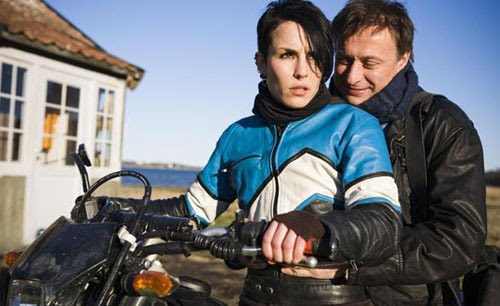
The Girl with the Dragon Tattoo

The Girl with the Dragon Tattoo is as fine a mystery as you’re likely to see this year.

A Swedish film, Tattoo follows a rather ragged investigative journalist as he seeks to unravel the mysterious disappearance of a wealthy and beautiful young woman from an isolated island some 40 years before. The girl with the dragon tattoo is a cyber investigator with in interest in the reporter. She finds herself helping him in ways she hadn’t imagined.

That’s about all I want to tell you about the plot. Besides, it’s a mystery – the plot, more or less, takes care of itself. Characters make mysteries interesting, and the characters here, that of the journalist and the girl, are very interesting people.

The journalist has just been convicted of libel, and he faces a healthy jail term in the very near future. The girl is a tightly wound, exceptionally private genius who can do things with computers that only people who don’t know anything about computers think people can do. Neither of them look like movie stars; they don’t even look like people who’d get along with one another. Nevertheless, they make a great team: unafraid of hard work and research, they spend more time detecting than getting in fistfights, which is a nice change of pace from many American mystery films.

I found that I cared about these people. I felt for them in their moments of danger, I cheered for them in their moments of triumph, and I respected them while they were about the hard, tedious work of unraveling a dark and twisted mystery.

This is a well made film, with an unerring sense of pace and place, that wrapped me up and held me in its spell from beginning to end. I loved The Girl with the Dragon Tattoo.

Sunday, September 12, 2010

Undisputed III: Redemption


Look, I’m not going to sit here and tell you that Undisputed III: Redemption is a great film.  It features a tired premise, uneven acting, and a penchant for Leone zooms that becomes downright distracting.  But it does know how to put together some exceptional fights.

Redemption uses the tired “martial arts tournament” premise to get its performers in the ring.  It mixes the prison tournament’s corruption with a dash of The Defiant Ones to provide some kind of narrative throughline, but its lead performers lack the ability to convey any sense of nuance or humanity.  And those zooms – oy!  I get it!  These are hard men!  Now, move along!

Nevertheless, Undisputed III: Redemption has those fights going for it.  And it’s here, in the ring, where the film excels.  With one glaring exception, the makers of this film cast gifted physical performers.  These men leap, spin, kick, and fall like men on wires, and the fact that there’s nothing between them and the mat but air makes their work all the more impressive.  Director Isaac Florentine understands this, and trusts his performers, coordinators, and choreographers enough to go with long takes that makes it possible for the audience to actually see the rhythm of a given fight, to enjoy the acrobatic skill of the performers, and to admire the clockwork displays that can only come from days and days of careful practice and preparation.  Sure, the film has one notable exception to this: one Mykel Shannon Jenkins, who plays the token American.  Jenkins isn’t a fighter or an acrobat: he’s just a guy in really great shape.  This means that during his fights, the rhythm of the film has to change to one dominated by creative editing.  It pulls us out of the proceedings and drags the film down, but what are you gonna do?

So, there it is: Undisputed III: Redemption, while not a great film, provides phenomenal fight scenes and the chance to see some real pros do some great work.  If you like the genre, you’ll like this film.

Thursday, September 09, 2010

A Town Called Panic

Quick – list the number of subtitled foreign films that your four-year-old asks to watch over and over again. That’s right: no English-language track; just subtitles. Of those films, how many can you watch over and over again, finding something new each time?

That’s what I thought.

I took a flyer on A Town Called Panic, a Belgian stop-motion film about the adventures of Cowboy, Indian, and Horse, three painted-lead toys in a world of painted-lead toys. Roger Ebert gave it a good review and it has generated some buzz on the film-related websites I frequent. I thought my kids might enjoy it, but it took us all by surprise when we found that it came in only one language: French. Undaunted, I made a deal: tough it out for the first ten minutes and, if they didn’t like it, I’d mail it back the very next day. Well, they toughed out that first ten minutes. Then the next ten, and the ten after that. They laughed, they talked amongst themselves, they had great fun. Because even though the film has plenty of dialogue, and even though the subtitles were beyond my four-year-old’s ken, it works just as well as a (functional) silent. Everything a four-year-old needs to enjoy the story is right there on the screen, and A Town Called Panic boasts plenty to enjoy. Before I knew it, the film ended and they boys were begging, “Again! Again!”

The film’s world is delightful, creating a place in which Cowboy, Indian, and Horse room together in a great big house. When Cowboy and Indian forget Horse’s birthday, they need to come up something right away. Cowboy thinks he’s got it, but life gets in the way and, before you know it, the adventure is on.

This is great stuff for a children’s adventure, and A Town Called Panic tells it with just the right combination of whimsy, danger, and flat-out creativity. What a delight.

Monday, September 06, 2010

Broken Embraces


Look, Pedro Almodovar doesn’t make bad movies.  If you have any doubt, just look at the screenshot I’m running with this review: think about that framing, that lighting, that reflection.  Think about how much it tells, how much it suggests, and how much it makes you want – have – need to know.

Almodovar thinks about every act, every scene, every frame.  He puts so much into every aspect of Broken Embraces that we, the audience, dine on a feast of many treasures.  We can enjoy it visually; we can think about how the music deepens and broadens the story; we can lose ourselves in that story; or we can simply fall in love with the characters.  A ticket to an Almodovar film is an invitation to another world, and the world of Broken Embraces fascinates, delights, troubles, entrances.

Here’s the part where I normally tease you into the story, just to help you get a sense of whether you’d find it interesting.  I’m not going to do that here, because I went into the film cold.  I knew nothing about it other than Almodovar’s name, and I enjoyed orienting myself to its tableau, figuring out the relationships as they changed and evolved for myself.  I’ll just stop here, sharing with you that if you want to see how mature, character-based, contemporary filmmaking is done right, Almodovar is your man and Broken Embraces is your film.  Enjoy.

Saturday, September 04, 2010

The Losers

Y’know that action movie trope of heroes leaping toward the camera as a fiery explosion lights up the screen behind them? The Losers doesn’t have it. In The Losers, a school bus filled with adorable kids (and the heroes who’ve rescued them) leaps off a (gentle) riverbank while a fiery explosion lights up the screen behind it.

That’s when I knew I was in.

So, what’s this movie about? Oh, c’mon. An evil genius betrays a team of commandos. The commandos exact their revenge. Not only does this represent the plotline of three major releases we’ve seen this summer, it serves as proof positive that evil geniuses need to get out more. If the League of Evil Geniuses ever had movie night, they’d know to never, never ever, betray a team of commandos. This ranks right up there with “Don’t waste time explaining your evil plans to your vanquished foe. Just shoot him.”

Anyway, these commandos call themselves The Losers. So, why should you care about them any more than The A-Team or The Expendables? I don’t know that you should. If you’re this film’s target audience, you’ll see all three films on general principle anyway, just like there are people out there who see every romantic comedy that comes down the pipe. The Losers brings the charismatic team members, the silly jokes, the ‘splosions, and all the rest as competently as any other middle-brow action entertainment out there, and it seems to have a reasonably good time doing it. Jeffrey Dean Morgan (Watchmen’s Comedian) looks great in a two-piece black suit (Note to self: I need to wear mine more often – ya just can’t go wrong in a two-piece black suit and a good white shirt.) that takes ever-increasing amounts of punishment and comes through it just as well as he does (Note to self: see if they make those suits in Kevlar.). Idris Elba (“The Wire”’s Stringer Bell) makes a fine #2 and comes across as a guy you don’t want to face in a knife fight. Zoe Saldana looks great in underwear, though she could really use a cheeseburger, and I don’t think you’d want to face her in a knife fight, either. Chris Evans, Columbus Short, and Oscar Janeda round out the team creditably well, though many of Evans’s comic beats fall flat (I’m not sure why – the guy has fine timing and seems up for anything – he was a riot in Scott Pilgrim.).

So there you have it. The Losers shows up on time, does its job, and goes home. It’s not the best thing you’ll see this year; but, if you’re in the mood for ‘splosion’s, it will deliver.

Wednesday, September 01, 2010

Love Me Tonight


Love Me Tonight begins with a marvelous bit of found syncopation, a musical sequence introducing us to morning in Paris through the rhythmic sweepings, nailings, workings, and ambient noises of a city coming alive.  It’s absolutely wonderful, and got me excited for the hour and a half to come.

Then, Maurice Chevalier shows up.

I’ve never been a big Chevalier hater.  In fact, checking his IMDB credits reveals that I hadn’t seen any of his film before now.  But I’ve gotta tell you that, after Love Me Tonight, I don’t understand why this guy was a movie star.  Sure, I can see why he would have been huge in vaudeville: he could sing, he could dance, and his exaggerated French accent would’ve wowed ‘em in music halls across the American hinterland.  On film, however, he exaggerated too much – he too clearly mugged, rather than acted, and he pulled me out of Love Me Tonight again and again and again.

So Chevalier’s a poor but honest tailor (fun side note, if you’re me: Ellermann is a rough German analogue to Tailor, so I was on the guy’s side even if the actor playing him bugged me) who finds himself posing as a count or duke or some such at a chateau in what’s supposed to be the Parisian countryside, but looks an awful lot like Pomona.  The most decadent, decayed fringes of the French aristocracy live in this chateau, people so dissolute and lacking in vitality that I wanted to guillotine the lot of them. 

Among these fossilized aristocrats live two women, Jeanette MacDonald (a princess) and Myrna Loy (a mere countess).  MacDonald’s the love interest and Loy’s the Baxter, and so we discover Love Me Tonight’s second biggest flaw (after the casting of Chevalier): Myrna Loy blows everyone else in the film off the screen.  She plays a bad girl of such spirit, such raw vitality, that she clearly belongs in a whole different movie.  [Come to think of it, I’m reminded of Brad Pitt in Thelma and Louise: the movie’s grooving along ok when suddenly this no-kidding Movie Star whom nobody’s ever seen before shows up and steals it out from under everybody, and the audience is left wondering who that kid was.]  So you see, she’s the worst kind of Baxter – she makes the audience think the protagonist is an idiot for not immediately zeroing in on her, as opposed to the weak sauce who’s supposed to capture our hearts.

Will the tailor capture the heart of the princess for no apparent reason?  Sure.  Will we see one jaw-droppingly cool stunt involving a train?  Absolutely.  Will the songs go home with us?  No.  The dancing (This is a musical, after all.)?  What dancing?  I didn’t see a legitimate dance number in the whole picture.

What I saw, sadly, was an hour and a half of a bad film actor pursuing a woman the story gave me no reason to care about, while a no-kidding hot number for the ages waited in the wings.

So pass on Love Me Tonight.  But fear not: I’m a loving kind of guy, and I’m not going to leave you hanging.  Here’s Nat King Cole singing a song I thought would turn up in the movie, but didn’t:


And here’s Myrna Loy being ridiculously awesome:


You’re welcome, and good night.

Monday, August 30, 2010

Hot Tub Time Machine

The advertising for Hot Tub Time Machine did nothing for me. The picture, about three friends and a tagalong nephew who accidentally return to 1986, seemed like a silly ‘80s sex comedy with middle-aged guys. Unfortunately, I had my fill of silly ‘80s sex comedies by 1986. But Roger Ebert liked it and I still have a soft spot for John Cusack, so I figured I’d spin up the first act and see how things went.

I laughed all the way through to the closing credits.

There’s so much to like about this movie that I don’t know where to begin. Is it with the proper debut of Rob Corddry, whom I loathed in Blackballed: The Bobby Dukes Story? The vulgar (yet clever) writing and spot-on delivery? The chemistry and timing of the leading cast (Cusack, Corddry, Craig Robinson, and Clark Duke)? Nice touches like the casting of actors like Crispin Glover and Billy Zabka in hilarious supporting roles? This movie has so much to offer!

Let’s start with Corddry, playing one of the most difficult kinds of roles: the comic jerk. He’s the guy everyone hates, the one who never grew out of the kinds of behaviors that made him barely tolerable back before everyone knew better. Guys like this, they turn out bitter and sad, but Corddry manages to make bitter and sad sympathetic and likeable. He’s the one guy who should never have left the ‘80s, he’s happy as hell to be back, and he gets all the best gags (I don’t want to spoil anything, but one gag still has me chuckling every time I see a soap dispenser.).

The writing epitomizes vulgar-as-funny, as opposed to MacGuyver’s vulgar-as-vulgar. Corddry and Cusack have an exchange that I’d love to describe, but my kids read this blog. Let’s just say that comic vulgarity, played straight by actors who know what they’re doing, has the power to knock me out of my chair. This exchange did just that, and it’s just one setup in a movie full of them. I wish I could buy a copy of this screenplay – I bet it’s even funnier on the page.

The lead cast, well, they each get their moments. Cusack’s takes an ‘uptight guy who needs a Manic Pixie Girlfriend’ role and gives it life and humor. Corddry, well, I already talked about him. CHUD.com’s Devin Faraci likens him to Belushi in Animal House, and he’s not far off. Craig Robinson provides the moral center and some achingly funny moments – I’ve never laughed so hard watching a grown man cry. Clark Duke, well, I think he’s the audience surrogate for the younger demographic, but he’s still wonderful as a guy far more mature, in his way, than his elders.

And the touches, well, who doesn’t love Crispin Glover in a time travel comedy or John Cusack in a skiing comedy set in the ‘80s or the introduction of one classic villain of the decade’s cinema with a line made famous by another classic villain? It’s silly, it’s good fun, and it’s remarkably effective in every way.

So, yeah, there’s no way a film entitled Hot Tub Time Machine should be any good. But one of the great things about film is its ability to surprise. This film surprised the heck out of me, and I couldn’t be happier about it.

So put the kids to bed, spin this one up, and have yourself a good time. I sure did.

Friday, August 20, 2010

The Letter


Nighttime on a rubber plantation, Southeastern Malaysia.  Far-off music plays as the camera glides toward the plantation house, an examplar of Pacific colonial architecture with slatted windows and a wide veranda.  You can practically feel the humidity.  You can practically smell the frangipani.

BANG!  A man staggers out of the house and onto the veranda.  A young Bette Davis, gun in hand, follows.  BANG!  BANG!  The man falls to the ground.  BANG!  BANG!  BANG!

And we’re off.

The Letter features Bette Davis in one of her strongest performances: a woman who shoots a man in cold blood and, because of her status relative to his and her confidence in the chumminess of a colonial judiciary, expects to get away with it.  She’s everything her position, and her actions, demands and requires that she be: fragile, tough, honest, devious, innocent, and deadly.  She’s a moving target, a woman who’ll let you think you have her figured out until her best interests dictate otherwise.

James Stephenson plays her ally, her adversary, her attorney, her mirror.  All that Davis hides behind her controlled façade, he emotes through his more studied, yet more forthcoming, visage.  A quick internet search tells me Stephenson earned an Oscar nomination for his performance, and further research shows that this roll kicked his career into overdrive –for one year, because the poor guy died of a heart attack in 1941, just one year after The Letter’s release.

As for the film, well, it has its flaws.  Its mechanisms can seem a bit mechanical, and the style of acting in vogue at the time of its production creates more a sense of big-D Drama than real people facing tough choices.  Nevertheless, it evokes the romance of the colonial Pacific like no other film, Davis and Stephenson earn the ticket price all by themselves, and you may very well keep guessing right up until the final scene. 

The Letter is a winner.